Advertisements
Advertisements
प्रश्न
Find the equation of the curve which passes through the point (1, 2) and the distance between the foot of the ordinate of the point of contact and the point of intersection of the tangent with x-axis is twice the abscissa of the point of contact.
Advertisements
उत्तर
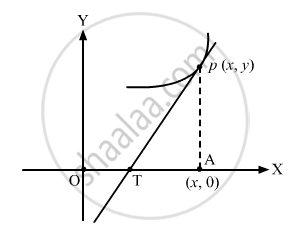
It is given that the distance between the foot of ordinate of point of contact (A) and point of intersection of tangent with x-axis (T) = 2x
\[\text{Coordinate of }T = \left( x - y\frac{dx}{dy}, 0 \right)\]
\[\Rightarrow y - 0 = \frac{dy}{dx}\left(x - \left( x - y \frac{dx}{dy} \right) \right)\]
\[\Rightarrow y \frac{dx}{dy} = 2x\]
\[\Rightarrow \int\frac{dx}{x} = 2\int\frac{dy}{y}\]
\[\Rightarrow \ln x = \ln y^2 + \ln c\]
\[x = c y^2 \]
\[\text{As the circle passes through }\left( 1, 2 \right).\]
\[1 = c \times 2^2 \]
\[ \Rightarrow c = \frac{1}{4}\]
\[ \Rightarrow 4x = y^2\]
APPEARS IN
संबंधित प्रश्न
Verify that y2 = 4ax is a solution of the differential equation y = x \[\frac{dy}{dx} + a\frac{dx}{dy}\]
Show that y = ax3 + bx2 + c is a solution of the differential equation \[\frac{d^3 y}{d x^3} = 6a\].
Verify that \[y = ce^{tan^{- 1}} x\] is a solution of the differential equation \[\left( 1 + x^2 \right)\frac{d^2 y}{d x^2} + \left( 2x - 1 \right)\frac{dy}{dx} = 0\]
Differential equation \[\frac{d^2 y}{d x^2} - \frac{dy}{dx} = 0, y \left( 0 \right) = 2, y'\left( 0 \right) = 1\]
Function y = ex + 1
Differential equation \[\frac{d^2 y}{d x^2} - y = 0, y \left( 0 \right) = 2, y' \left( 0 \right) = 0\] Function y = ex + e−x
(1 + x) (1 + y2) dx + (1 + y) (1 + x2) dy = 0
(y + xy) dx + (x − xy2) dy = 0
Solve the differential equation \[x\frac{dy}{dx} + \cot y = 0\] given that \[y = \frac{\pi}{4}\], when \[x=\sqrt{2}\]
Find the solution of the differential equation cos y dy + cos x sin y dx = 0 given that y = \[\frac{\pi}{2}\], when x = \[\frac{\pi}{2}\]
Find the particular solution of the differential equation \[\frac{dy}{dx} = - 4x y^2\] given that y = 1, when x = 0.
Find the particular solution of the differential equation \[\frac{dy}{dx} = \frac{xy}{x^2 + y^2}\] given that y = 1 when x = 0.
Solve the following initial value problem:
\[x\frac{dy}{dx} + y = x \cos x + \sin x, y\left( \frac{\pi}{2} \right) = 1\]
Solve the following initial value problem:
\[\frac{dy}{dx} + y \cot x = 4x\text{ cosec }x, y\left( \frac{\pi}{2} \right) = 0\]
The rate of growth of a population is proportional to the number present. If the population of a city doubled in the past 25 years, and the present population is 100000, when will the city have a population of 500000?
Find the equation of the curve such that the portion of the x-axis cut off between the origin and the tangent at a point is twice the abscissa and which passes through the point (1, 2).
The slope of the tangent at each point of a curve is equal to the sum of the coordinates of the point. Find the curve that passes through the origin.
The slope of a curve at each of its points is equal to the square of the abscissa of the point. Find the particular curve through the point (−1, 1).
The solution of the differential equation y1 y3 = y22 is
The differential equation
\[\frac{dy}{dx} + Py = Q y^n , n > 2\] can be reduced to linear form by substituting
Which of the following is the integrating factor of (x log x) \[\frac{dy}{dx} + y\] = 2 log x?
Determine the order and degree of the following differential equations.
| Solution | D.E. |
| y = 1 − logx | `x^2(d^2y)/dx^2 = 1` |
Solve the following differential equation.
`dy/dx + 2xy = x`
Choose the correct alternative.
The integrating factor of `dy/dx - y = e^x `is ex, then its solution is
y2 dx + (xy + x2)dy = 0
x2y dx – (x3 + y3) dy = 0
Solve the following differential equation `("d"y)/("d"x)` = x2y + y
For the differential equation, find the particular solution
`("d"y)/("d"x)` = (4x +y + 1), when y = 1, x = 0
Solve the following differential equation `("d"y)/("d"x)` = x2y + y
Solve the following differential equation
`y log y ("d"x)/("d"y) + x` = log y
Solve the following differential equation `("d"y)/("d"x)` = cos(x + y)
Solution: `("d"y)/("d"x)` = cos(x + y) ......(1)
Put `square`
∴ `1 + ("d"y)/("d"x) = "dv"/("d"x)`
∴ `("d"y)/("d"x) = "dv"/("d"x) - 1`
∴ (1) becomes `"dv"/("d"x) - 1` = cos v
∴ `"dv"/("d"x)` = 1 + cos v
∴ `square` dv = dx
Integrating, we get
`int 1/(1 + cos "v") "d"v = int "d"x`
∴ `int 1/(2cos^2 ("v"/2)) "dv" = int "d"x`
∴ `1/2 int square "dv" = int "d"x`
∴ `1/2* (tan("v"/2))/(1/2)` = x + c
∴ `square` = x + c
Find the particular solution of the following differential equation
`("d"y)/("d"x)` = e2y cos x, when x = `pi/6`, y = 0.
Solution: The given D.E. is `("d"y)/("d"x)` = e2y cos x
∴ `1/"e"^(2y) "d"y` = cos x dx
Integrating, we get
`int square "d"y` = cos x dx
∴ `("e"^(-2y))/(-2)` = sin x + c1
∴ e–2y = – 2sin x – 2c1
∴ `square` = c, where c = – 2c1
This is general solution.
When x = `pi/6`, y = 0, we have
`"e"^0 + 2sin pi/6` = c
∴ c = `square`
∴ particular solution is `square`
Integrating factor of the differential equation `x "dy"/"dx" - y` = sinx is ______.
Why is the equation \[x\frac{dy}{dx} + y = 0\] classified as a differential equation?
