Advertisements
Advertisements
Question
Find the equation of the curve which passes through the point (1, 2) and the distance between the foot of the ordinate of the point of contact and the point of intersection of the tangent with x-axis is twice the abscissa of the point of contact.
Advertisements
Solution
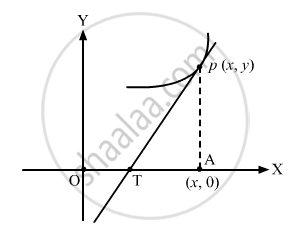
It is given that the distance between the foot of ordinate of point of contact (A) and point of intersection of tangent with x-axis (T) = 2x
\[\text{Coordinate of }T = \left( x - y\frac{dx}{dy}, 0 \right)\]
\[\Rightarrow y - 0 = \frac{dy}{dx}\left(x - \left( x - y \frac{dx}{dy} \right) \right)\]
\[\Rightarrow y \frac{dx}{dy} = 2x\]
\[\Rightarrow \int\frac{dx}{x} = 2\int\frac{dy}{y}\]
\[\Rightarrow \ln x = \ln y^2 + \ln c\]
\[x = c y^2 \]
\[\text{As the circle passes through }\left( 1, 2 \right).\]
\[1 = c \times 2^2 \]
\[ \Rightarrow c = \frac{1}{4}\]
\[ \Rightarrow 4x = y^2\]
APPEARS IN
RELATED QUESTIONS
Prove that:
`int_0^(2a)f(x)dx = int_0^af(x)dx + int_0^af(2a - x)dx`
Solve the equation for x: `sin^(-1) 5/x + sin^(-1) 12/x = π/2, x ≠ 0`
Show that the function y = A cos x + B sin x is a solution of the differential equation \[\frac{d^2 y}{d x^2} + y = 0\]
Show that y = AeBx is a solution of the differential equation
For the following differential equation verify that the accompanying function is a solution:
| Differential equation | Function |
|
\[x\frac{dy}{dx} + y = y^2\]
|
\[y = \frac{a}{x + a}\]
|
Differential equation \[\frac{d^2 y}{d x^2} - \frac{dy}{dx} = 0, y \left( 0 \right) = 2, y'\left( 0 \right) = 1\]
Function y = ex + 1
xy (y + 1) dy = (x2 + 1) dx
xy dy = (y − 1) (x + 1) dx
tan y dx + sec2 y tan x dy = 0
dy + (x + 1) (y + 1) dx = 0
Solve the following differential equation:
\[\text{ cosec }x \log y \frac{dy}{dx} + x^2 y^2 = 0\]
Solve the following differential equation:
\[\left( 1 + y^2 \right) \tan^{- 1} xdx + 2y\left( 1 + x^2 \right)dy = 0\]
If y(x) is a solution of the different equation \[\left( \frac{2 + \sin x}{1 + y} \right)\frac{dy}{dx} = - \cos x\] and y(0) = 1, then find the value of y(π/2).
In a simple circuit of resistance R, self inductance L and voltage E, the current `i` at any time `t` is given by L \[\frac{di}{dt}\]+ R i = E. If E is constant and initially no current passes through the circuit, prove that \[i = \frac{E}{R}\left\{ 1 - e^{- \left( R/L \right)t} \right\}.\]
The decay rate of radium at any time t is proportional to its mass at that time. Find the time when the mass will be halved of its initial mass.
A curve is such that the length of the perpendicular from the origin on the tangent at any point P of the curve is equal to the abscissa of P. Prove that the differential equation of the curve is \[y^2 - 2xy\frac{dy}{dx} - x^2 = 0\], and hence find the curve.
The rate of increase of bacteria in a culture is proportional to the number of bacteria present and it is found that the number doubles in 6 hours. Prove that the bacteria becomes 8 times at the end of 18 hours.
The solution of the differential equation \[\frac{dy}{dx} - \frac{y\left( x + 1 \right)}{x} = 0\] is given by
The differential equation satisfied by ax2 + by2 = 1 is
Integrating factor of the differential equation cos \[x\frac{dy}{dx} + y \sin x = 1\], is
In the following example, verify that the given function is a solution of the corresponding differential equation.
| Solution | D.E. |
| y = xn | `x^2(d^2y)/dx^2 - n xx (xdy)/dx + ny =0` |
Find the differential equation whose general solution is
x3 + y3 = 35ax.
Solve the following differential equation.
y dx + (x - y2 ) dy = 0
The integrating factor of the differential equation `dy/dx - y = x` is e−x.
Solve the following differential equation
`x^2 ("d"y)/("d"x)` = x2 + xy − y2
Choose the correct alternative:
Differential equation of the function c + 4yx = 0 is
A solution of differential equation which can be obtained from the general solution by giving particular values to the arbitrary constant is called ______ solution
Given that `"dy"/"dx"` = yex and x = 0, y = e. Find the value of y when x = 1.
Solve `x^2 "dy"/"dx" - xy = 1 + cos(y/x)`, x ≠ 0 and x = 1, y = `pi/2`
Solve the differential equation `"dy"/"dx"` = 1 + x + y2 + xy2, when y = 0, x = 0.
The differential equation of all non horizontal lines in a plane is `("d"^2x)/("d"y^2)` = 0
What distinguishes an ordinary differential equation from other types of differential equations?
