Advertisements
Advertisements
Question
A driver of a car travelling at 52 km h−1 applies the brakes and accelerates uniformly in the opposite direction. The car stops in 5 s. Another driver going at 3 km h−1 in another car applies his brakes slowly and stops in 10 s. On the same graph paper, plot the speed versus time graphs for the two cars. Which of the two cars travelled farther after the brakes were applied?
Advertisements
Solution
The data given in this numerical problem are in different units. So, we should first convert km h-1 unit into m s-1 unit.
For first car:
Initial velocity u = 52 km h-1
= `(52 "km")/(1 "h")`
= `(52 xx 1000 "m")/(1 xx 3600 "s")`
= 14.4 s-1
Final velocity, v = 0 km h-1 = 0.0 m s-1
Time taken, t = 5s
For second car:
Initial velocity, u = 3 km h-1
= `(3 "km")/(1"h")`
= `(3 xx 1000 "m")/(1 xx 3600 "s")`
= 0.8 ms-1
Final velocity, v = 0 km h-1 = 0.0 m s-1
Time taken, t = 10s
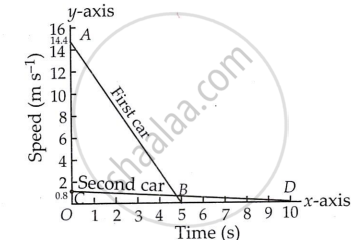
The area under a moving body's speed-time graph indicates the distance it has traveled.
So, Distance travelled by the first car = Area of the triangle AOB
= `1/2 xx "OB" xx "AO"`
= `1/2 xx 14.4` ms-1 × 5s
= `1/2 xx 14.4 xx 5 "m"`
= 36 m
Similarly, distance travelled by the second car = area of triangle COD.
= `1/2 xx "OD" xx "CO"`
= `1/2 xx 0.83 m s^-1 xx 10 s`
= `1/2 xx 0.83 xx 10 "m"`
= 4.1 m
Thus, the second car travels 4.1 m and the first car travels 36 m before coming to rest.
So, the first car travelled farther after the brakes were applied.
APPEARS IN
RELATED QUESTIONS
Given figure shows the distance-time graph of three objects A, B and C. Study the graph and answer the following questions:
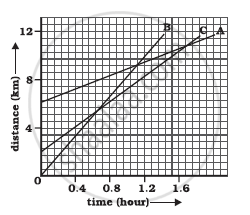
- Which of the three is travelling the fastest?
- Are all three ever at the same point on the road?
- How far has C travelled when B passes A?
- How far has B travelled by the time it passes C?
What does the slope of a distance-time graph indicate ?
What can you say about the motion of a body whose distance-time graph is a straight line parallel to the time axis ?
Fill in the following blank with suitable word :
The slope of a distance-time graph indicates ………………….. of a moving body.
Fill in the following blank with suitable word :
The slope of a speed-time graph of a moving body gives its………………………..
A car is travelling at 20 m/s along a road. A child runs out into the road 50 m ahead and the car driver steps on the brake pedal. What must the car’s deceleration be if the car is to stop just before it reaches the child ?
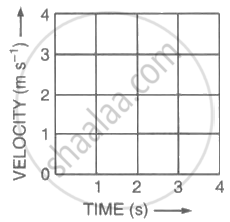
Figure (a) shows the displacement-time graph for the motion of a body. Use it to calculate the velocity of the body at t = 1 s, 2 s and 3 s, and then draw the velocity-time graph in Figure (b) for it.
 |
 |
| (a) | (b) |
If we denote speed by S, distance by D and time by T, the relationship between these quantities is ______.
Starting from A, Paheli moves along a rectangular path ABCD as shown in figure. She takes 2 minutes to travel each side. Plot a distance-time graph and explain whether the motion is uniform or non-uniform.

Assertion: The position-time graph of a uniform motion in one dimension of a body can have a negative slope
Reason: When the speed of the body decreases with time then, the position-time graph of the moving body has a negative slope.
