Advertisements
Advertisements
Question
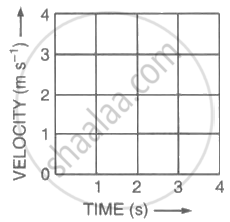
Figure (a) shows the displacement-time graph for the motion of a body. Use it to calculate the velocity of the body at t = 1 s, 2 s and 3 s, and then draw the velocity-time graph in Figure (b) for it.
 |
 |
| (a) | (b) |
Advertisements
Solution
We observe from the given displacement time graph above, that the slope is a straight line inclined with time axis, so the body is moving with uniform velocity.
velocity = Slope of straight line
t = 1; velocity = `2/1` = 2 m/s
t = 2; velocity = `4/2` = 2 m/s
t = 3; velocity = `6/3` = 2 m/s
Hence, velocity at t = 1 s, 2 s and 3 s is equal to 2 m s-1
Velocity-time graph for the motion of a body is given below:

APPEARS IN
RELATED QUESTIONS
The speed-time graph for a car is shown in the following figure:
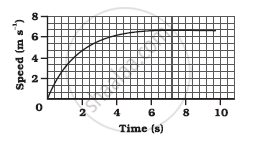
- Find how far the car travels in the first 4 seconds. Shade the area on the graph that represents the distance travelled by the car during the period.
- Which part of the graph represents uniform motion of the car?
Show the shape of the distance-time graph for the motion in the following case:
A car moving with a constant speed.
Show the shape of the distance-time graph for the motion in the following case:
A car parked on a side road.
Which of the following distance-time graphs shows a truck moving with speed which is not constant?
What can you say about the motion of a body whose distance-time graph is a straight line parallel to the time axis ?
Fill in the following blank with suitable word :
The slope of a distance-time graph indicates ………………….. of a moving body.
Starting from A, Paheli moves along a rectangular path ABCD as shown in figure. She takes 2 minutes to travel each side. Plot a distance-time graph and explain whether the motion is uniform or non-uniform.

The area under velocity time graph represents ______.
Assertion: The position-time graph of a uniform motion in one dimension of a body can have a negative slope
Reason: When the speed of the body decreases with time then, the position-time graph of the moving body has a negative slope.
What do you infer if
- Distance – time graph is a straight line.
- The velocity-time graph is curved.
- Displacement time is zigzag.
