Advertisements
Advertisements
Question
Figure shows the distance-time graph for the motion of two vehicles A and B. Which one of them is moving faster?
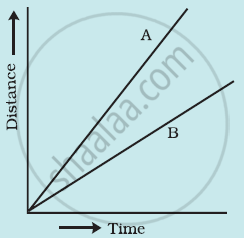
Figure: Distance-time graph for the motion of two cars
Advertisements
Solution
The speed is given by the relation
speed = `" distance travelled" / "time taken"`
This relation shows that the speed of a vehicle is high if it covers the maximum distance in a given time interval. To compare the distance, draw a line perpendicular to the time axis, as shown in the following distance-time graph

The graph clearly shows that for a given time t, vehicle A covers more distance than vehicle B. So, vehicle A is moving faster than vehicle B.
APPEARS IN
RELATED QUESTIONS
What can you say about the motion of an object if its speed-time graph is a straight line parallel to the time axis?
What conclusion can you draw about the speed of a body from the following distance-time graph ?
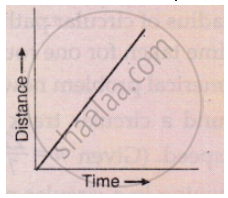
What can you say about the motion of a body whose distance-time graph is a straight line parallel to the time axis ?
Name the two quantities, the slope of whose graph give speed .
A cyclist is travelling at 15 m s-1. She applies brakes so that she does not collide with a wall 18 m away. What deceleration must she have ?
Figure (a) shows the displacement-time graph for the motion of a body. Use it to calculate the velocity of the body at t = 1 s, 2 s and 3 s, and then draw the velocity-time graph in Figure (b) for it.
 |
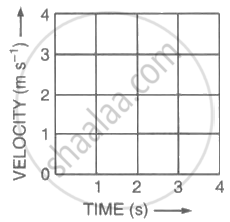 |
| (a) | (b) |
A spaceship is moving in space with a velocity of 60 kms−1. It fires its retro engines for 20 seconds and velocity is reduced to 55 kms−1. Calculate the distance travelled by a spaceship in 40 s, from the time of firing of the retro- rockets.
What are the uses of the graphical study of motion?
Complete the data of the table given below with the help of the distance-time graph given in the figure.
| Distance (m) | 0 | 4 | ? | 12 | ? | 20 |
| Time (s) | 0 | 2 | 4 | ? | 8 | 10 |

The area under velocity time graph represents ______.
