Advertisements
Advertisements
Question
A spaceship is moving in space with a velocity of 60 kms−1. It fires its retro engines for 20 seconds and velocity is reduced to 55 kms−1. Calculate the distance travelled by a spaceship in 40 s, from the time of firing of the retro- rockets.
Advertisements
Solution
Initial velocity of spaceship = u = 60 kms−1
Final velocity of spaceship = v = 55 kms−1
It decelerates for 20 s
t = 20 s
v = u + at
55 = 60 + a (20)
20a = 55 – 60
20a = −5
a = `(-5)/20`
a = − 0.25
distance travelled in the first 20 sec. = s = u × t − `1/2` a × t2
s = 60 × 20 − `1/2` × 0.25 × 202
= 1200 − `1/2` × 0.25 × 400
= 1200 − `1/2` × 100
= 1200 − 50
= 1,150 km.
After 20 sec. the velocity of the spaceship is constant at 55 km/sec. Hence, the distance travelled is = 55 × 20 = 1,100 km
The total distance travelled in 40 sec. = 1,150 + 1,100 = 2,250 km
APPEARS IN
RELATED QUESTIONS
Show the shape of the distance-time graph for the motion in the following case:
A car moving with a constant speed.
Figure shows the distance-time graph for the motion of two vehicles A and B. Which one of them is moving faster?
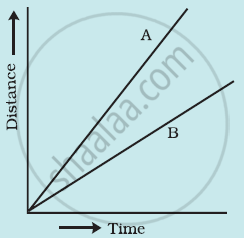
Figure: Distance-time graph for the motion of two cars
Fill in the following blank with suitable word :
The slope of a speed-time graph of a moving body gives its………………………..
A cyclist is travelling at 15 m s-1. She applies brakes so that she does not collide with a wall 18 m away. What deceleration must she have ?
A student draws a distance-time graph for a moving scooter and finds that a section of the graph is horizontal line parallel to the time axis. Which of the following conclusion is correct about this section of the graph?
Two students were asked to plot a distance-time graph for the motion described by Table A and Table B.
| Table A |
||||||
| Distance moved (m) | 0 | 10 | 20 | 30 | 40 | 50 |
| Time (minutes) | 0 | 2 | 4 | 6 | 8 | 10 |
| Table B |
||||||
| Distance moved (m) | 0 | 5 | 10 | 15 | 20 | 25 |
| Time (minutes) | 0 | 1 | 2 | 3 | 4 | 5 |
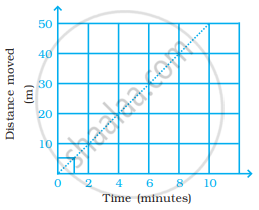
The graph given in figure is true for
Boojho goes to the football ground to play football. The distance-time graph of his journey from his home to the ground is given in the figure.
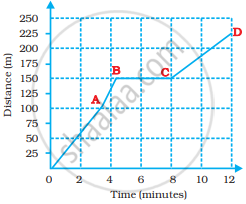
- What does the graph between points B and C indicate about the motion of Boojho?
- Is the motion between 0 to 4 minutes uniform or non-uniform?
- What is his speed between 8 and 12 minutes of his journey?
The area under velocity time graph represents ______.
The slope of the distance-time curve is steeper/greater is the ______.
The slope of the distance-time graph indicates the speed.
