Advertisements
Advertisements
Question
A die is thrown again and again until three sixes are obtained. Find the probability of obtaining the third six in the sixth throw of the die.
Advertisements
Solution
The probability of getting a six in a throw of die 1/6 and not getting a six is 5/6.
Let `p = 1/6 and q = 5/6`
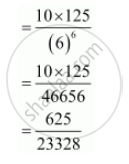
The probability that the 2 sixes come in the first five throws of the die is `""^5C_2 (1/6)^2(5/6)^3 = (10xx(5)^3)/(6)^5 `
∴ Probability that third six comes in the sixth throw `(10xx(5)^3)/(6)^5 xx 1/6`
APPEARS IN
RELATED QUESTIONS
Suppose that 80% of all families own a television set. If 5 families are interviewed at random, find the probability that
a. three families own a television set.
b. at least two families own a television set.
If P(A) = 0.8, P(B) = 0.5 and P(B|A) = 0.4, find P(A|B)
Evaluate P(A ∪ B), if 2P(A) = P(B) = `5/13` and P(A | B) = `2/5`
Determine P(E|F).
Two coins are tossed once, where
E: tail appears on one coin, F: one coin shows head
A black and a red dice are rolled.
Find the conditional probability of obtaining a sum greater than 9, given that the black die resulted in a 5.
A fair die is rolled. Consider events E = {1, 3, 5}, F = {2, 3} and G = {2, 3, 4, 5} Find P (E|F) and P (F|E)
An instructor has a question bank consisting of 300 easy True/False questions, 200 difficult True/False questions, 500 easy multiple choice questions and 400 difficult multiple choice questions. If a question is selected at random from the question bank, what is the probability that it will be an easy question given that it is a multiple-choice question?
Consider the experiment of throwing a die, if a multiple of 3 comes up, throw the die again and if any other number comes, toss a coin. Find the conditional probability of the event ‘the coin shows a tail’, given that ‘at least one die shows a 3’.
In a game, a man wins a rupee for a six and loses a rupee for any other number when a fair die is thrown. The man decided to throw a die thrice but to quit as and when he gets a six. Find the expected value of the amount he wins/loses.
A card is drawn from a well-shuffled pack of playing cards. What is the probability that it is either a spade or an ace or both?
An urn contains 2 white and 2 black balls. A ball is drawn at random. If it is white, it is not replaced into the urn. Otherwise, it is replaced with another ball of the same colour. The process is repeated. Find the probability that the third ball is drawn is black.
Two balls are drawn from an urn containing 3 white, 5 red and 2 black balls, one by one without replacement. What is the probability that at least one ball is red?
In an examination, 30% of students have failed in subject I, 20% of the students have failed in subject II and 10% have failed in both subject I and subject II. A student is selected at random, what is the probability that the student has failed in at least one subject?
In an examination, 30% of students have failed in subject I, 20% of the students have failed in subject II and 10% have failed in both subject I and subject II. A student is selected at random, what is the probability that the student has failed in exactly one subject?
From a pack of well-shuffled cards, two cards are drawn at random. Find the probability that both the cards are diamonds when first card drawn is kept aside
From a pack of well-shuffled cards, two cards are drawn at random. Find the probability that both the cards are diamonds when the first card drawn is replaced in the pack
Three fair coins are tossed. What is the probability of getting three heads given that at least two coins show heads?
A problem in Mathematics is given to three students whose chances of solving it are `1/3, 1/4` and `1/5`. What is the probability that the problem is solved?
The probability that a car being filled with petrol will also need an oil change is 0.30; the probability that it needs a new oil filter is 0.40; and the probability that both the oil and filter need changing is 0.15. If the oil had to be changed, what is the probability that a new oil filter is needed?
The probability that a car being filled with petrol will also need an oil change is 0.30; the probability that it needs a new oil filter is 0.40; and the probability that both the oil and filter need changing is 0.15. If a new oil filter is needed, what is the probability that the oil has to be changed?
A year is selected at random. What is the probability that it contains 53 Sundays
A year is selected at random. What is the probability that it is a leap year which contains 53 Sundays
Choose the correct alternative:
If A and B are any two events, then the probability that exactly one of them occur is
The total number of ways in which 5 balls of different colours can be distributed among 3 persons so that each person gets at least one ball is ______
If P(A) = `3/10`, P(B) = `2/5` and P(A ∪ B) = `3/5`, then P(B|A) + P(A|B) equals ______.
Two cards are drawn out randomly from a pack of 52 cards one after the other, without replacement. The probability of first card being a king and second card not being a king is:
If two balls are drawn from a bag containing 3 white, 4 black and 5 red balls. Then, the probability that the drawn balls are of different colours is:
A bag contains 3 red and 4 white balls and another bag contains 2 red and 3 white balls. If one ball is drawn from the first bag and 2 balls are drawn from the second bag, then find the probability that all three balls are of the same colour.
If for two events A and B, P(A – B) = `1/5` and P(A) = `3/5`, then `P(B/A)` is equal to ______.
Read the following passage:
|
Recent studies suggest the roughly 12% of the world population is left-handed.
Assuming that P(A) = P(B) = P(C) = P(D) = `1/4` and L denotes the event that child is left-handed. |

Based on the above information, answer the following questions:
- Find `P(L/C)` (1)
- Find `P(overlineL/A)` (1)
- (a) Find `P(A/L)` (2)
OR
(b) Find the probability that a randomly selected child is left-handed given that exactly one of the parents is left-handed. (2)
A Problem in Mathematics is given to the three students A, B and C. Their chances of solving the problem are `1/2, 1/3` and `1/4` respectively. Find the probability that at least two of them will solve the problem.
Compute P(A|B), if P(B) = 0.5 and P (A ∩ B) = 0.32.
Which complement form is correct when \[P(B)\neq 0\]?
For independent events, which equality holds provided \[P(B)\neq 0\]?
Which sequence correctly applies a given condition when finding a conditional probability?
