Advertisements
Advertisements
प्रश्न
A die is thrown again and again until three sixes are obtained. Find the probability of obtaining the third six in the sixth throw of the die.
Advertisements
उत्तर
The probability of getting a six in a throw of die 1/6 and not getting a six is 5/6.
Let `p = 1/6 and q = 5/6`
The probability that the 2 sixes come in the first five throws of the die is `""^5C_2 (1/6)^2(5/6)^3 = (10xx(5)^3)/(6)^5 `
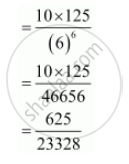
∴ Probability that third six comes in the sixth throw `(10xx(5)^3)/(6)^5 xx 1/6`
APPEARS IN
संबंधित प्रश्न
The probability that a certain kind of component will survive a check test is 0.6. Find the probability that exactly 2 of the next 4 tested components survive
A bag X contains 4 white balls and 2 black balls, while another bag Y contains 3 white balls and 3 black balls. Two balls are drawn (without replacement) at random from one of the bags and were found to be one white and one black. Find the probability that the balls were drawn from bag Y.
If P(A) = 0.8, P(B) = 0.5 and P(B|A) = 0.4, find
- P(A ∩ B)
- P(A|B)
- P(A ∪ B)
Evaluate P(A ∪ B), if 2P(A) = P(B) = `5/13` and P(A | B) = `2/5`
Determine P(E|F).
Two coins are tossed once, where
E: no tail appears, F: no head appears
Determine P(E|F).
Mother, father and son line up at random for a family picture
E: son on one end, F: father in middle
A black and a red dice are rolled.
Find the conditional probability of obtaining the sum 8, given that the red die resulted in a number less than 4.
Consider the experiment of throwing a die, if a multiple of 3 comes up, throw the die again and if any other number comes, toss a coin. Find the conditional probability of the event ‘the coin shows a tail’, given that ‘at least one die shows a 3’.
A and B are two events such that P (A) ≠ 0. Find P (B|A), if A is a subset of B.
If a leap year is selected at random, what is the chance that it will contain 53 Tuesdays?
In a game, a man wins a rupee for a six and loses a rupee for any other number when a fair die is thrown. The man decided to throw a die thrice but to quit as and when he gets a six. Find the expected value of the amount he wins/loses.
If A and B are events such as that P(A) = `1/2`, P(B) = `1/3` and P(A ∩ B) = `1/4`, then find
1) P(A / B)
2) P(B / A)
A card is drawn from a well-shuffled pack of playing cards. What is the probability that it is either a spade or an ace or both?
An urn contains 2 white and 2 black balls. A ball is drawn at random. If it is white, it is not replaced into the urn. Otherwise, it is replaced with another ball of the same colour. The process is repeated. Find the probability that the third ball is drawn is black.
Five dice are thrown simultaneously. If the occurrence of an odd number in a single dice is considered a success, find the probability of maximum three successes.
Two balls are drawn from an urn containing 3 white, 5 red and 2 black balls, one by one without replacement. What is the probability that at least one ball is red?
In a college, 70% of students pass in Physics, 75% pass in Mathematics and 10% of students fail in both. One student is chosen at random. What is the probability that:
(i) He passes in Physics and Mathematics?
(ii) He passes in Mathematics given that he passes in Physics.
(iii) He passes in Physics given that he passes in Mathematics.
In an examination, 30% of students have failed in subject I, 20% of the students have failed in subject II and 10% have failed in both subject I and subject II. A student is selected at random, what is the probability that the student has failed in exactly one subject?
A bag contains 10 white balls and 15 black balls. Two balls are drawn in succession without replacement. What is the probability that, first is white and second is black?
An urn contains 4 black, 5 white, and 6 red balls. Two balls are drawn one after the other without replacement, What is the probability that at least one ball is black?
Can two events be mutually exclusive and independent simultaneously?
If P(A) = 0.5, P(B) = 0.8 and P(B/A) = 0.8, find P(A/B) and P(A ∪ B)
One bag contains 5 white and 3 black balls. Another bag contains 4 white and 6 black balls. If one ball is drawn from each bag, find the probability that one white and one black
Two thirds of students in a class are boys and rest girls. It is known that the probability of a girl getting a first grade is 0.85 and that of boys is 0.70. Find the probability that a student chosen at random will get first grade marks.
Given P(A) = 0.4 and P(A ∪ B) = 0.7 Find P(B) if P(B/A) = 0.5
In a multiple-choice question, there are three options out of which only one is correct. A person is guessing the answer at random. If there are 7 such questions, then the probability that he will get exactly 4 correct answers is ______
Three machines E1, E2, E3 in a certain factory produced 50%, 25% and 25%, respectively, of the total daily output of electric tubes. It is known that 4% of the tubes produced one each of machines E1 and E2 are defective, and that 5% of those produced on E3 are defective. If one tube is picked up at random from a day’s production, calculate the probability that it is defective.
Let A and B be two events. If P(A) = 0.2, P(B) = 0.4, P(A ∪ B) = 0.6, then P(A|B) is equal to ______.
If two balls are drawn from a bag containing 3 white, 4 black and 5 red balls. Then, the probability that the drawn balls are of different colours is:
If A and B are two events such that P(A) = `1/3`, P(B) = `1/5` and P(A ∪ B) = `1/2`, then P(A|B') + P(B|A') is equal to ______.
If A and B are two events such that `P(A/B) = 2 xx P(B/A)` and P(A) + P(B) = `2/3`, then P(B) is equal to ______.
A Problem in Mathematics is given to the three students A, B and C. Their chances of solving the problem are `1/2, 1/3` and `1/4` respectively. Find the probability that exactly two students will solve the problem.
If P(B) = `3/5`, P(A | B) = `1/2` and P(A ∪ B) = `4/5`, then P(A ∪ B) + P(A' ∪ B) =
Which statement is the multiplication rule for two events A and B?
Which complement form is correct when \[P(B)\neq 0\]?
