Advertisements
Advertisements
प्रश्न
A die is thrown again and again until three sixes are obtained. Find the probability of obtaining the third six in the sixth throw of the die.
Advertisements
उत्तर
The probability of getting a six in a throw of die 1/6 and not getting a six is 5/6.
Let `p = 1/6 and q = 5/6`
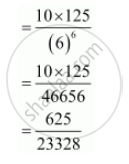
The probability that the 2 sixes come in the first five throws of the die is `""^5C_2 (1/6)^2(5/6)^3 = (10xx(5)^3)/(6)^5 `
∴ Probability that third six comes in the sixth throw `(10xx(5)^3)/(6)^5 xx 1/6`
APPEARS IN
संबंधित प्रश्न
In a game, a man wins Rs 5 for getting a number greater than 4 and loses Rs 1 otherwise, when a fair die is thrown. The man decided to thrown a die thrice but to quit as and when he gets a number greater than 4. Find the expected value of the amount he wins/loses
40% students of a college reside in hostel and the remaining reside outside. At the end of the year, 50% of the hostelers got A grade while from outside students, only 30% got A grade in the examination. At the end of the year, a student of the college was chosen at random and was found to have gotten A grade. What is the probability that the selected student was a hosteler ?
Given that E and F are events such that P(E) = 0.6, P(F) = 0.3 and P(E ∩ F) = 0.2, find P (E|F) and P(F|E).
If `P(A) = 6/11, P(B) = 5/11 "and" P(A ∪ B) = 7/11` find
- P(A ∩ B)
- P(A|B)
- P(B|A)
Determine P(E|F).
A coin is tossed three times, where
E: at most two tails, F: at least one tail
A fair die is rolled. Consider events E = {1, 3, 5}, F = {2, 3} and G = {2, 3, 4, 5} Find P (E|F) and P (F|E)
A die is tossed thrice. Find the probability of getting an odd number at least once.
A and B are two events such that P (A) ≠ 0. Find P (B|A), if A ∩ B = Φ.
If a leap year is selected at random, what is the chance that it will contain 53 Tuesdays?
An urn contains 2 white and 2 black balls. A ball is drawn at random. If it is white, it is not replaced into the urn. Otherwise, it is replaced with another ball of the same colour. The process is repeated. Find the probability that the third ball is drawn is black.
Box I contains two white and three black balls. Box II contains four white and one black balls and box III contains three white ·and four black balls. A dice having three red, two yellow and one green face, is thrown to select the box. If red face turns up, we pick up the box I, if a yellow face turns up we pick up box II, otherwise, we pick up box III. Then, we draw a ball from the selected box. If the ball is drawn is white, what is the probability that the dice had turned up with a red face?
Five dice are thrown simultaneously. If the occurrence of an odd number in a single dice is considered a success, find the probability of maximum three successes.
In a college, 70% of students pass in Physics, 75% pass in Mathematics and 10% of students fail in both. One student is chosen at random. What is the probability that:
(i) He passes in Physics and Mathematics?
(ii) He passes in Mathematics given that he passes in Physics.
(iii) He passes in Physics given that he passes in Mathematics.
A bag contains 10 white balls and 15 black balls. Two balls are drawn in succession without replacement. What is the probability that, one is white and other is black?
Two balls are drawn from an urn containing 5 green, 3 blue, and 7 yellow balls one by one without replacement. What is the probability that at least one ball is blue?
From a pack of well-shuffled cards, two cards are drawn at random. Find the probability that both the cards are diamonds when the first card drawn is replaced in the pack
Three fair coins are tossed. What is the probability of getting three heads given that at least two coins show heads?
Two cards are drawn one after the other from a pack of 52 cards without replacement. What is the probability that both the cards drawn are face cards?
If A and B are two events such that P(A ∪ B) = 0.7, P(A ∩ B) = 0.2, and P(B) = 0.5, then show that A and B are independent
If for two events A and B, P(A) = `3/4`, P(B) = `2/5` and A ∪ B = S (sample space), find the conditional probability P(A/B)
One bag contains 5 white and 3 black balls. Another bag contains 4 white and 6 black balls. If one ball is drawn from each bag, find the probability that both are white
Given P(A) = 0.4 and P(A ∪ B) = 0.7 Find P(B) if A and B are mutually exclusive
Choose the correct alternative:
A letter is taken at random from the letters of the word ‘ASSISTANT’ and another letter is taken at random from the letters of the word ‘STATISTICS’. The probability that the selected letters are the same is
If X denotes the number of ones in five consecutive throws of a dice, then P(X = 4) is ______
If P(A) = `2/5`, P(B) = `3/10` and P(A ∩ B) = `1/5`, then P(A|B).P(B'|A') is equal to ______.
Two cards are drawn out randomly from a pack of 52 cards one after the other, without replacement. The probability of first card being a king and second card not being a king is:
If A and B are two events such that P(A) = `1/3`, P(B) = `1/5` and P(A ∪ B) = `1/2`, then P(A|B') + P(B|A') is equal to ______.
Bag I contains 3 red, 4 black and 3 white balls and Bag II contains 2 red, 5 black and 2 white balls. One ball is transferred from Bag I to Bag II and then a ball is draw from Bag II. The ball so drawn is found to be black in colour. Then the probability, that the transferred ball is red, is ______.
If A and B are events and \[P(B) \neq 0\], which expression gives \[P(A \mid B)\]?
If A and B are any two events of S and \[P(F)\neq 0\], which formula is correct?
Which sequence correctly applies a given condition when finding a conditional probability?
