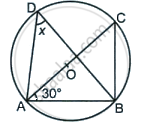
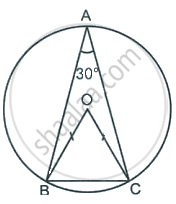
Find the value of x in the following figure, where O is the centre of the circle:
![Nootan solutions for माठेमटिक्स [इंग्रजी] इयत्ता १० आयसीएसई chapter 15 - Circles - Shaalaa.com](/images/mathematics-english-class-10-icse_6:8d4d7165de72474d81faa9e5f82aa90d.jpg "Nootan solutions for माठेमटिक्स [इंग्रजी] इयत्ता १० आयसीएसई chapter 15 - Circles")
Below listed, you can find solutions for Chapter 15 of CISCE Nootan for माठेमटिक्स [इंग्रजी] इयत्ता १० आयसीएसई.
Find the value of x in the following figure, where O is the centre of the circle:
Find the value of x in the following figure, where O is the centre of the circle:
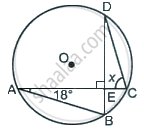
Find the value of x in the following figure, where O is the centre of the circle:
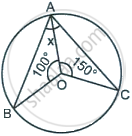
Find the value of x in the following figure, where O is the centre of the circle:
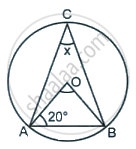
Find the value of x in the following figure, where O is the centre of the circle:
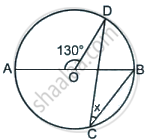
Find the value of x in the following figure, where O is the centre of the circle:
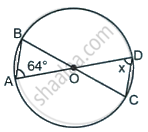
Find the value of x in the following figure, where O is the centre of the circle:

Find the value of x in the following figure, where O is the centre of the circle:
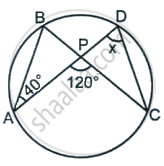
Find the value of x in the following figure, where O is the centre of the circle:
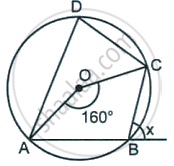
Find the value of x in the following figure, where O is the centre of the circle:

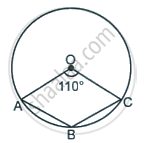
In the following figure, ‘O’ is the centre of the circle and ∠AOC = 110°. Find ∠ABC.
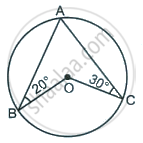
In the following figure, ‘O’ is the centre of the circle. If ∠ABO = 20° and ∠ACO = 30°, find ∠BOC.
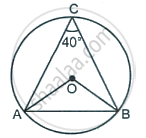
In the following, ‘O’ is the centre of the circle. If ∠ACB = 40°, then find ∠OAB.
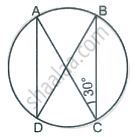
In the given figure, AD || BC. If <ACB = 30°, find DBC.
In the given figure, O is the centre of the circle. If ∠AOC = 160°, find:
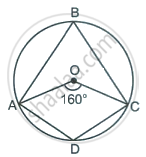
ABC and ADC are two right triangles with common hypotenuse AC. Prove that ∠CAD = ∠CBD.
In the given figure, ΔABC is an isosceles triangle with AB = AC and ∠ABC = 50°. Find ∠BDC and ∠BЕС.
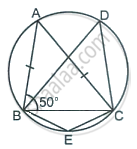
In the given figure, A, B, C and D are points on the circle with centre O. Given, ∠ABC = 62°, find:
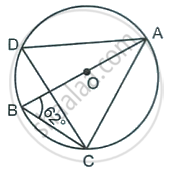
In the given figure, O is the centre of the circle and AB is a diameter. If AC = BD and ∠AOC = 72°, find:
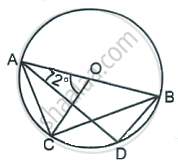
ABCD is a cyclic quadrilateral in a circle with centre O. If ∠ADC = 130°; find ∠BAC.
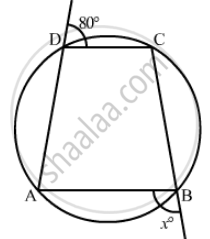
In the given figure, ABCD is a cyclic quadrilateral. Find the value of x.
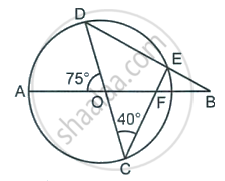
In the given figure, AB and CD line segments pass through the centre O of the circle. If ∠OCE = 40°, ∠AOD = 75°, find ∠CDE and ∠OBE.
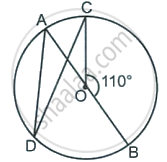
In the given figure, AB is a diameter of the circle with centre O. If ∠BOC = 110°, find ∠ADC.
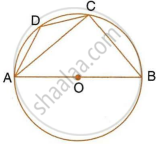
In AB and BC are two chords of a circle with centre O such that, ∠ABO = ∠ACO, prove that: AB = AC.
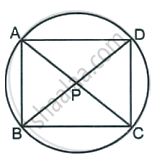
ABCD is a cyclic quadrilateral whose diagonals AC and BD intersect at P. If AB = DC, prove that:
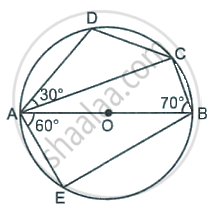
In Fig. AB is a diameter of a circle, with centre O. If ∠ABC = 70°, ∠CAD = 30° and ∠BAE = 60°, find ∠BAC, ∠ACD and ∠AВЕ.
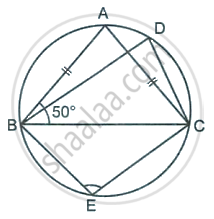
In the Fig., ΔABC is an isosceles triangle with AB = AC and ∠ABC = 50°. Find ∠BDC and ∠BEC.
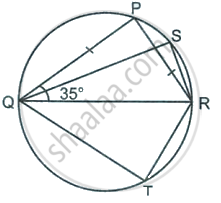
In the Fig., PQR is an isosceles triangle with PQ = PR and ∠PQR = 35°. Find ∠QSR.
In the figure given, O is the centre of the circle. ∠DAE = 70°. Find giving suitable reasons, the measure of:

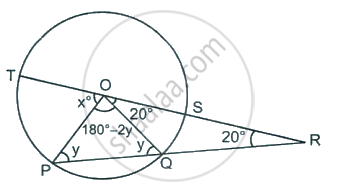
In the given figure ‘O’ is the centre of the circle. If QR = OP and ∠ORP = 20°. Find the value of ‘x’ giving reasons.
O is the circumcentre of the triangle ABC and OD is perpendicular on BC. Prove that ∠BOD = ∠A.
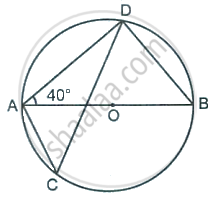
In Fig., AB is the diameter of the circle such that ∠DAB = 40°. Find ∠DCA.
In a circle with center O, chords AB and CD intersect inside the circumference at E. Prove that ∠ AOC + ∠ BOD = 2∠ AEC.
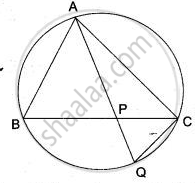
In the given figure. P is any point on the chord BC of a circle such that AB = AP. Prove that CP = CQ.
Prove that the circle drawn on any one of the equal sides of an isosceles triangle as diameter bisects the base.
AB is a diameter of the circle C(O, r), and radius OD ⊥ AB. If C is any point on arc DB, find BAD and ∠ACD.
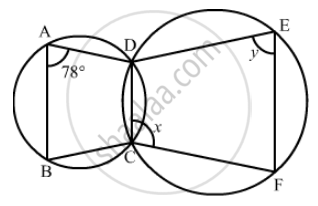
In the given figure, ∠BAD = 78°, ∠DCF = x° and ∠DEF = y°. Find the values of x and y.
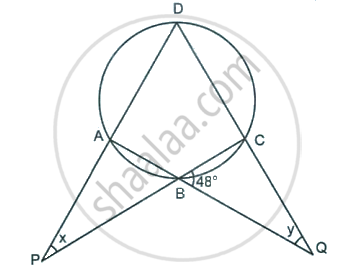
In figure, ABCD is a cyclic quadrilateral. <CBQ = 48° and x = 2y. Find the value of y.
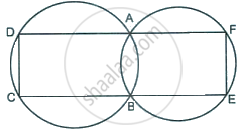
Two circles ABCD and ABEF intersect at point A and B. If CBE and DAF are straight lines, prove that CD is parallel to EF.
If circles are drawn taking two sides of a triangle as diameters, prove that the point of intersection of these circles lie on the third side.
In the adjoining figure, ‘O’ is the centre of the circle and ΔABC is an equilateral triangle. Find:
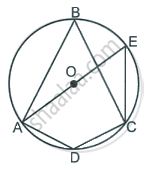
In the following figure, ‘O’ is the centre of the circle. If ∠AOB = 40° and ∠BCD = 105°, find ∠OBD.
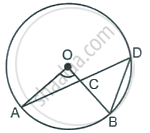
In the given figure, ABCD is a cyclic quadrilateral in which AC and BD are its diagonals. If ∠DBC = 55° and ∠BAC = 45°, find ∠BCD.
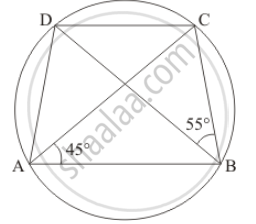
AB is the diameter of the circle with centre O. OD is parallel to BC and ∠AOD = 60°. Calculate the numerical values of:
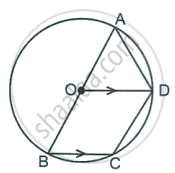
In the given figure, ‘O’ is the centre of the circle. AEB and DCB are the straight lines. Find:
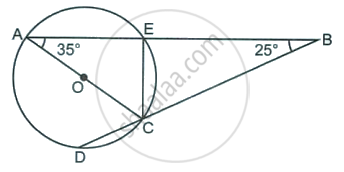
The sides DC and EB of a cyclic quadrilateral are produced to meet at F, the sides DE and CB are produced to meet at A. If ∠BED = 98° and ∠DFE = 42°, find:
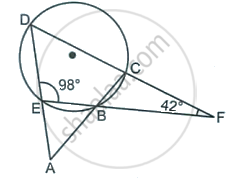
Prove that the parallelogram, inscribed in a circle, is a rectangle.
In the given figure, AB is a diameter and DC || AB. If <CAB = 24°, find ∠ADC.
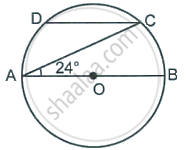
Two circles intersect at points M and N. Through M, the diameters MA and MB of the two circles are drawn. Show that A, N and B are collinear.
In the given figure, AB is the diameter of a circle with centre O. A circle is drawn with AO as diameter. A chord AD of the larger circle intersects the smaller circle at C. Show that:
AC = CD
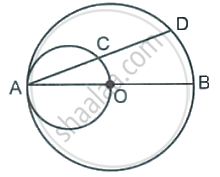
Two chords AB and CD intersect at P inside the circle. Prove that the sum of the angles subtended by the arcs AC and BD at the centre O is equal to twice the angle APC.
In the given figure, ∠BAD = 65°, ∠ABD = 70°, ∠BDC = 45°
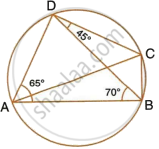
ABCD is a cyclic quadrilateral in which AB is parallel to DC and AB is a diameter of the circle. Given ∠BED = 65°, calculate:
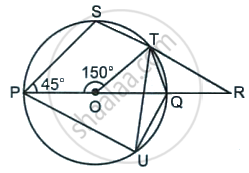
In the adjoining figure, O is the centre of the circle. If <SPQ = 45° and ∠POT = 150°, find the measures of:
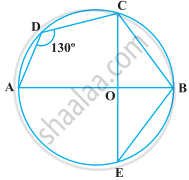
In the following figure, ∠ADC = 130° and chord BC = chord BE. Find ∠CBE.
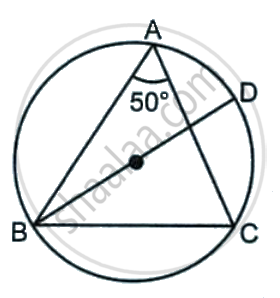
In the adjoining figure, I is the incentre of ΔАBC. BI produced meets the circumcircle of ΔABC at D. If ∠BAC = 50° and ∠ACB = 70°, calculate:
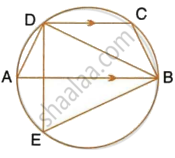
In the given figure, AD is a diameter. O is the centre of the circle. AD is parallel to BC and ∠CBD = 32°.
Find:

Bisectors of angles A, B and C of a triangle ABC intersect its circumcircle at D, E and F respectively. Prove that the angles of the triangle DEF are 90°-A, 90° − `1/2 A, 90° − 1/2 B, 90° − 1/2` C.
Prove that any four vertices of a regular pentagon are concylic (lie on the same circle).
In the given figure, chords BA and DC of a circle meet at point P. Prove that:
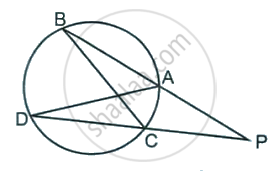
If non-parallel sides of a trapezium are equal, prove that it is cyclic.
Prove that the rhombus, inscribed in a circle, is a square.
The radius of a circle is 8 cm. Find the length of a tangent drawn to this circle from a point at a distance of 17 cm from its centre.
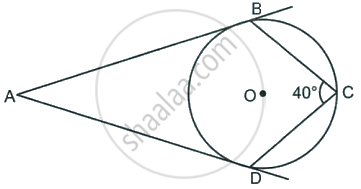
In the given figure, AB and AD are the tangents to the circle from an external point A. If ∠BCD = 40°, find ∠BAD.
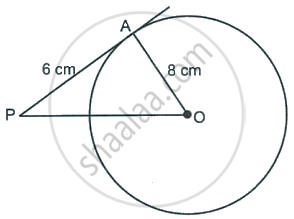
The tangent to a circle of radius 8 cm from an external point P is of length 6 cm. Find the distance of P from the nearest point to the circle.
Two concentric circles are of radii 12 cm and 13 cm. Find the length of the chord of the outer circle which touches the inner circle.
Three circles of radii 3 cm, 4 cm and 5 cm touch each other externally. Find the perimeter of triangle formed by joining the centres of these circles.
Two circles are of radii 10 cm and 6 cm. Find the distance between their centres if they touch externally.
Two circles are of radii 10 cm and 6 cm. Find the distance between their centres if they touch internally.
Two circle touch each other internally. Show that the tangents drawn to the two circles from any point on the common tangent are equal in length.
Two circles touch each other externally at point P. Q is a point on the common tangent through P. Show that the tangents drawn from Q to the given two circles are equal in length.
In the given figure, prove that: BP + CQ + AR = `1/2` × perimeter of ΔABC.
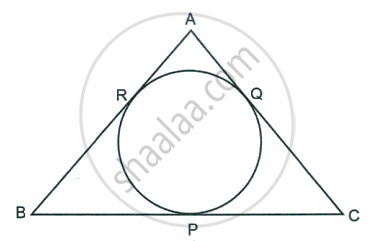
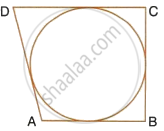
If the sides of a quadrilateral ABCD touch a circle, prove that:
AB + CD = BC + AD.
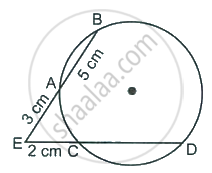
Two chords AB and CD of a circle intersect externally at E. If EC = 2 cm, EA = 3 cm, AB = 5 cm, find the length of CD.
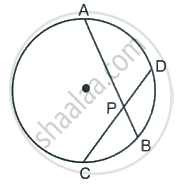
In the given figure, 4 × CP = PD = 12 cm and AP = 9 cm, find BP.
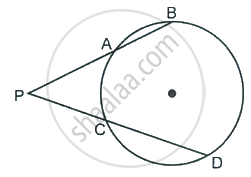
In the given figure, PA = 3 cm, AB = 5 cm, PC = 4 cm, find CD.
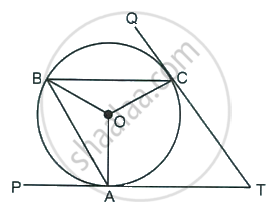
In the given figure, TP and TQ are two tangents to the circle with centre O, touching at A and C respectively. If ∠BCQ = 55° and ∠BAP = 60°, find:
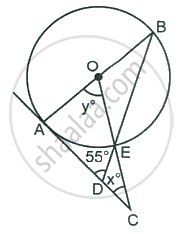
In the given figure AC is a tangent to the circle with centre O.
If ∠ADB = 55°, find x and y. Give reasons for your answers.
In the given figure, PQ is a tangent to the circle at A. AB and AD are bisectors of ∠CAQ and ∠PAC. if ∠BAQ = 30°. Prove that:

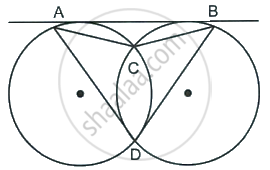
In the given figure, AB is a common tangent of two circles intersecting at C and D. Write down the measure of ∠ACB + ∠ADB and justify it.
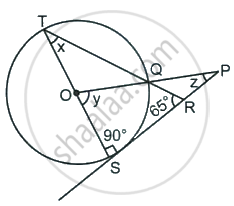
In the figure given below, O is the center of the circle and SP is a tangent. If ∠SRT = 65°, find the value of x, y and Z.
In the given figure, AB = 7 cm and BC = 9 cm.
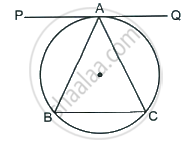
PAQ is a tangent at A to the circumcircle of ΔABC such that PAQ is parallel to BC, prove that ΔABC is an isosceles triangle.
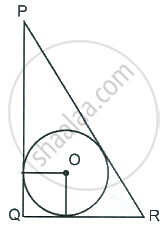
In the given figure, PQ = 24 cm, PR = 25 cm, ∠PQR = 90°, find the radius of inscribed circle of ΔPQR.
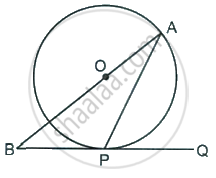
The following figure, shows a circle with centre ‘O’ and a tangent BPQ at point P. Show that ∠APQ + ∠BAP = 90°.
Two circles touch each other internally at a point P. A chord AB of the bigger circle intersects the other circle in C and D. Prove that ∠CPA = ∠DPB.

In the given figure, PA is a tangent to the circie and PBC is a secant. AQ is the bisector of ∠BAC. Show that ΔPAQ is an isosceles triangle. Also show that: ∠CAQ = `1/2` (∠PBA− ∠PAB).
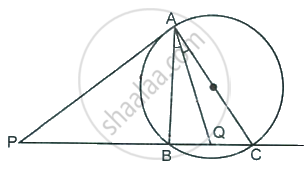
In a cyclic quadrilateral ABCD, the diagonal AC bisects the angle BCD. Prove that the diagonal BD is parallel to the tangent to the circle at point A.
Two circles intersect each other at points A and B. Their common tangent touches the circles at points P and Q as shown in the figure. Show that the angles PAQ and PBQ are supplementary.

AB is the diameter of a circle with centre ‘O’. A line MN touches the given circle at point R and cuts the tangents to the circle through A and B at M and N, respectively. Prove that: ∠MON = 90°
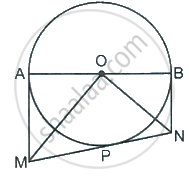
In the given figure, O is the centre of the circle. The tangents at B and D intersect at point P. If AB || CD and ∠ABC = 50°, find:
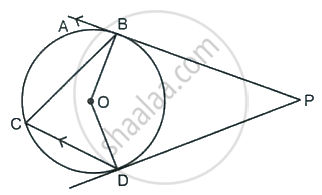
If the sides of a rectangle touch a circle, prove that the rectangle is a square.
In the given diagram, O is the centre of the circle. PR and PT are two tangents drawn from the external point P and touching the circle at Q and S respectively. MN is a diameter of the circle. Given ∠PQM = 42° and ∠PSM = 25°.
Find:

In the given diagram an isosceles ΔABC is inscribed in a circle with centre O. PQ is a tangent to the circle at C. OM is perpendicular to chord AC and ∠COM = 65°.
Find:

The figure shows a circle of radius 9 cm with 0 as the centre. The diameter AB produced meets the tangent PQ at P. If PA = 24 cm, find the length of tangent PQ:

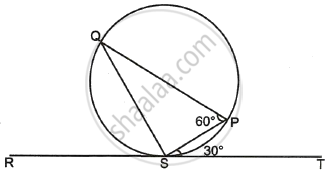
In the given diagram RT is a tangent touching the circle at S. If ∠PST = 30° and ∠SPQ = 60°, then ∠PSQ is equal to ______.
40°
30°
60°
90°
In the given figure, O is the centre of the circle and ∠BAC= 20°, ∠BOC is ______.

40°
30°
10°
20°
In the given figure, the value of x is ______.
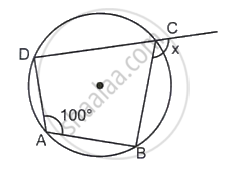
80°
100°
120°
160°
Angle in a semi-circle is ______.
0°
60°
90°
180°
In the given figure, two concentric circles of radii 6 cm and 10 cm are shown. The length of BC is ______.
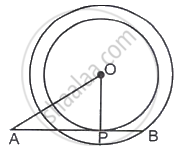
8 cm
16 cm
12 cm
4 cm
If BA and DC are two chords of a circle, which meets at point P when produced. If CD = 3 cm, PA = 10 cm, PB = 4 cm then PC is equal to ______.
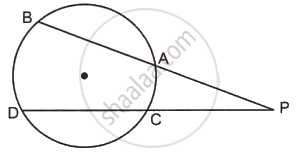
5 cm
4 cm
6 cm
3 cm
ABC is an isosceles triangle with AB = AC and ∠BAC = 40°. If a circle passing through B and C intersects sides AB and AC at D and E respectively, then ∠ADE is equal to ______.
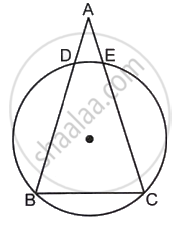
40°
50°
60°
70°
In the figure given below, AB || DC. If ∠B = 70°, then ∠BCD is ______.
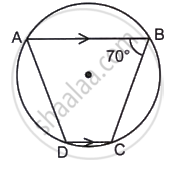
80°
110°
100°
70°
In the figure given below, AD = BD and ∠BAD = 65°. ∠ACB is equal to ______.
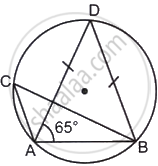
30°
40°
50°
65°
In the given figure, ‘O’ is the centre of the circle and AE = ED. If ∠ABC = 110° then ∠CBD is equal to ______.
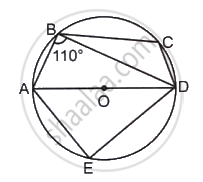
20°
30°
40°
55°
In the given diagram, PS and PT are the tangents to the circle. SQ || PT and ∠SPT = 80°. The value of ∠QST is ______.
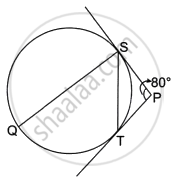
140°
90°
80°
50°
In the given figure, O is the centre of the circle. Determine
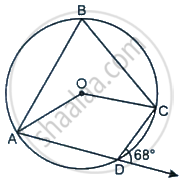
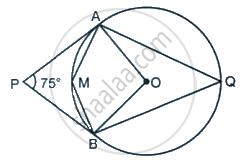
In the given figure, O is the centre of the circle. Determine ∠AQB and ∠AMB, if PA and PB are tangents.
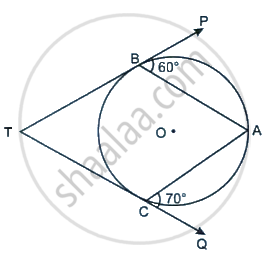
In the given figure, TBP and TCQ are tangents to the circle whose centre is O. Also, ∠PBA = 60° and ∠ACQ =70°. Determine ∠BAC and ∠BТС.
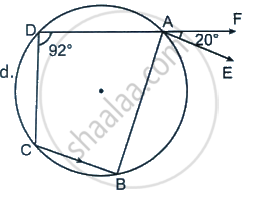
In the given figure, ABCD is a cyclic quadrilateral. AE is drawn parallel to CB and DA is produced. If ∠ADC = 92°, ∠FAE = 20°, determine ∠BCD.
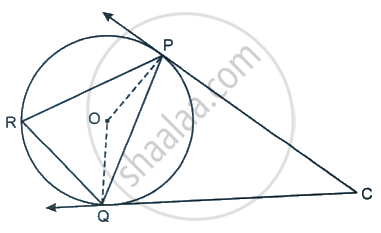
In the given figure, PQ = QR and ∠RQP = 72°. CP and CQ are tangents. Determine ∠POQ.
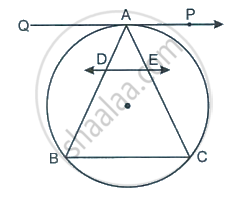
A circle circumscribes a ΔABC, DE is parallel to the tangent AP at A and intersects AB and AC in D and E respectively. Prove that:
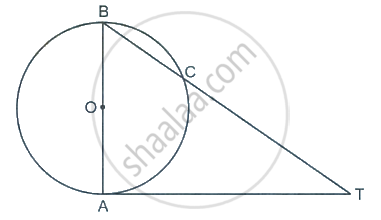
In the given figure, AB is a diameter of the circle. The length of AB = 5 cm. If O is the centre of the circle and the length of tangent segment AT = 12 cm, determine CT.
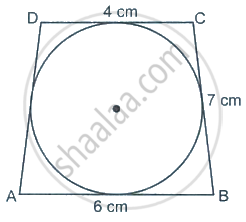
In figure, a circle touches all the four sides of a quadrilateral ABCD whose sides AB = 6 cm, BC = 7 cm and CD = 4 cm. Find AD.
A circle touches the side BC of a ΔABC at a point P and touches AB and AC when produced at Q and R respectively. As shown in the figure that AQ = `1/2` (Perimeter of ΔABC).

Shaalaa.com has the CISCE Mathematics माठेमटिक्स [इंग्रजी] इयत्ता १० आयसीएसई CISCE solutions in a manner that help students grasp basic concepts better and faster. The detailed, step-by-step solutions will help you understand the concepts better and clarify any confusion. Nootan solutions for Mathematics माठेमटिक्स [इंग्रजी] इयत्ता १० आयसीएसई CISCE 15 (Circles) include all questions with answers and detailed explanations. This will clear students' doubts about questions and improve their application skills while preparing for board exams.
Further, we at Shaalaa.com provide such solutions so students can prepare for written exams. Nootan textbook solutions can be a core help for self-study and provide excellent self-help guidance for students.
Concepts covered in माठेमटिक्स [इंग्रजी] इयत्ता १० आयसीएसई chapter 15 Circles are Theorems on Angles in a Circle, Chord, Geometrical Concepts Related to a Circle, Cyclic Quadrilateral and Concyclic Points, Some Important Results on Circles, Advanced Theorems Related to Circles, Arc of the Circle, Segment of a Circle.
Using Nootan माठेमटिक्स [इंग्रजी] इयत्ता १० आयसीएसई solutions Circles exercise by students is an easy way to prepare for the exams, as they involve solutions arranged chapter-wise and also page-wise. The questions involved in Nootan Solutions are essential questions that can be asked in the final exam. Maximum CISCE माठेमटिक्स [इंग्रजी] इयत्ता १० आयसीएसई students prefer Nootan Textbook Solutions to score more in exams.
Get the free view of Chapter 15, Circles माठेमटिक्स [इंग्रजी] इयत्ता १० आयसीएसई additional questions for Mathematics माठेमटिक्स [इंग्रजी] इयत्ता १० आयसीएसई CISCE, and you can use Shaalaa.com to keep it handy for your exam preparation.
