Advertisements
Advertisements
प्रश्न
In the following figure, ∠ADC = 130° and chord BC = chord BE. Find ∠CBE.
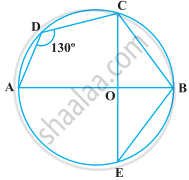
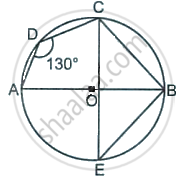
In the given figure, AB is a diameter of the circle with centre O. If ∠ADC = 130° and chord BC = chord BE, find ∠CBE.
Advertisements
उत्तर
Let us consider the points A, B, C, and D, which form a cyclic quadrilateral.
∴ ∠ADC + ∠OBC = 180° ... [The sum of opposite angles of a cyclic quadrilateral is 180°.]
⇒ 130° + ∠ABC = 180°
⇒ ∠ABC = 180° – 130° = 50°
In ΔBOC and ΔBOE,
BC = BE ...[Given]
OC = OE ... [Radii of a same circle]
And OB = OB ...[Common]
∴ ΔBOC ≅ ΔBOE ...[By SSS congruency]
⇒ ∠OBC = ∠OBE ...[By C.P.C.T]
Now, ∠CBE = ∠OBC + ∠OBE
= 50° + 50°
= 100°
APPEARS IN
संबंधित प्रश्न
From an external point P, tangents PA and PB are drawn to the circle with centre O. If CD is the tangent to the circle at point E and PA = 14 cm. Find the perimeter of ABCD.
In the fig. ABC is right triangle right angled at B such that BC = 6cm and AB = 8cm. Find the radius of its in circle.
In the given figure, AB is a chord of length 16 cm of a circle of radius 10 cm. The tangents at A and B intersect at a point P. Find the length of PA.
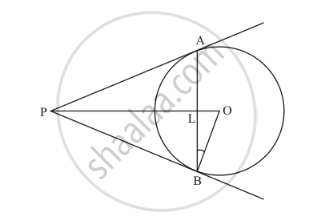
In the given figure, PO⊥QO. The tangents to the circle at P and Q intersect at a point T. Prove that PQ and OT are right bisector of each other.
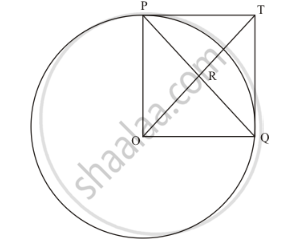
The perimeter (in cm) of a square circumscribing a circle of radius a cm, is
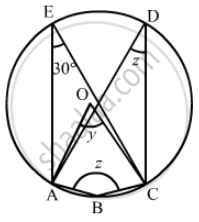
In the given figure, O is the centre of the circle. If ∠CEA = 30°, Find the values of x, y and z.
A is a point at a distance 13 cm from the centre O of a circle of radius 5 cm. AP and AQ are the tangents to the circle at P and Q. If a tangent BC is drawn at a point R lying on the minor arc PQ to intersect AP at B and AQ at C, find the perimeter of the ∆ABC.
If the angle between two tangents drawn from a point P to a circle of radius ‘a’ and centre ‘O’ is 90°, then OP = ______
AB is a diameter of a circle and AC is its chord such that ∠BAC = 30°. If the tangent at C intersects AB extended at D, then BC = BD.
Which is the longest straight line that can be drawn inside a circle?
