Advertisements
Advertisements
Questions
In the following figure, ∠ADC = 130° and chord BC = chord BE. Find ∠CBE.
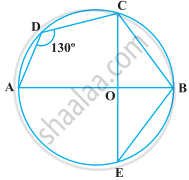
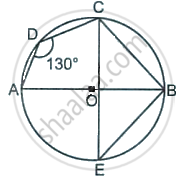
In the given figure, AB is a diameter of the circle with centre O. If ∠ADC = 130° and chord BC = chord BE, find ∠CBE.
Advertisements
Solution
Let us consider the points A, B, C, and D, which form a cyclic quadrilateral.
∴ ∠ADC + ∠OBC = 180° ... [The sum of opposite angles of a cyclic quadrilateral is 180°.]
⇒ 130° + ∠ABC = 180°
⇒ ∠ABC = 180° – 130° = 50°
In ΔBOC and ΔBOE,
BC = BE ...[Given]
OC = OE ... [Radii of a same circle]
And OB = OB ...[Common]
∴ ΔBOC ≅ ΔBOE ...[By SSS congruency]
⇒ ∠OBC = ∠OBE ...[By C.P.C.T]
Now, ∠CBE = ∠OBC + ∠OBE
= 50° + 50°
= 100°
RELATED QUESTIONS
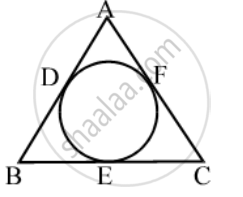
In the given figure, the incircle of ∆ABC touches the sides BC, CA and AB at D, E, F respectively. Prove that AF + BD + CE = AE + CD + BF = `\frac { 1 }{ 2 } ("perimeter of ∆ABC")`
In Fig., if AB = AC, prove that BE = EC
true or false
A circle is a plane figure.
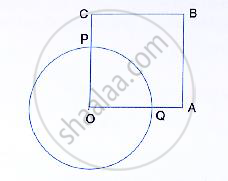
In the following figure, OABC is a square. A circle is drawn with O as centre which meets OC
at P and OA at Q. Prove that:
(i) ΔOPA ≅ ΔOQC, (ii) ΔBPC ≅ ΔBQA.
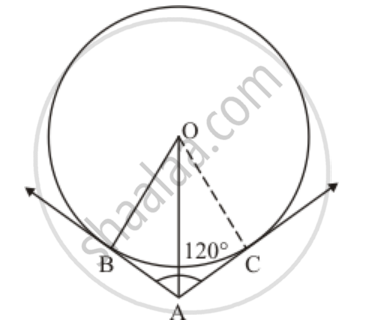
In the given figure, two tangents AB and AC are drawn to a circle with centre O such that ∠BAC = 120°. Prove that OA = 2AB.
Draw a circle of radius 3.6 cm. In the circle, draw a chord AB = 5 cm. Now shade the minor segment of the circle.
Construct a triangle XYZ in which XY = YZ= 4.5 cm and ZX = 5.4 cm. Draw the circumcircle of the triangle and measure its circumradius.
State, if the following statement is true or false:
The longest chord of a circle is its diameter.
If the radius of a circle is 5 cm, what will its diameter be?
If d1, d2 (d2 > d1) be the diameters of two concentric circles and c be the length of a chord of a circle which is tangent to the other circle, then ______
