Advertisements
Advertisements
प्रश्न
In the Fig., ΔABC is an isosceles triangle with AB = AC and ∠ABC = 50°. Find ∠BDC and ∠BEC.
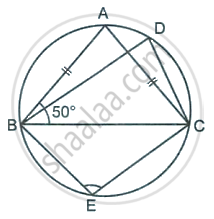
बेरीज
Advertisements
उत्तर
Triangle ABC is isosceles with AB = AC.
∠ABC = 50°.
Points D and E lie on the circle passing through B and C, intersecting sides AB and AC, respectively.
Step 1: Since AB = AC, angles opposite these sides are equal. ∠ABC = ∠ACB = 50°.
Step 2: Find ∠BAC: Sum of angles in
ΔABC = 180° ∠ABC + ∠ACB + ∠BAC = 180°
50° + 50° + ∠BAC = 180°
∠BAC = 80°
Step 3: In cyclic quadrilateral BCED (since B, C, D, and E lie on the circle), opposite angles sum to 180°. ∠BDC + ∠BAC = 180° ∠BDC + 80° = 180° ∠BDC = 100°
Step 4: Find ∠BEC: In ΔBEC, ∠BEC is the external angle for ΔBEC at E. By cyclic properties and congruent triangles, it can be shown that
∠BEC = 2 × ∠ABC = 100°
shaalaa.com
या प्रश्नात किंवा उत्तरात काही त्रुटी आहे का?
