Advertisements
Advertisements
प्रश्न
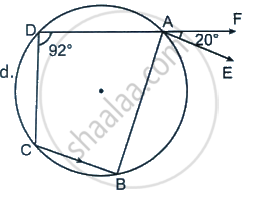
In the given figure, ABCD is a cyclic quadrilateral. AE is drawn parallel to CB and DA is produced. If ∠ADC = 92°, ∠FAE = 20°, determine ∠BCD.
Advertisements
उत्तर
Given:
ABCD is a cyclic quadrilateral.
AE ∥, CB, and DA are produced to F.
∠ADC = 92°, ∠FAE = 20°.
To find: ∠BCD
1. Use Cyclic Quadrilateral Property
Opposite angles of a cyclic quadrilateral are supplementary:
∠ADC + ∠ABC = 180°
92° + ∠ABC = 180°
∠ABC = 88°
2. Relate ∠FAE to ∠BAD
AE ∥ CB, so the angle made by AF (extension of AD) with AE equals the angle made by AD with CB:
∠FAE = angle between AD and CB.
∠BAD = interior angle between AD and AB.
Because CB is parallel to AE, and AF is the extension of AD:
Exterior angle ∠FAE equals the interior angle ∠BAD.
Therefore:
∠BAD = 20°
3. Use Property of Cyclic Quadrilateral (Opposite arcs and angles)
In the same quadrilateral ABCD:
∠BAD (20°) and ∠BCD are opposite angles of the cyclic quadrilateral.
∠BAD (20°) and ∠BCD are opposite angles of the cyclic quadrilateral.
Thus:
∠BAD + ∠BCD = 180°
20° + ∠BCD = 180°
∠BCD = 180° − 20°
= 108°
