Advertisements
Advertisements
प्रश्न
Prove that the parallelogram, inscribed in a circle, is a rectangle.
Advertisements
उत्तर
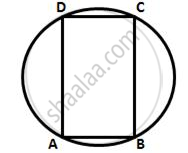
Let ABCD be a parallelogram inscribed in a circle.
Now, ∠BAD + ∠BCD
(Opposite angles of a parallelogram are equal.)
And ∠BAD + ∠BCD = 180°
(A pair of opposite angles in a cyclic quadrilateral are supplementary.)
∠BAD + ∠BCD = `(180^circ)/2` = 90°
The other two angles are 90°, and the opposite pair of sides are equal.
∴ ABCD is a rectangle.
संबंधित प्रश्न
ABC is a right angles triangle with AB = 12 cm and AC = 13 cm. A circle, with centre O, has been inscribed inside the triangle.
Calculate the value of x, the radius of the inscribed circle.

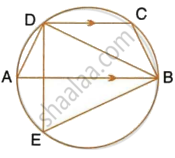
ABCD is a cyclic quadrilateral in which AB is parallel to DC and AB is a diameter of the circle. Given ∠BED = 65°, calculate:
- ∠DAB,
- ∠BDC.
Prove that the perimeter of a right triangle is equal to the sum of the diameter of its incircle and twice the diameter of its circumcircle.
Prove that the circle drawn on any one of the equal sides of an isosceles triangle as diameter bisects the base.
The following figure shows a circle with PR as its diameter. If PQ = 7 cm and QR = 3RS = 6 cm, find the perimeter of the cyclic quadrilateral PQRS.

In the given figure, AB is the diameter of a circle with centre O.
If chord AC = chord AD, prove that:
- arc BC = arc DB
- AB is bisector of ∠CAD.
Further, if the length of arc AC is twice the length of arc BC, find:
- ∠BAC
- ∠ABC

Using ruler and a compass only construct a semi-circle with diameter BC = 7cm. Locate a point A on the circumference of the semicircle such that A is equidistant from B and C. Complete the cyclic quadrilateral ABCD, such that D is equidistant from AB and BC. Measure ∠ADC and write it down.
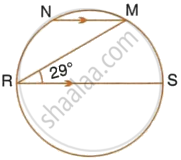
In the given figure, RS is a diameter of the circle. NM is parallel to RS and ∠MRS = 29°. Calculate : ∠NRM
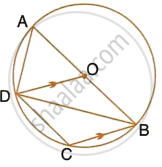
In the given figure, AB is a diameter of the circle with centre O. DO is parallel to CB and ∠DCB = 120°.
Calculate: ∠ADC
Also, show that the ΔAOD is an equilateral triangle.
In Fig, Chord ED is parallel to the diameter AC of the circle. Given ∠CBE = 65°, Calculate ∠ DEC.

