Advertisements
Advertisements
प्रश्न
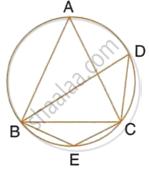
In the given figure, AC is the diameter of the circle with center O.
CD is parallel to BE.
∠AOB = 80° and ∠ACE = 20°
Calculate:
- ∠BEC
- ∠BCD
- ∠CED

Advertisements
उत्तर
Join AE.
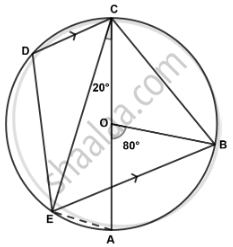
a. The angle subtended by a chord at the center is twice the angle subtended on the circumference.
∴ ∠AOB = 2∠AEB
⇒ 80° = 2∠AEB
∠AEB = `(80°)/2`
∠AEB = 40°
We know that an angle in a semicircle is a right angle.
⇒ ∠AEC = 90°
From figure,
∠BEC = ∠AEC − ∠AEB
= 90° − 40°
= 50°
b. From figure,
∠ECD = ∠CEB = 50° .....(Alternate angles are equal.)
We know that the angle subtended by a chord at the centre is twice the angle subtended on the circumference.
∠AOB = 2∠BCA
80° = 2∠BCA
∠BCA = `80/2`
∠BCA = 40°
From figure,
∠BCD = ∠BCA + ∠ACE + ∠ECD
= 40° + 20° + 50°
= 110°
c. The sum of opposite angles of a cyclic quadrilateral is 180°.
∠BED + ∠BCD = 180°
∠BED = 180° − ∠BCD
= 180° − 110°
= 70°
From figure,
∠BED = ∠BEC + ∠CED
70° = 50° + ∠CED
∠CED = 70° − 50°
∠CED = 20°
संबंधित प्रश्न
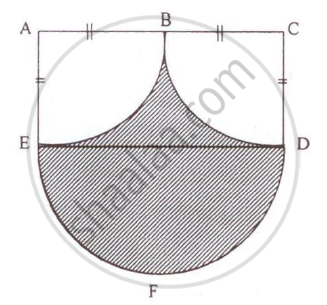
Calculate the area of the shaded region, if the diameter of the semicircle is equal to 14 cm. Take `pi = 22/7`
Prove that the parallelogram, inscribed in a circle, is a rectangle.
In the given figure, RS is a diameter of the circle. NM is parallel to RS and ∠MRS = 29°. Calculate : ∠RNM

In the given figure, PQ is a diameter. Chord SR is parallel to PQ. Given that ∠PQR = 58°,
Calculate:
- ∠RPQ,
- ∠STP.

Prove that the circle drawn on any one of the equal sides of an isosceles triangle as diameter bisects the base.
In the given figure, AB is a diameter of the circle. Chord ED is parallel to AB and ∠EAB = 63°. Calculate : ∠BCD.
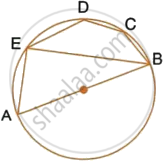
In the given figure, AB is a diameter of the circle with centre O. DO is parallel to CB and ∠DCB = 120°.
Calculate: ∠ADC
Also, show that the ΔAOD is an equilateral triangle.
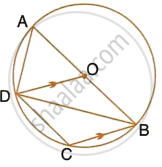
In Fig, Chord ED is parallel to the diameter AC of the circle. Given ∠CBE = 65°, Calculate ∠ DEC.

In the figure, ∠DBC = 58°. BD is diameter of the circle.
Calculate:
- ∠BDC
- ∠BEC
- ∠BAC
In the figure given alongside, AD is the diameter of the circle. If ∠ BCD = 130°, Calculate: (i) ∠ DAB (ii) ∠ ADB.

