Advertisements
Advertisements
प्रश्न
In the given figure, PQ is a tangent to the circle at A. AB and AD are bisectors of ∠CAQ and ∠PAC. if ∠BAQ = 30°. Prove that:
- BD is a diameter of the circle.
- ABC is an isosceles triangle.

Advertisements
उत्तर
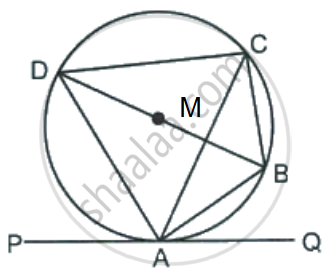
i) ∠BAQ = 30°
Since AB is the bisector of ∠CAQ
= ∠CAB = ∠BAQ = 30°
⇒ ∠CAQ = 2 × 30° = 60°
Since P–A–Q is a straight line, ∠CAP + ∠CAQ = 180°
⇒ ∠CAP + 60° = 180°
⇒ ∠CAP = 120°
AD is the bisector of ∠CAP
⇒ ∠CAD = `1/2` × 120° = 60°
So ∠CAD + ∠CAB = 60° + 30° = 90°
Since the angle in a semi-circle = 90°
= Angle made by the diameter to any point on the circle is 90°
So, BD is the diameter of the circle.
Since BD is the diameter of the circle, it will pass through the centre.
By the Alternate segment theorem
∠ABD = angle DAC = 60°
So, in ∠BMA,
∠AMB = 90° (because MA is perpendicular to diameter BD)
= angle BMA = angle BMC = 90°
In ΔBMA and ΔBMC:
∠BMA = ∠BMC = 90°
BM = BM (common side)
MA = MC (both are radii of the circle)
So, ΔBMA ≅ ΔBMC
⇒ AB = BC (SAS congruence criterion)
∴ ΔABC is an isosceles triangle.
APPEARS IN
संबंधित प्रश्न
Draw a line segment AB of length 7 cm. Taking A as centre, draw a circle of radius 3 cm and taking B as centre, draw another circle of radius 2 cm. Construct tangents to each circle from the centre of the other circle.
Draw a pair of tangents to a circle of radius 5 cm which are inclined to each other an angle of 60º.
Draw a circle with the help of a bangle. Take any point P outside the circle. Construct the pair of tangents from the point P to the circle.
A park is of the shape of a circle of diameter 7 m. It is surrounded by a path of width of 0.7 m. Find the expenditure of cementing the path, if its cost is Rs 110 per sq m.
Draw two circles of radii 2.5 cm and 3.5 cm respectively so that their centres are 8 cm apart. Draw direct comm on tangents to the circle.
Draw two concentric circles with radii 4 cm and 6 cm. Taking a point on the outer circle, construct a pair of tangents to inner circle. By measuring the lengths of both the tangents, show that they are equal to each other.
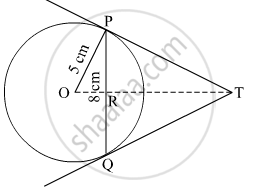
In Figure 2, PQ is a chord of length 8 cm of a circle of radius 5 cm. The tangents at P and Q intersect at a point T. Find the length TP.
Draw a circle of radius 3 cm and construct a tangent to it from an external point without using the center.
Construct a pair of tangents to a circle of radius 3 cm which are inclined to each other at an angle of 60°.
Draw a circle of radius 2.5 cm. Construct a pair of tangents from a point Pat a distance of 6 cm from the centre of the circle.
