Advertisements
Advertisements
प्रश्न
In the given figure, PQ is a tangent to the circle at A. AB and AD are bisectors of ∠CAQ and ∠PAC. if ∠BAQ = 30°. Prove that:
- BD is a diameter of the circle.
- ABC is an isosceles triangle.

Advertisements
उत्तर
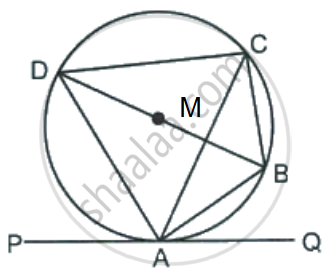
i) ∠BAQ = 30°
Since AB is the bisector of ∠CAQ
= ∠CAB = ∠BAQ = 30°
⇒ ∠CAQ = 2 × 30° = 60°
Since P–A–Q is a straight line, ∠CAP + ∠CAQ = 180°
⇒ ∠CAP + 60° = 180°
⇒ ∠CAP = 120°
AD is the bisector of ∠CAP
⇒ ∠CAD = `1/2` × 120° = 60°
So ∠CAD + ∠CAB = 60° + 30° = 90°
Since the angle in a semi-circle = 90°
= Angle made by the diameter to any point on the circle is 90°
So, BD is the diameter of the circle.
Since BD is the diameter of the circle, it will pass through the centre.
By the Alternate segment theorem
∠ABD = angle DAC = 60°
So, in ∠BMA,
∠AMB = 90° (because MA is perpendicular to diameter BD)
= angle BMA = angle BMC = 90°
In ΔBMA and ΔBMC:
∠BMA = ∠BMC = 90°
BM = BM (common side)
MA = MC (both are radii of the circle)
So, ΔBMA ≅ ΔBMC
⇒ AB = BC (SAS congruence criterion)
∴ ΔABC is an isosceles triangle.
APPEARS IN
संबंधित प्रश्न
Draw a line segment AB of length 7 cm. Taking A as centre, draw a circle of radius 3 cm and taking B as centre, draw another circle of radius 2 cm. Construct tangents to each circle from the centre of the other circle.
Construct an equilateral triangle ABC with side 6 cm. Draw a circle circumscribing the triangle ABC.
Draw a line segment AB of length 8 cm. Taking A as centre, draw a circle of radius 4 cm and taking B as centre, draw another circle of radius 3 cm. Construct tangents to each circle from the centre of the other circle.
Draw a circle of radius 3 cm. Draw a tangent to the circle making an angle of 30° with a line passing through the centre.
Draw a circle of radius 3 cm. Take two points P and Q on one of its diameters extended on both sides, each at a distance of 7 cm on opposite sides of its centre. Draw tangents to the circle from these two points P and Q.
Draw a pair of tangents to a circle of radius 3 cm, which are inclined to each other at an angle of 60°.
Draw a circle of radius 4 cm and take a point Pon its circumference. Construct a tangent to the circle at P.
Draw two circles with radii 2.5 cm and 4 cm and with their centres 7 cm apart.
Draw a direct common tangent and a transverse common tangent. Calculate the length of the direct common tangent.
Construct a pair of tangents to a circle of radius 4 cm from a point P lying outside the circle at a distance of 6 cm from the centre.
Using ruler and compass construct a triangle ABC in which AB = 6 cm, ∠BAC = 120° and AC = 5 cm. Construct a circle passing through A, B and C. Measure and write down the radius of the circle.
