Advertisements
Advertisements
Question
In the given figure, PQ is a tangent to the circle at A. AB and AD are bisectors of ∠CAQ and ∠PAC. if ∠BAQ = 30°. Prove that:
- BD is a diameter of the circle.
- ABC is an isosceles triangle.

Advertisements
Solution
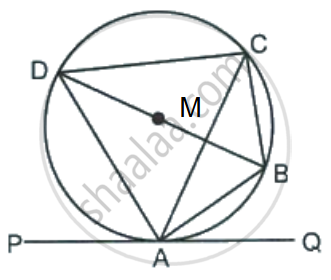
i) ∠BAQ = 30°
Since AB is the bisector of ∠CAQ
= ∠CAB = ∠BAQ = 30°
⇒ ∠CAQ = 2 × 30° = 60°
Since P–A–Q is a straight line, ∠CAP + ∠CAQ = 180°
⇒ ∠CAP + 60° = 180°
⇒ ∠CAP = 120°
AD is the bisector of ∠CAP
⇒ ∠CAD = `1/2` × 120° = 60°
So ∠CAD + ∠CAB = 60° + 30° = 90°
Since the angle in a semi-circle = 90°
= Angle made by the diameter to any point on the circle is 90°
So, BD is the diameter of the circle.
Since BD is the diameter of the circle, it will pass through the centre.
By the Alternate segment theorem
∠ABD = angle DAC = 60°
So, in ∠BMA,
∠AMB = 90° (because MA is perpendicular to diameter BD)
= angle BMA = angle BMC = 90°
In ΔBMA and ΔBMC:
∠BMA = ∠BMC = 90°
BM = BM (common side)
MA = MC (both are radii of the circle)
So, ΔBMA ≅ ΔBMC
⇒ AB = BC (SAS congruence criterion)
∴ ΔABC is an isosceles triangle.
APPEARS IN
RELATED QUESTIONS
Draw two concentric circles of radii 3 cm and 5 cm. Construct a tangent to smaller circle from a point on the larger circle. Also measure its length.
Draw a right triangle ABC in which AB = 6 cm, BC = 8 cm and ∠B = 90°. Draw BD perpendicular from B on AC and draw a circle passing through the points B, C and D. Construct tangents from A to this circle.
Draw a pair of tangents to a circle of radius 5 cm which are inclined to each other an angle of 60º.
Using ruler and compasses only, draw an equilateral triangle of side 4.5 cm and draw its circumscribed circle. Measure the radius of the circle.
Construct a tangent to a circle of radius 4 cm from a point on the concentric circle of radius 6 cm and measure its length. Also, verify the measurement by actual calculation.
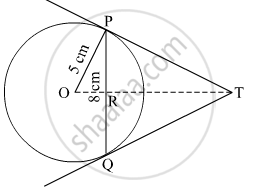
In Figure 2, PQ is a chord of length 8 cm of a circle of radius 5 cm. The tangents at P and Q intersect at a point T. Find the length TP.
Use a ruler and a pair of compasses to construct ΔABC in which BC = 4.2 cm, ∠ ABC = 60°, and AB 5 cm. Construct a circle of radius 2 cm to touch both the arms of ∠ ABC of Δ ABC.
Draw a circle of radius 3 cm. Construct a square about the circle.
Construct a tangent to a circle of radius 4 cm from a point which is at a distance of 6 cm from its centre.
Using ruler and compass construct a triangle ABC in which AB = 6 cm, ∠BAC = 120° and AC = 5 cm. Construct a circle passing through A, B and C. Measure and write down the radius of the circle.
