Advertisements
Advertisements
Question
Draw two circles of radii 3 cm and 3.5 cm, their centres being 8 cm apart. Construct a transverse common tangent and measure its length.
Advertisements
Solution
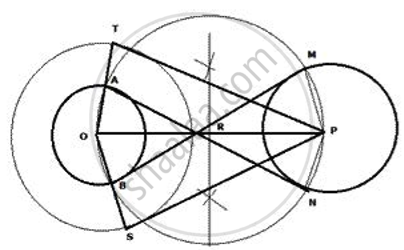
Steps of construction:
(i) Draw a line OP= 8 cm.
(ii) At O, draw a circle of radius 3 cm.
(iii) At P, draw a circle of radius 3.5 cm.
(iv) At O, draw a third circle concentric to the smaller circle and radius= (3.5 + 3) cm= 6.5 cm
(v) Draw a perpendicular bisector of OP. Let R be the mid-point of OP.
(vi) With R as centre and OR as radii, draw a fourth circle. Mark as T and S where the third and fourth ci rel es intersect each other.
(vii) Join OT and OS to meet the smaller circle at A and B.
(viii) Join PT and PS.
(ix) On PT and PS, draw perpendiculars to meet the bigger circle at M and N.
(x) Join AM and BN.
AM and BN are the required tangents.
On measuring, AM= BN = 8 cm.
APPEARS IN
RELATED QUESTIONS
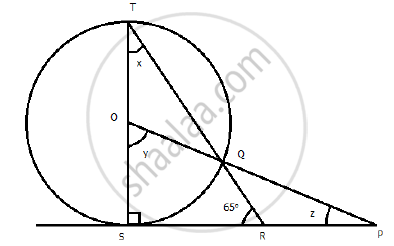
In the figure given below, O is the centre of the circle and SP is a tangent. If ∠SRT = 65°,
find the value of x, y and z.
Using ruler and compasses only, draw an equilateral triangle of side 4.5 cm and draw its circumscribed circle. Measure the radius of the circle.
The bisectors of angles A and B of a scalene triangle ABC meet at O.
- What is the point O called?
- OR and OQ are drawn perpendicular to AB and CA respectively. What is the relation between OR and OQ?
- What is the relation between angle ACO and angle BCO?
Draw a circle of radius 4.2 cm. Draw a pair of tangents to this circle inclined to each other at an angle of 45°.
Draw a circle of radius 3 cm. Draw a tangent to the circle making an angle of 30° with a line passing through the centre.
A park is of the shape of a circle of diameter 7 m. It is surrounded by a path of width of 0.7 m. Find the expenditure of cementing the path, if its cost is Rs 110 per sq m.
Draw two concentric circles with radii 4 cm and 6 cm. Taking a point on the outer circle, construct a pair of tangents to inner circle. By measuring the lengths of both the tangents, show that they are equal to each other.
Draw a circle of radius 3 cm. Construct a square about the circle.
Which of the following is not true for a point P on the circle?
Draw two concentric circles of radii 3 cm and 5 cm. Taking a point on outer circle construct the pair of tangents to the other. Measure the length of a tangent and verify it by actual calculation.
