Advertisements
Advertisements
प्रश्न
Use ruler and compass only for answering this question.
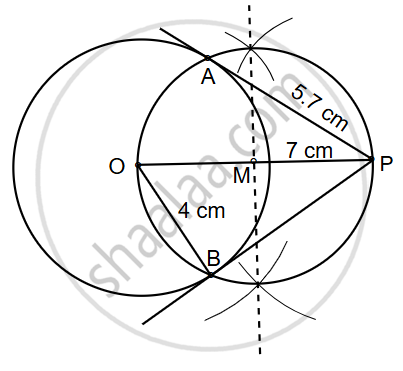
Draw a circle of radius 4 cm. Mark the centre as O. Mark a point P outside the circle at a distance of 7 cm from the centre. Construct two tangents to the circle from the external point P.
Measure and write down the length of any one tangent.
Advertisements
उत्तर
Steps of Construction:
- Draw a circle with centre O and radius 4 cm using a compass.
- Mark a point P on a horizontal line such that OP = 7 cm.
- Join OP.
- Draw the perpendicular bisector of OP to obtain its midpoint, say M.
- With M as centre and radius MO, draw a circle.
- This circle will cut the given circle at two distinct points A and B.
- Join PA and PB.
- PA and PB are the required tangents from the external point P to the given circle.
Measure the length of the tangent.
Length of tangent
`sqrt(OP^2 − "radius"^2)`
= `sqrt(7^2 − 4^2)`
= `sqrt(49 − 16)`
= `sqrt(33)`
= 5.74 cm (approximately)
So, the length of one tangent is 5.74 cm.
APPEARS IN
संबंधित प्रश्न
- Using ruler and compasses only, construct a triangle ABC in which AB = 8 cm, BC = 6 cm and CA = 5 cm.
- Find its in centre and mark it I.
- With I as centre, draw a circle which will cut off 2 cm chords from each side of the triangle. What is the length of the radius of this circle.
Draw a circle of radius 4.2 cm. Draw a pair of tangents to this circle inclined to each other at an angle of 45°.
Draw a circle of radius 3 cm. Draw a tangent to the circle making an angle of 30° with a line passing through the centre.
Draw a circle of radius 3 cm. Take two points P and Q on one of its diameters extended on both sides, each at a distance of 7 cm on opposite sides of its centre. Draw tangents to the circle from these two points P and Q.
Draw a circle of radius 4 cm and take a point Pon its circumference. Construct a tangent to the circle at P.
Use a ruler and a pair of compasses to construct ΔABC in which BC = 4.2 cm, ∠ ABC = 60°, and AB 5 cm. Construct a circle of radius 2 cm to touch both the arms of ∠ ABC of Δ ABC.
Draw an isosceles triangle with sides 6 cm, 4 cm, and 6 cm. Construct the incircle of the triangle. Also, write the steps of construction.
A pair of tangents can be constructed from a point P to a circle of radius 3.5cm situated at a distance of ______ from the centre.
A circle of radius r has a center O. What is first step to construct a tangent from a generic point P which is at a distance r from O?
Construct a tangent to a circle of radius 4 cm from a point which is at a distance of 6 cm from its centre.
