Advertisements
Advertisements
Question
Use ruler and compass only for answering this question.
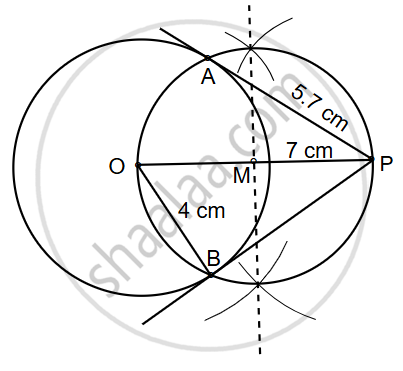
Draw a circle of radius 4 cm. Mark the centre as O. Mark a point P outside the circle at a distance of 7 cm from the centre. Construct two tangents to the circle from the external point P.
Measure and write down the length of any one tangent.
Advertisements
Solution
Steps of Construction:
- Draw a circle with centre O and radius 4 cm using a compass.
- Mark a point P on a horizontal line such that OP = 7 cm.
- Join OP.
- Draw the perpendicular bisector of OP to obtain its midpoint, say M.
- With M as centre and radius MO, draw a circle.
- This circle will cut the given circle at two distinct points A and B.
- Join PA and PB.
- PA and PB are the required tangents from the external point P to the given circle.
Measure the length of the tangent.
Length of tangent
`sqrt(OP^2 − "radius"^2)`
= `sqrt(7^2 − 4^2)`
= `sqrt(49 − 16)`
= `sqrt(33)`
= 5.74 cm (approximately)
So, the length of one tangent is 5.74 cm.
APPEARS IN
RELATED QUESTIONS
Construct a tangent to a circle of radius 4 cm from a point on the concentric circle of radius 6 cm and measure its length. Also verify the measurement by actual calculation.
Draw a circle of radius 3 cm. Draw a pair of tangents to this circle, which are inclined to each other at an angle of 60º.
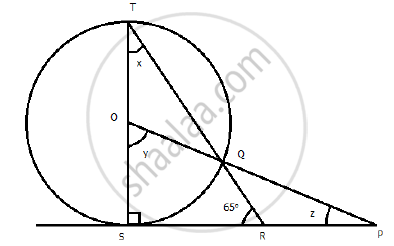
In the figure given below, O is the centre of the circle and SP is a tangent. If ∠SRT = 65°,
find the value of x, y and z.
Using ruler and compasses only, draw an equilateral triangle of side 4.5 cm and draw its circumscribed circle. Measure the radius of the circle.
Draw an inscribing circle of a regular hexagon of side 5.8 cm.
Draw a circle of radius 4.2 cm. Draw a pair of tangents to this circle inclined to each other at an angle of 45°.
A park is of the shape of a circle of diameter 7 m. It is surrounded by a path of width of 0.7 m. Find the expenditure of cementing the path, if its cost is Rs 110 per sq m.
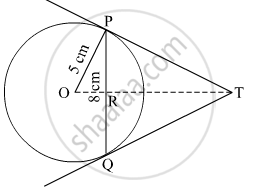
In Figure 2, PQ is a chord of length 8 cm of a circle of radius 5 cm. The tangents at P and Q intersect at a point T. Find the length TP.
You are given a circle with radius ‘r’ and center O. You are asked to draw a pair of tangents which are inclined at an angle of 60° with each other. Refer to the figure and select the option which would lead us to the required construction. d is the distance OE.

A circle of radius r has a center O. What is first step to construct a tangent from a generic point P which is at a distance r from O?
