Advertisements
Advertisements
Question
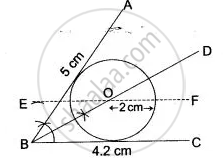
Use a ruler and a pair of compasses to construct ΔABC in which BC = 4.2 cm, ∠ ABC = 60°, and AB 5 cm. Construct a circle of radius 2 cm to touch both the arms of ∠ ABC of Δ ABC.
Advertisements
Solution
BC = 4.2 cm, ∠ ABC = 60°, and AB = 5 cm.
Steps of construction:
(i) Draw BC of length 4.2 cm.
(ii) Draw an angle of 60° at B.
(iii) Cut BA = 5 cm and join A to B.
(iv) Draw angle bisector of ∠ ABC.
(v) Draw BD at 2 cm intersecting EF at O.
(vi) Taking O as centre and 2 cm as radius draw the required circle.
APPEARS IN
RELATED QUESTIONS
Draw a right triangle ABC in which AB = 6 cm, BC = 8 cm and ∠B = 90°. Draw BD perpendicular from B on AC and draw a circle passing through the points B, C and D. Construct tangents from A to this circle.
Draw a circle with the help of a bangle. Take a point outside the circle. Construct the pair of tangents from this point to the circles. Give the justification of the construction.
Draw a circle of radius 5 cm. Draw two tangents to this circle so that the angle between the tangents is 45°.
Using ruler and compasses only, draw an equilateral triangle of side 4.5 cm and draw its circumscribed circle. Measure the radius of the circle.
Construct an equilateral triangle ABC with side 6 cm. Draw a circle circumscribing the triangle ABC.
Draw a circle of radius 4 cm. From a point 6 cm away from its centre, construct a pair of tangents to the circle and measure their lengths.
A pair of tangents can be constructed from a point P to a circle of radius 3.5cm situated at a distance of ______ from the centre.
You are given a circle with radius ‘r’ and center O. You are asked to draw a pair of tangents which are inclined at an angle of 60° with each other. Refer to the figure and select the option which would lead us to the required construction. d is the distance OE.

There is a circle with center O. P is a point from where only one tangent can be drawn to this circle. What can we say about P?
A pair of tangents can be constructed from a point P to a circle of radius 3.5 cm situated at a distance of 3 cm from the centre.
