मराठी
महाराष्ट्र राज्य शिक्षण मंडळएचएससी कला (इंग्रजी माध्यम) इयत्ता ११ वी

Write your views/opinions in brief on the following topic. Liberty, equality, and fraternity lead to an ideal nation.

Advertisements
Advertisements

प्रश्न

Write your views/opinions in brief on the following topic.

Liberty, equality, and fraternity lead to an ideal nation.

टीपा लिहा
Advertisements

उत्तर

Liberty, equality, and fraternity are considered the trinity of democracy. Liberty gives impetus for progress, equality ensures equal opportunities, and contentment and fraternity provide a healthy atmosphere and solidarity in times of distress. These three essentials go hand in hand in an ideal nation.

shaalaa.com
Writing Skills
  या प्रश्नात किंवा उत्तरात काही त्रुटी आहे का?
पाठ 1.4: Pillars of Democracy - Brainstorming [पृष्ठ ४०]

APPEARS IN

बालभारती English Yuvakbharati [English] Standard 11 Maharashtra State Board
पाठ 1.4 Pillars of Democracy
Brainstorming | Q (A2) (iii) (b) | पृष्ठ ४०

संबंधित प्रश्‍न

Write an application in response to the following advertisement using information given in the CV provided :

SITUATION VACANT
                                Wanted
Smart, English speaking salesman for an electronic
showroom. Good salary offered. An experienced candidate will be preferred.
Write giving details to : The Proprietor, Ganesh Electronics, M.G. Road, Solapur.
C. V. (Resume)
(1) Name: Suhas Randive
(2) Age: 29 years
(3) Address: 105, Roshan Apartment, L.T. Road, Pune - 11
(4) Educational: B. A. (First class), Pune University qualification
(5) Experience: 3 years' experience of working as a salesman in a textile shop.
(6) Interests: Travelling, photography, reading.

Summers are becoming hotter with each passing year. Write a description of one such very hot day. What did you see and hear as you walked outside ? 

How were birds and animals affected ? 


Fill in the blank with the suitable word. 

I ran _____________ my old friend in the market place. 


Explain the use of figurative language in the poem.


The poet uses the word lonely in reference to a cloud. Explain.


But a caged BIRD stands on the grave of dreams
His shadow shouts on a nightmare scream
His wings are clipped and his feet are tied
So he opens his throat to sing.

Read the above lines and answer the question that follow.

What is the main conflict in this poem?


Comment on the imagery used in the poem.


What thought makes him feel safer?


Explain ‘may his tribe increase.’


Show with references from the story how T.S Arthur uses direct and indirect characterisation to highlight the traits of the characters.


As soon as the sports meet ended, the children ran on the field. (Begin: Hardly ……………) 


Fill in the blank with an appropriate word:

Air pollution is responsible for the spread ……… bronchitis. 


Think of a time when you found yourself in an embarrassing situation. Narrate how you got into that situation, how you dealt with it and the lesson you learned from it.


‘Catamaran’ is a kind of a boat. Do you know which Indian language this word is derived from? Check the dictionary.


The phrase 'inter alia' meaning 'among other things' is one of the many Latin expressions commonly used in English.

Find out what these Latin phrases mean.

1.Prima face

2. ad hoc

3. in camera

4.ad infinitum

5.mutatis multanis

6.tabula rasa


Indicate the details that tell us that the narrator was not very financially comfortable during his stay in London.


Use the phrase in a sentence of your own, after finding out its meaning.

blast off


Bring out the contrast between the two houses with the help of the following points.

House of March House of Laurence
1. Old, brown house a. ___________________
2. ___________________ b. Well kept grounds
3. Children played all around. c. ___________________
4. ___________________ d. No motherly face smiled at the windows.

Write a summary of the sonnet. Refer to the earlier poems for the points to be covered for writing the summary.

  • Title
  • Introductory paragraph (about the poem, type, nature, tone)
  • Main body (central idea, the gist of the poem)
  • Conclusion (opinion, views, appeal).

Write the appreciation of the poem.

  • About the poem/poet/title
  • Theme
  • Poetic devices, language, style
  • Special features/novelties/focusing elements
  • Values, message
  • Your opinion about the poem.

You are going to meet a Great Indian Bustard very soon. Prepare at least 10 questions to interview him.


Complete the table. One is done for you.

  The World around you What we should aim to be
1. Callous Caring for people, environment, life
2. Violent  
3. Greedy  
4. Corrupt  

Write about your feelings and reactions in 4-5 lines.

You may describe your feelings and reactions using other words than those given here


Pick outlines from the poem that help create images of the following in our mind and write them in the table.

No. Old Woman The Street Schoolboys
1.      
2.      
3.      

Give, in your own words, TWO reasons for the following:

The woman was reluctant to cross the street by herself.


Do you have pet animals? Write an interesting story about your own or your friends' pet. 


‘..... and that’s how I realized that courage and hope can help me overcome any major mishap/problem in life.’ Write an episode/experience from your own life that leads to the above conclusion.


Write an informal letter from a teenager to his/her parent, expressing a few thoughts from the poem.

(My dear ______/Dearest ______./Hi! ______ Are you surprised to see this letter? I wanted to talk to you about this, but then I thought I will be able to express myself better in a letter. Love,/Yours lovingly/Yours ______).


Write your opinion, in your own words:-

Why do you think the children dislike their aunt’s story?


Write 3 to 5 sentences about the following character.

The Aunt


Discuss in groups the procedure of planting a tree. Write the steps in bullet points and present them before the class.

  • ______
  • ______
  • ______
  • ______

Imagine you are the lion and someone is interviewing you.
Write the answer to the following question.

Who were your companions on the way to Oz?


Dinesh and Divya have been assigned homework on non-finite. They are not sure when to use a gerund and when to use an infinitive. They decide to meet their teacher and get their doubts cleared. The teacher introduces them to Mr. Gerund and Ms. Infinitive.


Look at the picture given below and frame your own slogan.


Fill in the value trees with the best qualities you like to follow in your life from the given list. Write a few lines about your favourite quality in the box.

Best qualities in life
Affectionate Cooperative Gratitude Loving Responsible
Ambitious Courageous Happiness Loyal Self-confident
Brave Dependability Helpfulness Good manners Self-control
Calm Diligence Honest Patriotic Self-esteem
Caring Enthusiastic Humble Peaceful Sensitive
Cheerful Fairness Imaginative Perseverance Sincerity
Committed Faithfulness Intelligent Polite Successful
Compassionate Flexible Joyful Positive Tolerant
Concerned Forgiveness Kind Rational Truthful
Confident Generosity Leader Resourceful Versatile
Contented Giving Logical Respect Witty
My favourite quality is...
__________________________________________________________________________________
__________________________________________________________________________________

Work in groups and write a paragraph on “Laughter is the best medicine.”


Fill in the blank by choosing the preposition from the option.

The boy ran ______ the dog.


______ do you play?


The word in the sentence is jumbled. Write them in order.

footprint to someone this belonged.


Punctuate the following sentence.

next wednesday my sister mita is going to join the state bank of india.


Punctuate the following sentence.

when I went fishing I caught an old shoe a plastic bag and a bad cold.


Use the option to fill in the blank.

The cows ______ grazing in the field.


Answer the question by looking at the picture.

Example: What is happening in picture 5?

The girl is diving into the water.

What are Anil and his friends pulling in picture 3?

______are pulling______


Write rhyming words for the words given below. One has been done for you.

  1. morning - evening
  2. car
  3. high
  4. boots
  5. heat
  6. where

Tina goes to her school library to borrow a book. Complete her dialogue with the librarian by using and or or in the blanks.

Tina Ma’am, I want to borrow a book.
Librarian Do you want a story book ______a book of poems?
Tina I want a story book.
Librarian Do you like stories about animals ______adventure stories?
Tina I like both.
Librarian Go to the second cupboard. On the first shelf, you will find animal stories ______ on the second, adventure stories.
Tina Ma’am, I want Black Beauty______ Panchantantra Stories
Librarian You can have either Black Beauty______Panchantantra Stories

Look at the words given below and put them under the things that they are made of –


Do you know that there are seven wonders in the world? Can you tell the name of the one which is in India? Find out and write the names of all the seven wonders and the countries they are located in.

  Wonders of the world Countries
(i) The Taj Mahal  
(ii) The Great Wall of China  
(iii)    
(iv)    
v)    
(vi)    
vii)    

State whether the following statement are true or false

Both Jimmy and Bob were of the same age.


How did the author react on seeing his photograph?


While waiting in the studio the narrator kept reading ______.


The photographer was pleased after ______.


‘Just one more installment and BABY’S REALLY OURS!’ This tells us that the couple


Read the following passage and write a summary of it. Suggest a suitable title to the summary.

According to some experts, a staggering 93 percent of our daily communication is non-verbal. Facial expressions are easy to decipher. One can readily detect happiness, sadness, anger. Physicians can tell a patient is doing well (or not) by looking at his/her face.

Eye contact is another type of non-verbal communication, which can tell a lot about the other person. The eyes convey a range of emotions-happiness, sadness, boredom, surprise, confidence ..... even emotional interest. Staring at someone's forehead may intimidate the recipient, staring at the mouth is sometimes interpretated as a sign of emotional interest. In fact staring into someone's eyes is a sign of lying, and so is looking away. In certain cultures, lack of eye contact is taken as a sign of respect.

If body language is to be defined, it is a combination of facial expression, gestures, eye contact, body movements and posture and voice.

Frequent blinking is a sign of the person feeling distressed or uncomfortable. If the pupils are dilated, it often indicates interest, even emotional interest. The lips also reflect our body language, and lip biting indicates worry and/or anxiety; tightening of the lips may be an indication of disapproval. Slightly turned-up lips indicate happiness and slightly turned-down lips indicate sadness.


“What man calls civilization always results in deserts. Man is never on the square he uses up the fat and greenery of the earth. Each generation wastes a little more of the future with greed and lust for riches”- Don Marquis

With our modern awareness of ecology are we likely to make sufficient progress in conservation, or are we still in danger of damaging the earth beyond repair? Write a discursive essay discussing the issue being raised.


You are a regular visitor to your school library. Describe your library. Give details of the familiar sights. What do you see and feel as different students come irt and check out the books? Why is this place so important?


What was the very first thing that the children noticed when it stopped raining on Venus in Ray Bradbury's story. 'All Summer in a Day'?


Find some examples of antithesis from your mother tongue and translate them into English.


Write a composition (300-350 words) of the following:

Study the picture given below. Write a story or a description or an account of what it suggests to you. Your composition may be about the subject of the picture or you may take suggestions from it; however, there must be a clear connection between the picture and your composition.
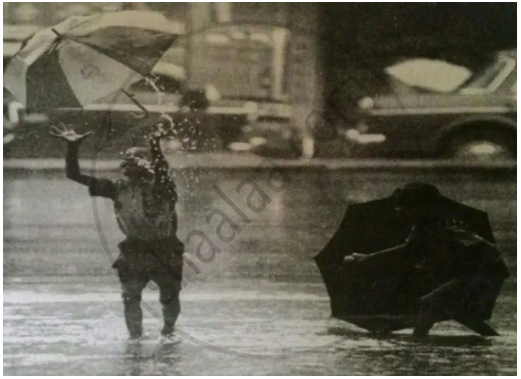

Read the passage given below and answer the questions (i), (ii) and (iii) that follow.

(1) “Can I see the Manager?” I said, and added solemnly, “Alone.” I don't know why I said “Alone.” “Certainly,” said the accountant and fetched him.  
(2) The Manager was a grave, calm man. I held my fifty-six dollars clutched in a crumpled ball in my pocket.
“Are you the Manager?” I asked. God knows I did not doubt it.
“Yes,” he said.
“Can I see you …. alone?” I asked.
5
(3) The Manager looked at me in some alarm. He felt that I had an awful secret to reveal.
“Come in here,” he said, and led the way to a private room. He turned the key in the lock.
“We are safe from interruption here,” he said; “Sit down.”
We both sat down and looked at each other. I found no voice to speak.
“You are one of Pinkerton’s men, I presume,” he said.
10


(4)

He had gathered from my mysterious manner that I was a detective. I knew what he was thinking, and it made me worse.
“No, not from Pinkerton’s,” I said, seeming to imply that I came from a rival agency. “To tell the truth,” I went on, as if I had been prompted to lie about it,
“I am not a detective at all. I have come to open an account. I intend to keep all my money in this bank.”
The Manager looked relieved but still serious; he concluded now that I was a son of Baron Rothschild or a young Gould.
“A large account, I suppose,” he said.
“Fairly large,” I whispered. “I propose to deposit fifty-six dollars now and fifty dollars a month regularly.”

15


20


25

(5) The Manager got up and opened the door. He called to the accountant.
“Mr. Montgomery,” he said unkindly loud, “this gentleman is opening an account, he will deposit fifty-six dollars. Good morning.”
I rose. A big iron door stood open at the side of the room.
“Good morning,” I said, and stepped into the safe. “Come out,” said the Manager coldly and showed me the other way.

30
(6) I went up to the accountant’s wicket and poked the ball of money at him with a quick convulsive movement as if I were doing a conjuring trick. My face was ghastly pale.
“Here,” I said, “deposit it.” The tone of the words seemed to mean, “Let us do this painful thing while the fit is on us.”
He took the money and gave it to another clerk.

35
(7) He made me write the sum on a slip and sign my name in a book. I no longer knew what I was doing. The bank swam before my eyes.
“Is it deposited?” I asked in a hollow, vibrating voice.
“It is,” said the accountant. “Then I want to draw a cheque.”
My idea was to draw out six dollars of it for present use. Someone gave me a chequebook through a wicket and someone else began telling me how to write it out. The people in the bank had the impression that I was an invalid millionaire. I wrote something on the cheque and thrust it in at the clerk. He looked at it.

40


45

(8) “What! Are you drawing it all out again?” he asked in surprise. Then I realised that I had written fifty-six instead of six. I was too far gone to reason now. I had a feeling that it was impossible to explain the thing. I had burned my boats. All the clerks had stopped writing to look at me. Reckless with misery, I made a plunge.
“Yes, the whole thing.”
“You withdraw all your money from the bank?” “Every cent of it.”
“Are you not going to deposit anymore?” said the clerk, astonished.
“Never.”


50


55

(9) An idiot hope struck me that they might think something had insulted me while I was writing the cheque and that I had changed my mind. I made a wretched attempt to look like a man with a fearfully quick temper.  
(10) The clerk prepared to pay the money.
“How will you have it?” he said. This question came as a bolt from the blue.
“What?”
“How will you have it?”
“Oh!”— I caught his meaning and answered without even trying to think— “in fifties.”
He gave me a fifty-dollar bill. “And the six?” he asked dryly.
“In sixes,” I said.
He gave it to me and I rushed out.
As the big door swung behind me. I caught the echo of a roar of laughter that went up to the ceiling of the bank. Since then, I bank no more. I keep my money in cash in my trousers pocket and my savings in silver dollars in a sock.

60


65


70

Adapted from: My Financial Career
By Stephen Leacock
 
    1. Find a single word from the passage that will exactly replace the underlined word or words in the following sentences.    [3]
      1. The kind stranger went and got back the ball from where it had rolled into the bush.
      2. I took offence at the expression on his face that was clearly meant to insinuate I was a liar.
      3. The firm experienced a financial loss when the contract went to a contender who had just entered the business.
    2. For each of the words given below, choose the correct sentence that uses the same word unchanged in spelling, but with a different meaning from that which it carries in the passage.   [3]
      1. alarm (line 8)
        1. The silence from the other end set off alarm bells in her head.
        2. The pallor of his skin alarmed those standing around.
        3. I set my alarm for six o’clock but slept through it.
        4. The sound of the approaching jets caused some alarm in the war room.
      2. wicket (line 44)
        1. The wicketkeeper was the true saviour of the day for that one match.
        2. The team wanted to bat while the wicket was still dry.
        3. The man at the window handed us our tickets through the wicket.
        4. The quick loss of wickets demoralised the team.
      3. reason (line 48)
        1. After the tragedy, his ability to reason is severely diminished.
        2. They reasoned they could get better seats if they arrived early.
        3. Recipients of funds were selected without rhyme or reason.
        4. We have every reason to celebrate.
  1. Answer the following questions as briefly as possible in your own words.
    1. With reference to the passage, explain the meaning of the expression of the ‘I had burned my boats?’   [2]
    2. Cite any two instances of the behaviour of the bank employees that indicate the insignificance of a deposit of fifty-six dollars.    [2]
    3. Why do you think the people in the bank thought of the narrator as an “invalid millionaire?”    [2]
  2. Summarise why the narrator decided ‘to bank no more’ (paragraphs 6 to 10). You are required to write the summary in the form of a connected passage in about 100 words. Failure to keep within the word limit will be penalised.    [8]

Share
Notifications

Englishहिंदीमराठी


      Forgot password?
Use app×