Advertisements
Advertisements
प्रश्न
How did the other Women react to Woman 5?
Advertisements
उत्तर
Woman 6 looks at the photos when woman 5 keeps explaining the location and incidents connected to that woman’s photo and looks at them without interest. Woman 1 could not look at the photos as she was worried about her husband Joe.
APPEARS IN
संबंधित प्रश्न
What are the poetic devices (figurative language) in the poem? How do they contribute to the meaning/how do they effect the poem?
What does Wordsworth compare himself to? Why?
Comment on the imagery used in the poem.
Anderson through the story a Little Match Girl gives an idea about the Victorian society of his times?
Fill in the blank with an appropriate word :
Sheila's grandmother found it difficult to climb __________ the steep staircase.
Fill in each of the numbered blanks with the correct form of the word given in brackets. Do not copy the passage, but write in correct serial order the word or phrase appropriate to the blank space.
Example:
(0) He had been (0) ……… (sit) on the bank of a small irrigation canal.
Answer: sitting
He was (1) ………. (gaze) at a couple of herons (2) ……… (fish) in the muddy water, when he (3) ……… (feel) something bumps his elbow. (4) ……… (look) around, he (5) ………. (find) at his side a little goat, jet black and soft as velvet with lovely grey eyes. Neither her owner nor her mother (6) ……… (be) around. She continued to (7) ……… (nudge) Mukesh, so he (8) ……… (look) in his pocket for nourishment.
Re-write the following sentence according to the instructions are given. Make other changes that may be necessary, but do not change the meaning of the sentence.
As soon as the function got over. The crowd dispersed.
(Begin: Hardly had……….)
What does the notice 'The world's most dangerous animal' at a cage in the zoo at Lusaka, Zambia, signify?
Give reasons for the following.
Satyajit's feeling that he was an impostor.
The person who makes mistake or commits crime should be punished because _________________.
- _______________________________
- _______________________________
- _______________________________
- _______________________________
Colours mentioned in the hexagons given below are associated with something or the other. Discuss with your partner and fill in the blanks.

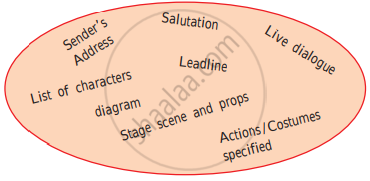
The diagram below encircles the various features that make the script of a skit/ play. List the other words and mention the form of writing of which it is a feature.
Do you have pet animals? Write an interesting story about your own or your friends' pet.
Have you ever eaten any fruit/vegetable picking it straight from the tree or field? Write about that experience in 3-5 lines.
Look around in your vicinity - your family, friends, neighbours, classmates, etc. and write about any four teenagers who have made a name for themselves by doing something extraordinary.
| Teenager Group | Name/s | Special/extraordinary tasks/things performed |
| 1. Family | ||
| 2. Friends | ||
| 3. Neighbours | ||
| 4. Classmates |
Draft Letter for the following
You are Sudha. Your neighbour has a pet dog that barks continuously. Write a letter to the Editor of a weekly newspaper of your locality, highlighting the nuisance and noise pollution created thus. Also, suggest ways to solve the problem.
Having an ice cream on a hot summer day is exciting and enjoyable.
Write about some of the exciting and enjoyable things that one can do in the winter season.
______ do you want for your birthday?
I got ______ to see his favourite heroine.
Here is a word, morning. Now write down words related to it.

Why didn’t the grandmother feel sentimental when the author went abroad for higher education?
Describe Mary Kom’s personal experiences during her first International Championship match from the time of selection to winning the medal.
Write conversation on the following situation.
Between a father and a son on choice of a career
In H.C. Anderson's story, what forces the Little Match Girl to go about selling matches on the street?
One cannot always get what one wants and sometimes it is for the best. Present your reflections on this statement.
Write a composition (in approximately 400-450 words) on the following subject:
A person should be judged by the way they treat their subordinates. Present your reflections on this statement.
Imagine someone has invited your family to a programme and you were the only person at home when the invitation was given orally.
Write a note (4-5 lines) to pass on the message to the other people in your family. Or, Write an imaginary conversation in which you pass on the message to your parents.
Write a composition (in approximately 400 – 450 words) on the following subject.
During the lunch break, a surprising sight unfolded as a monkey entered your school campus. Narrate your experience as you took charge and guided junior students to their classrooms ensuring their safety.
Write a composition (in approximately 400 – 450 words) on any one of the following subjects.
You become what you read. Present your reflections on this statement.
Using the given informal letter as a model, write a letter about the topic given below.
Write letter to your father asking permission to go on a educational tour.
