Advertisements
Advertisements
प्रश्न
Draw a neat labelled diagram.
Electrolysis
Advertisements
उत्तर

APPEARS IN
संबंधित प्रश्न
What is an alloy?
Why do we apply paint on iron articles?
What are alloys?
Explain how painting of an iron gate prevents it from rusting.
Choose the correct answer from the options given below:
Heating an ore in a limited supply of air or in the absence of air at a temperature just below its melting point is known as
A. Smelting
B. Ore-dressing
C. Calcination
D. Bessemerisation
What type of chemical reaction is involved in the corrosion of iron?
What is meant by galvanisation? Why is it done?
The corrosion of copper produces a ______ coating of basic copper carbonate on its surface.
Explain why, though aluminium is more reactive than iron, yet there is less corrosion of aluminium when both are exposed to air.
What is corrosion?
Name two metals which resist corrosion due to the formation of a thin, hard and impervious layer of oxide on their surface.
Explain why, the galvanised iron article is protected against rusting even if the zinc layer is broken.
If copper is kept exposed to damp air for a considerable time, it gets a green coating on its surface. This is due to the formation of ______.
Explain with reason:
Roasting is carried out on sulphide ores and not on carbonate ores.
Identify the process shown in the diagram and explain it in short

Answer the following question.
a) What is meant by corrosion?
b) Write names of any two methods of prevention of corrosion.
c) In which method, metal like copper, aluminium are coated with a thin layer of their oxides by means of electrolysis.
d) Explain this method with diagram.
Answer the following question.
List two properties of alloys.
Corrosion of silver causes a black layer of _______.
When one of the metals in an alloy is mercury the alloy is called _______.
Pressure cooker : Anodizing : : Silver plated spoons : _______
Rusting of iron : Fe2O3 : : corrosion of copper : ______
Find the odd one out and give its explanation.
Write the name.
Method used to present corrosion of copper.
Write scientific reason.
Coins are made from metals and alloys.
Observe the following diagram and give answers.
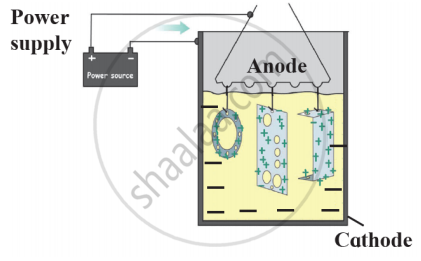
- Name this method of prevention of corrosion.
- For prevention of which metal this method is used?
- What is used as anode in this method?
Give solutions by giving examples of corrosion?
Amalgam is an alloy of ____________.
A man painted his main gate made up of iron, to
- prevent it from rusting.
- protect it from sun.
- make it look beautiful.
- make it dust free.
Which of the above statement(s) is/are correct?
Explain the following:
Bubbles are produced when acetic acid is added to a solution of sodium hydrogencarbonate.
Give an example of a chemical reaction for the following situation:
Sound is produced
Gold plated ornaments is the example of ______.
Give scientific reasons.
Silver amalgam is used for filling dental cavities.
Describe two changes that are harmful. Explain why you consider them harmful. How can you prevent them?
