The corrosion of copper produces a ______ coating of basic copper carbonate on its surface.
Advertisements
प्रश्न
The corrosion of copper produces a ______ coating of basic copper carbonate on its surface.
Advertisements
उत्तर
The corrosion of copper produces a green coating of basic copper carbonate on its surface.
Explanation:
When a copper object is exposed to moist air for a long time, it slowly reacts with oxygen, carbon dioxide, and water vapour. This oxidation process causes the shiny brown metal to corrode, producing a green layer on its surface commonly called a patina. This green substance is basic copper carbonate, which is a chemical mixture of copper hydroxide and copper carbonate [CuCO3 . Cu(OH)2].
APPEARS IN
संबंधित प्रश्न
Give two examples of alloys with their chemical composition.
Tinning : Tin : : Galvanizing : _________
Why do we apply paint on iron articles?
Explain the term corrosion.
What are alloys?
Two methods by which rusting of iron can be prevented are ______ and ______.
Name the metal which is used for galvanising iron.
Explain why, iron sheets are coated with zinc.
Tiffin boxes are electroplated with ______ but car bumpers are electroplated with ______ to protect them from rusting.
Explain why, though aluminium is more reactive than iron, yet there is less corrosion of aluminium when both are exposed to air.
Name any two metals which do not corrode easily.
Name two metals which resist corrosion due to the formation of a thin, hard and impervious layer of oxide on their surface.
Name an alloy of copper. State its chemical composition and any one use.
Explain why, the galvanised iron article is protected against rusting even if the zinc layer is broken.
A metal X which is resistant to corrosion is produced by the electrolysis of its molten oxide whereas another metal Y which is also resistant to corrosion is produced by the reduction of its oxide with carbon. Metal X can be used in powder form in thermite welding whereas metal Y is used in making cathodes of ordinary dry cells.
- Name the metals X and Y.
- Which of the two metals is more reactive: X or Y?
- Name one ore or metal X. Also write its chemical formula.
- Name one ore of metal Y. Also write its chemical formula.
- Name one alloy of metal X and one alloy of metal Y.
Mention two uses of the following metals and non-metals
Iron
Explain how the activity series accounts for each of the following:
tendency to corrosion
What is corrosion? What are necessary conditions for corrosion?
Observe the following picture a write down the chemical reaction with the explanation.
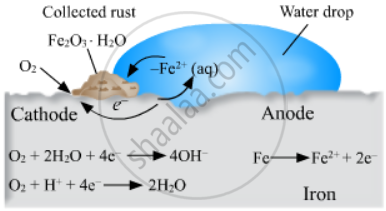
What is done to prevent corrosion of metals?
What is ‘rusting’?
Explain the term – rusting and give a word equation for the formation of rust. If polished iron nails are kept in three separate test tubes, state the contents in each test tube required, to prove the conditions for rusting.
Observe the following picture and answer the following questions:
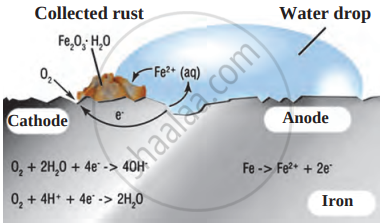
- What is rust?
- Write the chemical formula of rust.
- Write the reaction of oxidation of iron at the anode.
- Write the reaction of oxidation of iron at the cathode.
- What is corrosion?
Pressure cooker : Anodizing : : Silver plated spoons : _______
Find the correlation:
Bronze : ______ :: Tin : Cu+Zn.
Write the name.
An alloy of copper and tin-
Write scientific reason.
Anodization method is useful for prevention of the corrosion of the aluminium.
Complete flow chart given below.
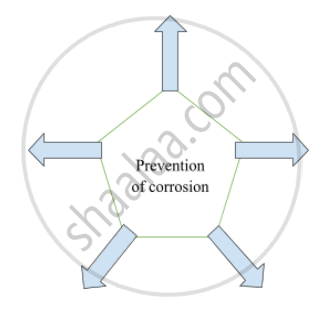
Write a molecular formula for rust.
Give solutions by giving examples of corrosion?
Galvanisation is a method of protecting iron from rusting by coating it with a thin layer of ____________.
Amalgam is an alloy of ____________.
Copper objects lose their shine and form green coating of ____________.
The diagram shows the reaction between metal and dil. acid.

What is the reason for different behaviour of Mg in test tube B?
The table shown below gives information about four substances: A, B, C and D.
| SUBSTANCE | MELTING POINT (K) | ELECTRICAL CONDUCTIVITY | |
| SOLID | LIQUID/ AQUEOUS | ||
| A | 295 | Good | Good |
| B | 1210 | Poor | Good |
| C | 1890 | Poor | Good |
| D | 1160 | Poor | Poor |
Identify Ionic compounds from the above given substances.
Marble’s popularity began in ancient Rome and Greece, where white and off-white marble were used to construct a variety of structures, from hand-held sculptures to massive pillars and buildings.

The substance not likely to contain CaCO3 is:
A man painted his main gate made up of iron, to
- prevent it from rusting.
- protect it from sun.
- make it look beautiful.
- make it dust free.
Which of the above statement(s) is/are correct?
Give an example of a chemical reaction for the following situation:
Sound is produced
Describe two changes that are harmful. Explain why you consider them harmful. How can you prevent them?
