Advertisements
Advertisements
प्रश्न
Explain why, though aluminium is more reactive than iron, yet there is less corrosion of aluminium when both are exposed to air.
Advertisements
उत्तर
Aluminium is more reactive than iron and quickly reacts with oxygen to form a thin layer of aluminium oxide (Al2O3) on its surface. This oxide layer is non-porous, tough, and tightly adheres to the metal, acting as a barrier that prevents further air and moisture from penetrating deeper.
On the other hand, when iron reacts with moist air, it forms a porous, flaky layer of iron oxide (rust). This layer crumbles and falls off easily, continuously exposing the fresh iron beneath to the environment and allowing corrosion to propagate throughout the metal. Thus, aluminium effectively protects itself from ongoing corrosion, while iron does not.
APPEARS IN
संबंधित प्रश्न
Name any three objects (or structures) which are gradually damaged by the corrosion of iron and steel.
The corrosion of iron is called ______.
The process of depositing a thin layer of zinc on iron articles is called ______.
Explain why, the galvanised iron article is protected against rusting even if the zinc layer is broken.
Name a common metal which is highly resistant to corrosion.
Brass is an alloy of ______.
State under what conditions corrosion is faster ?
No chemical reaction takes place when granules of a solid, A, are mixed with the powder of another solid, B. However when the mixture is heated, a reaction takes place between its components. One of the products, C, is a metal and settles down in the molten state while the other product, D, floats over it. It was observed that the reaction is highly exothermic.
(i) Based on the given information make an assumption about A and B and write a chemical equation for the chemical reaction indicating the conditions of reaction, physical state of reactants and products and thermal status of reaction.
(ii) Mention any two types of reactions under which above chemical reaction can be classified.
What are the adverse effects of corrosion?
Give a reason why rust turns moist red litmus blue.
Find the odd one out and give its explanation.
Write scientific reason.
Coins are made from metals and alloys.
Draw a neat labelled diagram.
Electrolysis
Observe the following diagram and write answers.
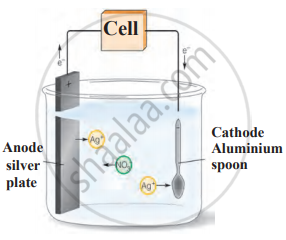
- Name the method.
- Explain the method.
- Give two examples of this method.
Give solutions by giving examples of corrosion?
The diagram shows the reaction between metal and dil. acid.

What is the reason for different behaviour of Mg in test tube B?
Identify the correct statement from the following:
Generally, when metals are treated with mineral acids, hydrogen gas is liberated but when metals (except Mn and Mg), treated with HNO3, hydrogen is not liberated, why?
Describe two changes that are harmful. Explain why you consider them harmful. How can you prevent them?
