Advertisements
Advertisements
प्रश्न
Name two metals which resist corrosion due to the formation of a thin, hard and impervious layer of oxide on their surface.
Advertisements
उत्तर
- Aluminium
- Zinc
APPEARS IN
संबंधित प्रश्न
What is an alloy?
Why do we apply paint on iron articles?
Explain how painting of an iron gate prevents it from rusting.
Name any three objects (or structures) which are gradually damaged by the corrosion of iron and steel.
The chemical reaction involved in the corrosion of iron metal is that of ______.
The process of depositing a thin layer of zinc on iron articles is called ______.
What is corrosion?
Give the constituents of brass.
What are the special properties of stainless steel?
A common metal which is highly resistant to corrosion is ______.
A metal X which is resistant to corrosion is produced by the electrolysis of its molten oxide whereas another metal Y which is also resistant to corrosion is produced by the reduction of its oxide with carbon. Metal X can be used in powder form in thermite welding whereas metal Y is used in making cathodes of ordinary dry cells.
- Name the metals X and Y.
- Which of the two metals is more reactive: X or Y?
- Name one ore or metal X. Also write its chemical formula.
- Name one ore of metal Y. Also write its chemical formula.
- Name one alloy of metal X and one alloy of metal Y.
What is corrosion? What are necessary conditions for corrosion?
What is done to prevent corrosion of metals?
Answer the following question.
List two properties of alloys.
Observe the following picture and answer the following questions:
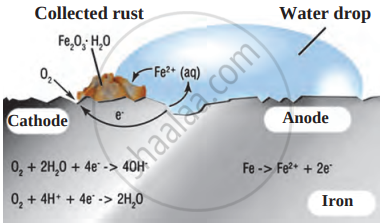
- What is rust?
- Write the chemical formula of rust.
- Write the reaction of oxidation of iron at the anode.
- Write the reaction of oxidation of iron at the cathode.
- What is corrosion?
Observe the following diagram and write answers.
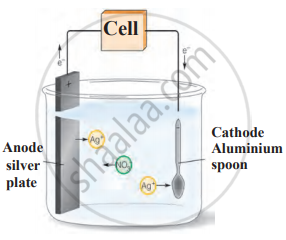
- Name the method.
- Explain the method.
- Give two examples of this method.
Which among the following alloys contain mercury as one of its constituents?
The table shown below gives information about four substances: A, B, C and D.
| SUBSTANCE | MELTING POINT (K) | ELECTRICAL CONDUCTIVITY | |
| SOLID | LIQUID/ AQUEOUS | ||
| A | 295 | Good | Good |
| B | 1210 | Poor | Good |
| C | 1890 | Poor | Good |
| D | 1160 | Poor | Poor |
Identify Ionic compounds from the above given substances.
Iron pillar near the Qutub Minar in Delhi is famous for the following facts. Which of these facts is responsible for its long stability?
