Advertisements
Advertisements
प्रश्न
Give solutions by giving examples of corrosion?
Advertisements
उत्तर
Corrosion can be prevented by the following methods:
- Galvanising: Galvanising is a process of giving a thin coating of zinc on iron or steel materials to protect them from corrosion. Zinc, being more electropositive than iron, undergoes corrosion first. Thus, it prevents corrosion of iron. However, if the zinc layer goes away and the inner iron gets exposed, then the inner iron layer will start to rust.
- Tinning: Tinning is the process of giving a coating of tin over other metals. Cooking vessels, made of copper and brass, get a greenish coating due to corrosion. This greenish coating is poisonous. If food is kept in such a vessel, it gets spoilt. Therefore, copper and brass vessels are coated with tin (kalhai) to prevent corrosion.
- Anodising: The process of coating metals such as aluminium and copper with a thin and strong layer of their oxides by electrolysis is called the anodising process. For this, the copper or aluminium article is used as the anode. As this oxide layer is strong and uniform all over the surface, it is useful for the prevention of the corrosion of the metal.
- Electroplating: Electroplating is the process in which a less reactive metal is coated on a more reactive metal by electrolysis. It protects the object made of reactive metal from corrosion. For example, silver-plated spoons, gold-plated ornaments, etc.
- Alloying: The homogenous mixture formed by mixing metal with other metals or nonmetals in a certain proportion is called an alloy. Alloying helps to decrease the intensity of corrosion of metals. For example, stainless steel does not get stains with air or water and also does not rust. It is an alloy made from 74% iron, 18% chromium and 8% carbon.
APPEARS IN
संबंधित प्रश्न
Write two methods of preventing the rusting of iron.
Why do we apply paint on iron articles?
Two methods by which rusting of iron can be prevented are ______ and ______.
Choose the correct answer from the options given below:
Heating an ore in a limited supply of air or in the absence of air at a temperature just below its melting point is known as
A. Smelting
B. Ore-dressing
C. Calcination
D. Bessemerisation
What is anodising? Give its applications.
Explain the term “corrosion” with an example. Write a chemical equation to show the process of corrosion of iron.
What special name is given to the corrosion of iron?
Name the metal which is used for galvanising iron.
The process of depositing a thin layer of zinc on iron articles is called ______.
Give the constituents of brass.
Name five methods of preventing rusting of iron.
Explain why, the galvanised iron article is protected against rusting even if the zinc layer is broken.
No chemical reaction takes place when granules of a rusty-brown solid A are mixed with the powder of another solid B. However, when the mixture is heated, a reaction takes place between its components. One of the products C is a metal and settles down in the molten state while the other product D floats over it. It was observed that the reaction is highly exothermic.
- What could the solids A and B be?
- What are the products C and D most likely to be?
- Write the chemical equation for the reaction between A and B leading to the formation of C and D. Mention the physical states of all the reactants and products in this equation and indicate the heat change which takes place.
- What is the special name of such a reaction? State one use of such a reaction.
- Name any two types of chemical reactions under which the above reaction can be classified.
Four metals P, Q, R and S are all obtained by the reduction of their oxides with carbon. Metal P is used to form a thin layer over the sheets of metal S to prevent its corrosion. Metal Q is used for electroplating tiffin boxes made of metal S whereas metal R is used in making car batteries. Metals Q and R form an alloy called solder. What are metals P, Q, R and S? How have you arrived at this conclusion?
Compare roasting and calcination.
Explain with reason:
Roasting is carried out on sulphide ores and not on carbonate ores.
Observe the following picture a write down the chemical reaction with the explanation.
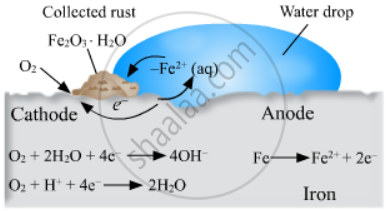
Complete the process of iron rusting by filling the blanks. Suggest a way to prohibit the process.
The iron rust is formed due to........................... reaction. Different
regions on iron surface become anode and cathode.
Reaction on anode region :
`F_e(s) → Fe^(2+) (aq) +2e^-`
Reaction on anode region :
`O_2(g) + 4H^+(aq) +............................ → 2H_2 O (l) `
When Fe2+ ions migrate from anode region they react with ................... to form Fe3+ ions.
A reddish coloured hydrated oxide is formed from ............... ions. It is called rust.
`2Fe_(3+) (aq) + 4H_2O(l) → ................. + 6H_+(aq) `
A way to prevent rusting ..................................................................
Answer the following question.
a) What is meant by corrosion?
b) Write names of any two methods of prevention of corrosion.
c) In which method, metal like copper, aluminium are coated with a thin layer of their oxides by means of electrolysis.
d) Explain this method with diagram.
Find the odd man out:
Answer the following question:
What is corrosion? Do gold ornaments corrode? Justify.
What is ‘rusting’?
Which of the following method is used to prevent the accumulation of greenish layer on brass due to corrosion?
Corrosion of silver causes a black layer of _______.
To prevent corrosion of iron and steel _______ method is used.
Rusting of iron : Fe2O3 : : corrosion of copper : ______
Find the odd one out and give its explanation.
Draw a neat labelled diagram.
Electrolysis
Amalgam is an alloy of ____________.
Alloys are homogeneous mixtures of a metal with a metal or non-metal. Which among the following alloys contain non-metal as one of its constituents?
Explain the following:
Bubbles are produced when acetic acid is added to a solution of sodium hydrogencarbonate.
Gold plated ornaments is the example of ______.
| A process of forming a thick oxide of aluminium when aluminium is exposed to air. This coat makes it resistant to corrosion. Resistance can be improved by making a layer of oxide thinker. In this technique, the aluminium article is the anode, and the electrolyte is sulphuric acid. The anode reaction results in the formation of a black-coloured film of aluminium oxide on the anode. By putting appropriate dyes in the electrolytic solution, both coloured surface with the decorative finish is achieved. Kitchen articles like anodised such as pressure cookers, pans and frames of sliding windows are applications of this technique. |
- Name the anode and electrolyte used in this technique.
- How can we make aluminium articles made resistant to corrosion?
- Name the technique used to coat the aluminium articles.
In ______ process a layer of molten tin is deposited on metals.
Describe two changes that are harmful. Explain why you consider them harmful. How can you prevent them?
