Advertisements
Advertisements
प्रश्न
Give solutions by giving examples of corrosion?
Advertisements
उत्तर
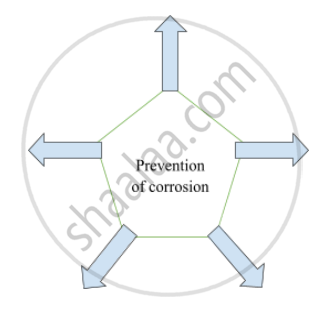
Corrosion can be prevented by the following methods:
- Galvanising: Galvanising is a process of giving a thin coating of zinc on iron or steel materials to protect them from corrosion. Zinc, being more electropositive than iron, undergoes corrosion first. Thus, it prevents corrosion of iron. However, if the zinc layer goes away and the inner iron gets exposed, then the inner iron layer will start to rust.
- Tinning: Tinning is the process of giving a coating of tin over other metals. Cooking vessels, made of copper and brass, get a greenish coating due to corrosion. This greenish coating is poisonous. If food is kept in such a vessel, it gets spoilt. Therefore, copper and brass vessels are coated with tin (kalhai) to prevent corrosion.
- Anodising: The process of coating metals such as aluminium and copper with a thin and strong layer of their oxides by electrolysis is called the anodising process. For this, the copper or aluminium article is used as the anode. As this oxide layer is strong and uniform all over the surface, it is useful for the prevention of the corrosion of the metal.
- Electroplating: Electroplating is the process in which a less reactive metal is coated on a more reactive metal by electrolysis. It protects the object made of reactive metal from corrosion. For example, silver-plated spoons, gold-plated ornaments, etc.
- Alloying: The homogenous mixture formed by mixing metal with other metals or nonmetals in a certain proportion is called an alloy. Alloying helps to decrease the intensity of corrosion of metals. For example, stainless steel does not get stains with air or water and also does not rust. It is an alloy made from 74% iron, 18% chromium and 8% carbon.
APPEARS IN
संबंधित प्रश्न
What is an alloy?
Give two examples of alloys with their chemical composition.
Explain the term corrosion.
Explain why rusting of iron objects is faster in coastal areas than in deserts.
What type of chemical reaction is involved in the corrosion of iron?
Name any three objects (or structures) which are gradually damaged by the corrosion of iron and steel.
The corrosion of iron is called ______.
The corrosion of copper produces a ______ coating of basic copper carbonate on its surface.
______ and ______ are necessary for the rusting of iron.
Explain why, though aluminium is more reactive than iron, yet there is less corrosion of aluminium when both are exposed to air.
What are the constituents of stainless steel?
Explain why, when a copper object remains in damp air for a considerable time, a green coating is formed on its surface. What is this process known as?
Brass is an alloy of ______.
Bronze is an alloy of ______.
What is corrosion? What are necessary conditions for corrosion?
State under what conditions corrosion is faster ?
Answer the following question.
a) What is meant by corrosion?
b) Write names of any two methods of prevention of corrosion.
c) In which method, metal like copper, aluminium are coated with a thin layer of their oxides by means of electrolysis.
d) Explain this method with diagram.
What is done to prevent corrosion of metals?
Give reason.
An iron article should be given a coat of paint
Give reason.
Copper and brass utensils should be tinned.
Give a reason why rust turns moist red litmus blue.
To prevent corrosion of iron and steel _______ method is used.
Rusting of iron : Fe2O3 : : corrosion of copper : ______
Find the odd one out and give its explanation.
Explain concept with example/explain with the help of a balanced equation.
Corrosion
Draw a neat labelled diagram.
Electrolysis
Draw a neat labelled diagram.
Anodizing
Complete flow chart given below.
Observe the following figure and write the answer of the question.
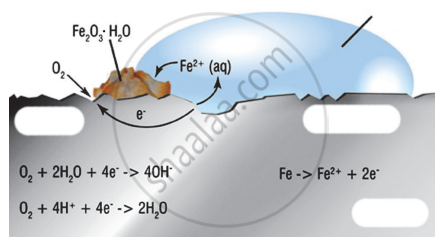
- Which process is shown in the figure?
- Explain the chemical reaction shown in the figure.
- Write the reactions on anode and cathode.
State two conditions necessary for rusting of iron.
Galvanisation is a method of protecting iron from rusting by coating it with a thin layer of ____________.
The diagram shows the reaction between metal and dil. acid.

What is the reason for different behaviour of Mg in test tube B?
Identify the correct statement from the following:
Iron pillar near the Qutub Minar in Delhi is famous for the following facts. Which of these facts is responsible for its long stability?
Explain the following:
Lime water turns milky on passing carbon dioxide gas into it.
Gold plated ornaments is the example of ______.
Give scientific reasons.
Silver amalgam is used for filling dental cavities.
