Advertisements
Advertisements
प्रश्न
Explain why, when a copper object remains in damp air for a considerable time, a green coating is formed on its surface. What is this process known as?
Advertisements
उत्तर
When a copper object remains in damp air for a long time, it reacts slowly with oxygen, carbon dioxide, and water vapour present in the air to form a green coating of basic copper carbonate (CuCO3.Cu(OH)2) on the outside of the object. This process is known as corrosion. Copper is very low in its reactivity; therefore, corrosion of copper also occurs slowly.
APPEARS IN
संबंधित प्रश्न
What is an alloy?
Tinning : Tin : : Galvanizing : _________
Why do we apply paint on iron articles?
Which metals do not corrode easily?
Explain why rusting of iron objects is faster in coastal areas than in deserts.
Name the metal which is used for galvanising iron.
The process of depositing a thin layer of zinc on iron articles is called ______.
Why is an iron grill painted frequently?
What is the corrosion of iron known as?
With the help of labelled diagrams, describe an activity to find out the conditions under which iron rusts.
Name a common metal which is highly resistant to corrosion.
Name the metal which is a constituent of blood pigment?
Choose the correct alternative and rewrite the following:
Iron is _____________________.
Explain the term – rusting and give a word equation for the formation of rust. If polished iron nails are kept in three separate test tubes, state the contents in each test tube required, to prove the conditions for rusting.
Write a short note on Alloying.
Observe the following picture and answer the following questions:
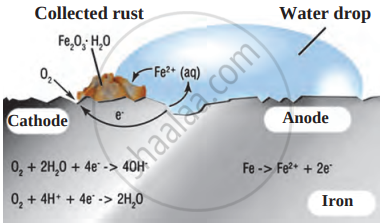
- What is rust?
- Write the chemical formula of rust.
- Write the reaction of oxidation of iron at the anode.
- Write the reaction of oxidation of iron at the cathode.
- What is corrosion?
Which of the following method is used to prevent the accumulation of greenish layer on brass due to corrosion?
State two conditions necessary for rusting of iron.
The table shown below gives information about four substances: A, B, C and D.
| SUBSTANCE | MELTING POINT (K) | ELECTRICAL CONDUCTIVITY | |
| SOLID | LIQUID/ AQUEOUS | ||
| A | 295 | Good | Good |
| B | 1210 | Poor | Good |
| C | 1890 | Poor | Good |
| D | 1160 | Poor | Poor |
Identify Ionic compounds from the above given substances.
Explain the following:
Bubbles are produced when acetic acid is added to a solution of sodium hydrogencarbonate.
