The process of depositing a thin layer of zinc on iron articles is called ______.
Advertisements
प्रश्न
The process of depositing a thin layer of zinc on iron articles is called ______.
Advertisements
उत्तर
The process of depositing a thin layer of zinc on iron articles is called galvanisation.
Explanation:
The galvanisation process involves dipping clean iron or steel articles into molten zinc to create a protective barrier coating. The zinc layer prevents rust by shielding the underlying iron from oxygen and moisture in the environment. Even if the zinc coating is scratched, it will corrode first to sacrificially protect the iron.
APPEARS IN
संबंधित प्रश्न
Which of the following methods is suitable for preventing an iron frying pan from rusting?
Give reasons:
Platinum, gold and silver are used to make jewellery.
The chemical reaction involved in the corrosion of iron metal is that of ______.
The corrosion of iron is called ______.
Name any two metals which do not corrode easily.
What is the corrosion of iron known as?
Name two metals which resist corrosion due to the formation of a thin, hard and impervious layer of oxide on their surface.
Explain why, the galvanised iron article is protected against rusting even if the zinc layer is broken.
In stainless steel alloy, iron metal is mixed with ______.
No chemical reaction takes place when granules of a rusty-brown solid A are mixed with the powder of another solid B. However, when the mixture is heated, a reaction takes place between its components. One of the products C is a metal and settles down in the molten state while the other product D floats over it. It was observed that the reaction is highly exothermic.
- What could the solids A and B be?
- What are the products C and D most likely to be?
- Write the chemical equation for the reaction between A and B leading to the formation of C and D. Mention the physical states of all the reactants and products in this equation and indicate the heat change which takes place.
- What is the special name of such a reaction? State one use of such a reaction.
- Name any two types of chemical reactions under which the above reaction can be classified.
Explain how the activity series accounts for each of the following:
tendency to corrosion
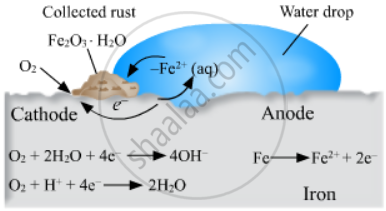
Observe the following picture a write down the chemical reaction with the explanation.
Find the odd man out:
What are the adverse effects of corrosion?
Choose the correct alternative and rewrite the following:
Iron is _____________________.
Answer the following question:
What is corrosion? Do gold ornaments corrode? Justify.
Which of the following method is used to prevent the accumulation of greenish layer on brass due to corrosion?
Match the columns.
| Group A | Group B |
| 1) Electroplating | a) Pressure cooker |
| 2) Anodising | b) Silver plated spoons |
| c) Coating of tin on copper | |
| d) Coating of Zinc on iron |
Write the name.
An alloy of copper and tin-
Explain concept with example/explain with the help of a balanced equation.
Corrosion
Observe the following figure and write the answer of the question.
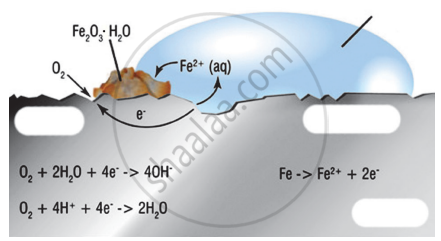
- Which process is shown in the figure?
- Explain the chemical reaction shown in the figure.
- Write the reactions on anode and cathode.
State two conditions necessary for rusting of iron.
Galvanisation is a method of protecting iron from rusting by coating it with a thin layer of ____________.
Alloys are homogeneous mixtures of a metal with a metal or non-metal. Which among the following alloys contain non-metal as one of its constituents?
A man painted his main gate made up of iron, to
- prevent it from rusting.
- protect it from sun.
- make it look beautiful.
- make it dust free.
Which of the above statement(s) is/are correct?
Galvanisation is a process used to prevent the rusting of which of the following?
State whether the following statement is true or false:
Ships suffer a lot of damage though they are painted.
Explain the following:
Lime water turns milky on passing carbon dioxide gas into it.
Give an example of a chemical reaction for the following situation:
Sound is produced
| A process of forming a thick oxide of aluminium when aluminium is exposed to air. This coat makes it resistant to corrosion. Resistance can be improved by making a layer of oxide thinker. In this technique, the aluminium article is the anode, and the electrolyte is sulphuric acid. The anode reaction results in the formation of a black-coloured film of aluminium oxide on the anode. By putting appropriate dyes in the electrolytic solution, both coloured surface with the decorative finish is achieved. Kitchen articles like anodised such as pressure cookers, pans and frames of sliding windows are applications of this technique. |
- Name the anode and electrolyte used in this technique.
- How can we make aluminium articles made resistant to corrosion?
- Name the technique used to coat the aluminium articles.
In ______ process a layer of molten tin is deposited on metals.
Describe two changes that are harmful. Explain why you consider them harmful. How can you prevent them?
