Advertisements
Advertisements
प्रश्न
What is meant by galvanisation? Why is it done?
Advertisements
उत्तर
Galvanisation is a process in which a thin layer of zinc metal is deposited on iron objects. This is done to prevent iron from rusting by protecting it from contact with air and moisture. Zinc metal, being more reactive, reacts with air to form a hard layer of zinc oxide, which prevents air from passing through it.
APPEARS IN
संबंधित प्रश्न
Explain why rusting of iron objects is faster in coastal areas than in deserts.
Name any three objects (or structures) which are gradually damaged by the corrosion of iron and steel.
State two conditions for the rusting of iron.
Tiffin boxes are electroplated with ______ but car bumpers are electroplated with ______ to protect them from rusting.
______ and ______ are necessary for the rusting of iron.
Name two metals which resist corrosion due to the formation of a thin, hard and impervious layer of oxide on their surface.
Name five methods of preventing rusting of iron.
Name an alloy of copper. State its chemical composition and any one use.
State under what conditions corrosion is faster ?
Choose the correct alternative and rewrite the following:
Iron is _____________________.
Give a reason why rust turns moist red litmus blue.
Rusting of iron : Fe2O3 : : corrosion of copper : ______
Match the columns.
| Group A | Group B |
| 1) Electroplating | a) Pressure cooker |
| 2) Anodising | b) Silver plated spoons |
| c) Coating of tin on copper | |
| d) Coating of Zinc on iron |
Write scientific reason.
Coins are made from metals and alloys.
Draw a neat labelled diagram.
Anodizing
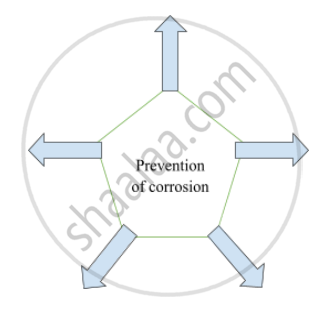
Complete flow chart given below.
Observe the following diagram and write answers.
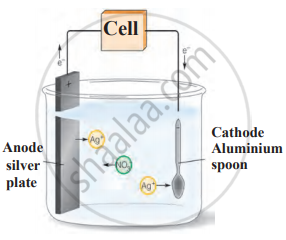
- Name the method.
- Explain the method.
- Give two examples of this method.
Give solutions by giving examples of corrosion?
The table shown below gives information about four substances: A, B, C and D.
| SUBSTANCE | MELTING POINT (K) | ELECTRICAL CONDUCTIVITY | |
| SOLID | LIQUID/ AQUEOUS | ||
| A | 295 | Good | Good |
| B | 1210 | Poor | Good |
| C | 1890 | Poor | Good |
| D | 1160 | Poor | Poor |
Identify Ionic compounds from the above given substances.
| A process of forming a thick oxide of aluminium when aluminium is exposed to air. This coat makes it resistant to corrosion. Resistance can be improved by making a layer of oxide thinker. In this technique, the aluminium article is the anode, and the electrolyte is sulphuric acid. The anode reaction results in the formation of a black-coloured film of aluminium oxide on the anode. By putting appropriate dyes in the electrolytic solution, both coloured surface with the decorative finish is achieved. Kitchen articles like anodised such as pressure cookers, pans and frames of sliding windows are applications of this technique. |
- Name the anode and electrolyte used in this technique.
- How can we make aluminium articles made resistant to corrosion?
- Name the technique used to coat the aluminium articles.
