Topics
The Living World: Adaptations and Classification
- Adaptations of Plants
- Adaptation in Aquatic Plants (Hydrophytes)
- Adaptation in Desert Plants (Xerophytes)
- Adaptation in plants of snowy regions
- Adaptation in Forest Plants
- Adaptation in Grassland Plants (Mesophytes)
- Adaptation for Ingestion of Food in Plants
- Adaptation in Animals
- Adaptation in Aquatic Animals
- Adaptation in Forest and Grassland Animals
- Adaptation in Desert Animals
- Adaptation in animals of snowy regions
- Adaptation in Aerial Animals
- Adaptation in Reptiles
- Adaptation for Food in Animals
- Adaptation for Blending with the Surroundings
- Classification of Living Organisms
- Taxonomic Hierarchy of Living Organisms: Unit of Classification
- Nomenclature
Plants: Structure and Function
Properties of Natural Resources
Nutrition in Living Organisms
- Nutrients and Nutrition
- Autotrophic Plants
- Symbiotic Plants
- Heterotrophic Plants
- Insectivorous Plants
- Saprophytic Plants
- Role of nutrients and effects of their deficiency on plants
- Transport System in Plants
- Nitrogen Fixation
- Nutrition in Animals
- Mode of Nutrition in Animals
- Holozoic Nutrition
- Saprozoic Nutrition
- Parasitic Nutrition
Food Safety
Measurement of Physical Quantities
Motion, Force and Work
Static Electricity
Heat
Disaster Management
Cell Structure and Micro-organisms
- Cell: Structural and Functional Unit of Life
- Measurement and observation of cells
- Plant Cell Vs Animal Cell
- Endoplasmic Reticulum (ER)
- Golgi Apparatus - "The delivery system of the cell"
- Lysosome - “Suicidal Bag”
- Mitochondria - “Power House of the Cell”
- Non-living Substances Or Cell Inclusion
- Plastids
- Microorganisms (Microbes) and Microbiology
- Useful micro-organisms
- Harmful Microorganisms
- Microbial Pathogenesis and Portals of Entry
The Muscular System and Digestive System in Human Beings
- Muscular System
- Muscles and Its Types
- Human Digestive System
- The Mouth and Buccal Cavity
- The Teeth and Its Structure
- The Salivary Glands
- The Food Pipe/Oesophagus
- Pharynx/Throat
- The Stomach
- The Small Intestine
- Pancreas (Islets of Langerhans)
- Human Digestive System
- The Large Intestine
- Important Glands of the Digestive System
- Effects of Tobacco, Alcohol, Smoking, on the Digestive System
Changes – Physical and Chemical
- Changes-Physical and Chemical
- Classification of Change: Natural and Man-made Changes
- Classification of Change: Harmful and Useful Changes
- Classification of Change: Slow and Fast Changes
- Classification of Change: Reversible and Irreversible Changes
- Classification of Change: Periodic and Non-periodic Changes
- Classification of Change: Physical Changes
- Classification of Change: Chemical Changes
- Corrosion of Metals
Elements, Compounds and Mixtures
Materials We Use
Natural Resources
Effects of Light
Sound : Production of Sound
Properties of a Magnetic Field
In the World of Stars
- Introduction
- Causes of Effects
- Prevention and Safety
Maharashtra State Board: Class 7
Introduction:
A tsunami is a large sea wave caused by earthquakes or volcanic eruptions under the ocean floor. The energy from these events pushes water upwards, creating waves. These waves travel at a high speed of 800 to 900 km/h and become very tall (up to 30 meters) when they reach the coast. Such a wave, generated by an earthquake or volcano occurring on the ocean floor, is called a ‘tsunami’. ‘Tsunami’ is a Japanese word that means ‘harbour wave.’
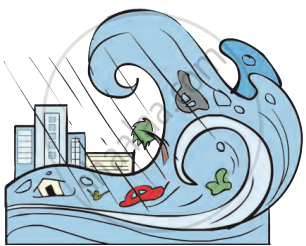
Tsunami
Maharashtra State Board: Class 7
Causes of Effects
Causes:
- Earthquakes under the ocean.
- Volcanic eruptions on the sea floor.
- Energy release pushes water upward, forming fast-moving waves.
Effects:
- Buildings and structures are destroyed.
- Loss of life and financial loss occur.
- Boats and ships near the coast are damaged.
- Trees are uprooted and landslides take place.
- Coastal areas become swamps due to land changes.
- Traffic disruptions and loss of businesses occur.
- Harbours are severely damaged.
Maharashtra State Board: Class 7
Prevention and Safety:
- Monitor earthquakes under the ocean to predict tsunami waves.
- Geostationary satellites are used to track and provide warnings.
- Warnings allow people in coastal areas to evacuate early and reduce loss of life.
