Topics
Matter
- Matter (Substance)
- Composition of Matter
- Characteristics of Particles (Molecules) of Matter
- States of Matter
- The Solid State
- The Liquid State
- The Gaseous State
- Change of State
- Concept of Melting (Fusion)
- Vaporisation or Boiling
Physical Quantities and Measurement
- Measurements
- Unit and Its Types
- Unit Systems
- Physical Quantities
- Rules and Conventions for Writing SI Units and Their Symbols
- The International System of Units (SI)
- Unit Prefixes
- Measurement of Length
- Devices for Measuring Length
- Measurement of Mass
- Devices for Measuring Mass
- Measurement of Time
- Devices for Measuring Time
- The Temperature and a Thermometer
- Measuring Temperature
- Area and It’s Unit
- Measurement of Area
Force
- Force - Push or Pull
- Effect of Force
- Types of Forces>Contact and Non-Contact Forces
- Force of Friction
- Effects of Friction
- Types of Friction>Rolling Friction
- Increasing and Reducing Friction
Simple Machines
- Concept of Work
- Concept of Energy
- Concept of Machines
- Principle of a Machine
- Efficiency of a Machine
- Simple Machines
- Mechanical Advantage
- Levers
- Types of Levers
- Pulley
- A Wheel and Axle
- An Inclined Plane
- A Wedge
- Screw
- Care of Machines
- Machines (Numerical)
Light
Magnetism
- Discovery of Magnets
- Classification of Magnets
- Magnetic and Non-magnetic Materials
- Magnet
- Magnetic Properties of Materials
- Concept of Magnetic Field
- Concept of Magnetism
- Making a Magnet
- Electromagnet
- Making of an Electromagnet
- Uses of Electromagnet
- Care and Storage of Magnets
- Demagnetization of a Magnet
- Introduction
- Activity
- Experiment
Introduction:
A shadow is formed when an opaque object blocks the path of light, preventing it from reaching a surface behind the object. This creates a dark area, called the shadow, which has the shape of the object blocking the light. The size and shape of the shadow depend on the position and distance between the light source, the object, and the surface where the shadow is cast. Shadows are longer when the light source is at a low angle (like in the morning or evening) and shorter when the light is directly overhead (like in the afternoon).

Formation of a shadow
Activity
Understanding Shadows and Their Changes
- Darken the room and shine a torchlight onto a wall.
- Ask a friend to stand between the torch and the wall.
- Observe the shadow forming on the wall behind them—this is where the light is blocked.
Actions and Observations:
- Move closer to the wall → The shadow becomes smaller.
- Move closer to the torch → The shadow becomes larger.
- Move the torch up, down, left, or right → The shape of the shadow changes.
- Change the distances between the torch, the object, and the wall → The shadow size also changes.

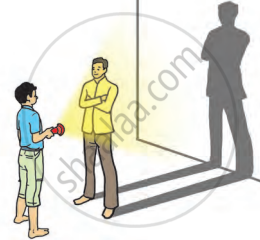
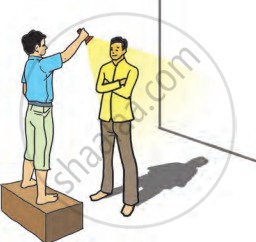
Conclusion:
A shadow is formed when an opaque object blocks light. The size and shape of the shadow depend on the distances between the light source, object, and surface. Closer to the light source = larger shadow, while closer to the surface = smaller shadow.
Experiment
1. Aim: To observe how shadows form with a point source and an extended light source and understand the difference between umbra and penumbra.
2. Requirements: A candle or torch (light source), cardboard with a pinhole (O), a screen, a big ball and a small ball, and string for hanging the ball.
3. Procedure
I. Point Source Setup
- Place a light source (candle or torch) behind the cardboard with a pinhole to create a point source of light.
- Hang the big ball between the cardboard and the screen placed 1 meter away. Observe the shadow (AB) of the ball on the screen.
- Result: The shadow is completely dark between points A and B (this is the umbra).

Shadow formed by a point source
II. Extended Source Setup
Remove the cardboard with the pinhole, making the light an extended source. Observe the shadow of the ball on the screen.
Result: Two parts appear in the shadow.
- Umbra (AD): Dark centre part.
- Penumbra (BC): Faint outer part.
Changing Shadow Size:
- Keep the extended light source and move the screen farther from the ball.
- Result: The umbra and penumbra increase in size.
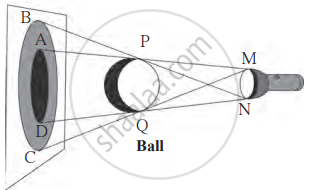
Shadow formed by an extended source
III. Using a Smaller Ball
Replace the big ball with a smaller ball. Observe its shadow on the screen.
- Result: Both the umbra and penumbra are visible.
Move the screen farther from the ball and observe.
- Result: The umbra shrinks and eventually disappears as the screen is moved farther away.
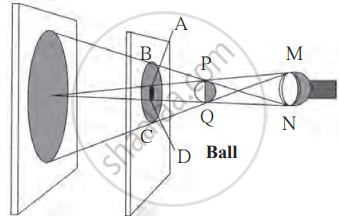
Shadow of a small object formed by an extended source
4. Conclusion: This experiment shows the formation of two types of shadows.
- Umbra: The dark part of the shadow where no light reaches.
- Penumbra: The lighter part where some light is blocked but not all.
With an extended source, both the umbra and penumbra are visible, and their size changes based on the distance between the objects.

