Topics
The Leaf
Plant Life
Unit 1 : Plant Life
The Leaf
- Root
- Types of Root
- Shoot System
- Stem
- The Structure of a Plant
- Types of Leaf
- Autotrophic Plants
- Insectivorous Plants
- Significance of Photosynthesis
- Modifications of Leaf
The Flower
The Cell
Unit 2: The Cell
The Flower
Human Body
Unit 3: Human Body
Cell - The Structure And Functions
Digestive System
- Food and Its Types
- Nutrients and Nutrition
- Component of Food
- Human Digestive System
- The Teeth and Its Structure
- The Salivary Glands
- The Food Pipe/Oesophagus
- The Stomach
- The Small Intestine
- Absorption of Food
- The Large Intestine
- Assimilation of Food
- The Aching Tooth
- Oral Health
Respiratory System
- Parts of Respiration
Circulatory System
Health and Hygiene
Unit 4 : Health and Hygiene
Digestive System
Unit 5: Adaptation
Habitat and Adaptation
- Habitat
- Adaptations of Plants
- Adaptation in Aquatic Plants (Hydrophytes)
- Adaptation in Desert Plants (Xerophytes)
- Adaptation in plants of snowy regions
- Adaptations in Seeds for Transport Through Air
- Adaptation in Animals
- Adaptation in Aquatic Animals
- Adaptation in Desert Animals
- Adaptation in Mountain Animal
- Adaptation in Aerial Animals
Respiratory System
The Circulatory System
Disease and Hygiene
Habitat and Adaptation
Maharashtra State Board: Class 7
Introduction:
Desert plants, like cacti, often have no leaves, or their leaves are small and needle-like to reduce water loss through evaporation. In many desert plants, leaves have transformed into thorns, which help minimise water loss and protect the plant from animals.
- The stems of desert plants store water and food, making them thick and fleshy. This helps the plant survive during dry periods.
- Since leaves are absent or small, the green stems perform photosynthesis, allowing the plant to make its own food.
- Desert plants have long roots that go deep into the soil to find water, and some roots spread wide to absorb water over a large area.
- A thick, waxy coating on the stems helps reduce water loss by sealing in moisture.
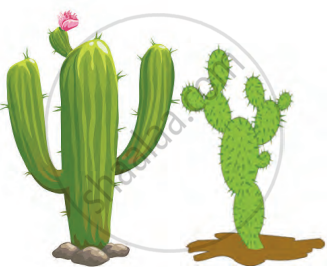
Cactus
Maharashtra State Board: Class 7
Experiment
1. Aim: To observe and compare the water loss (transpiration) in a cactus and a leafy plant.
2. Requirements
- Two potted plants: one cactus and one leafy plant
- Two plastic bags
- String or rubber bands
3. Procedure
- Take a potted cactus and a potted leafy plant.
- Loosely tie a plastic bag around the leaves of each plant, making sure the bags cover the leaves.
- Place both plants in sunlight from early morning.
- In the afternoon, bring the plants into the classroom.
- Observe the inside of the plastic bags for any signs of water condensation.
4. Conclusion: There will likely be more water droplets inside the bag covering the leafy plant than the cactus. This indicates that leafy plants lose more water through evaporation (transpiration) compared to cactus plants, which are adapted to conserve water.
CISCE: Class 12
Key Points: Adaptation in Desert Plants (Xerophytes)
| Type of Xerophyte | Habitat Condition | Main Adaptations | Key Features | Examples |
|---|---|---|---|---|
| Ephemeral annuals (Drought escapers) | Dry areas with short rainy period | Escape drought by short life cycle | Complete life cycle quickly | Argemone, Solanum |
| Succulents | Very dry habitats | Store water in organs | Fleshy stems/leaves/roots | Aloe, Opuntia, Euphorbia |
| Non-succulent perennials (True xerophytes) | Arid and semi-arid regions | Resist drought | Thick cuticle, sunken stomata | Acacia, Calotropis |
Related QuestionsVIEW ALL [11]
Related concepts
- Adaptations of Plants - Adaptations in Seeds for Transport Through Air
