Topics
Living World and Classification of Microbes
Health and Diseases
Force and Pressure
- Introduction to Effects of Force
- Types of Forces>Contact and Non-Contact Forces
- Balanced and Unbalanced Forces
- Inertia and Mass
- Types of Inertia
- Thrust and Pressure
- Pressure on Solids
- Pressure of liquid
- Gas Pressure
- Atmospheric Pressure
- Buoyancy Force (Upthrust Force)
- Archimedes Principle
- Density of substance and Relative density
Current Electricity and Magnetism
Inside the Atom
Composition of Matter
- Matter (Substance)
- Characteristics of Particles (Molecules) of Matter
- States of Matter
- The Solid State
- The Liquid State
- The Gaseous State
- Elements
- Earth and Elements
- Non-Metals
- Type of Element: Metalloid
- Compound
- Types of Compound
- Mixture
- Types of Mixtures
- Introduction to Solutions
- Suspension Solution
- Colloidal Solution
- Molecular Formula of Compounds
- Periodic Trends in the Modern Periodic Table
Metals and Nonmetals
Pollution
- Pollution
- Air Pollution
- Prevention and Control of Air Pollution
- Water Pollution
- Effects of Water Pollution
- Prevention and Control of Water Pollution
- Soil Pollution
- Effects of Soil Pollution
- Prevention and Control of Soil Pollution
- Relationship of Soil Pollution with Air and Water Pollution
- Laws for Control, Regulation, and Prevention of Pollution by Indian Government
Disaster Management
Cell and Cell Organelles
- Cell: Structural and Functional Unit of Life
- Prokaryotic and Eukaryotic Cell
- Plant Cell Vs Animal Cell
- Cell Organelles
- Structure of the Cell > Cell Wall: “Supporter and Protector”
- Structure of the Cell > Plasma Membrane / Cell Membrane
- Structure of the Cell > Cytoplasm: “Area of Movement”
- Structure of the Cell > Nucleus: “Brain” of the Cell
- Endoplasmic Reticulum (ER)
- Golgi Apparatus - "The delivery system of the cell"
- Lysosome - “Suicidal Bag”
- Mitochondria - “Power House of the Cell”
- Plastids
- Non-living Substances Or Cell Inclusion
Human Body and Organ System
- Human Body
- Human Organ System
- Mechanism of Respiration > Breathing
- Human Respiratory System
- Blood Circulatory System
- Human Heart
- Blood Vessels
- Circulation of Blood in the Heart (Functioning of Heart)
- Heart Beat
- Blood
- Plasma (The Liquid Portion of Blood)
- Composition of Blood > Cellular Elements: Red Blood Cells (Erythrocytes)
- Composition of Blood > Cellular Elements: White Blood Cells (Leukocytes)
- Composition of Blood > Cellular Elements: Blood Platelets (Thrombocytes)
- Functions of Blood
- Blood Transfusion and Blood Groups (ABO and Rh system)
- Blood Pressure (B.P.)
- Heart Related Conditions
Introduction to Acid and Base
Chemical Change and Chemical Bond
Measurement and Effects of Heat
Sound
Reflection of Light
Man Made Materials
Ecosystems
Life Cycle of Stars
- Galaxy
- Types of Galaxy
Maharashtra State Board: Class 6
Galaxy:
A galaxy is a very large group of stars, gas, dust, and dark matter that are all pulled together by gravity. Each galaxy has millions to trillions of stars, making it look like a huge island in space. They are dispersed globally and exhibit a wide range of shapes and sizes. There are billions of galaxies in the world, and our solar system is part of the Milky Way Galaxy. Galaxies are not only important for containing stars and planets but also for studying the mysteries of the universe, such as black holes, dark matter, and the cosmic evolution of stars and galaxies themselves.
Maharashtra State Board: Class 6
Types of Galaxy:
| Type of Galaxy | Shape | Features | Example |
|---|---|---|---|
| Spiral | It looks like a whirlpool or a pinwheel with long arms spiralling out from the centre. | The bright central core, arms made of stars, dust, and gas. | NGC 1232 |
| Elliptical | Shaped like an ellipse or oval, ranging from almost circular to very stretched out. | Mostly older stars, little gas and dust, minimal new star formation. | M87 |
| Barred Spiral | Similar to spiral galaxies but with a central bar of stars, gas, and dust, spiral arms start at the ends of the bar. | Bright central bar, spiral arms emanating from the ends of the bar. |
Milky Way |
| Irregular | No definite shape, often chaotic in appearance. | Composed of young stars and lots of gas and dust, often in irregular patches. | Large Magellanic Cloud |
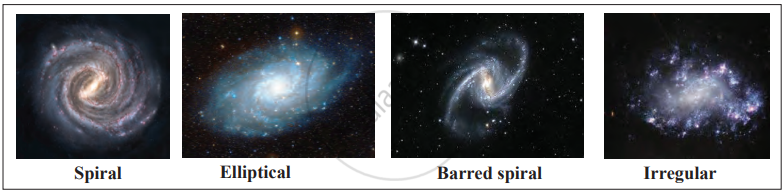
Various galaxies
