Topics
Some Basic Concepts of Chemistry
Introduction to Analytical Chemistry
- Introduction of Analytical Chemistry
- Analysis
- Mathematical Operation and Error Analysis
- Determination of Molecular Formula
- Chemical Reactions and Stoichiometric Calculations
- Limiting Reagent
- Concentration of a Solution
- Use of Graph in Analysis
Basic Analytical Techniques
- Introduction of Some Analytical Techniques
- Purification of Solids
- Crystallisation Method
- Fractional Crystallization
- Simple Distillation Method
- Solvent Extraction
- Chromatography Method
- Chromatography Method > Adsorption Chromatography
- Chromatography Method > Partition Chromatography
Structure of Atom
Chemical Bonding
- Concept of Chemical Bonding
- Kossel-lewis Approach to Chemical Bonding - Octet Rule
- Kossel and Lewis Approach to Chemical Bonding
- Formal Charge
- Limitations of the Octet Rule
- Valence Shell Electron Pair Repulsion (VSEPR) Theory
- Valence Bond Theory (VBT)
- Molecular Orbital Theory
- Parameters of Covalent Bond
- Dipole Moment
- Resonance
Redox Reactions
Modern Periodic Table
- Introduction of Periodic Table
- Structure of the Modern Periodic Table
- Periodic Table and Electronic Configuration
- Blockwise Characteristics of Elements
- Periodic Trends in Elemental Properties
Elements of Group 1 and 2
Elements of Group 13, 14 and 15
- Electronic Configuration of Elements of Groups 13, 14 and 15
- Trends in Atomic and Physical Properties of Elements of Groups 13, 14 and 15
- Chemical Properties of the Elements of the Groups 13,14 and 15
- Carbon: A Versatile Element
- Allotropes of Carbon > Diamond
- Molecular Structures of Some Important Compounds of the Group 13, 14 and 15 Elements
- Chemistry of Notable Compounds of Elements of Groups 13, 14 and 15
States of Matter
Adsorption and Colloids
Chemical Equilibrium
- Introduction of Chemical Equilibrium
- Equilibrium in Physical Processes
- Equilibrium in Chemical Processes - Dynamic Equilibrium
- Law of Mass Action and Equilibrium Constant
- Homogeneous Equilibria
- Characteristics of Equilibrium Constant
- Applications of Equilibrium Constants
- Le Chaterlier's Principle and Factors Altering the Composition of Equilibrium
- Industrial Application
Nuclear Chemistry and Radioactivity
- Introduction: Nuclear Chemistry is a Branch of Physical Chemistry
- Classification of Nuclides
- Nuclear Stability
- Radioactivity
- Radioactive Decays
- Modes of Decay
- Nuclear Reactions
- Applications of Radio Isotopes
Basic Principles of Organic Chemistry
- Organic Chemistry
- Structural Representation of Organic Molecules
- Classification of Organic Compounds
- Nomenclature
- Isomerism
- Theoretical Basis of Organic Reactions
Hydrocarbons
Chemistry in Everyday Life
Introduction:
John Dalton was a British scientist and chemist known for his significant contributions to atomic theory and modern chemistry. Born in 1766 in England, Dalton had a keen interest in science from a young age. He made notable advancements in understanding the behaviour of gases and is also known for his research on colour blindness, a condition sometimes referred to as "Daltonism" in his honour.
In 1803 A.D., Dalton introduced his famous atomic theory. This theory was a major milestone in understanding matter and laid the groundwork for modern chemistry. Dalton proposed that all matter is made up of extremely small and indivisible particles called atoms. Atoms are the basic building blocks of all substances, similar to how bricks make up a wall.
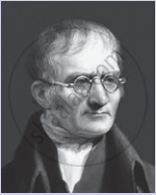
John Dalton
Dalton’s Atomic Theory:
Dalton proposed that everything around us is made up of tiny, invisible particles called atoms. Atoms are the fundamental building blocks of matter, similar to how bricks build a wall. He stated that atoms cannot be broken down into smaller particles or destroyed. They remain unchanged in chemical reactions, only rearranging to form new substances.
According to Dalton, all atoms of a single element are exactly the same in terms of size, mass, and chemical properties. For example, all oxygen atoms are identical to each other but different from hydrogen atoms.
- Atoms of different elements have distinct properties, such as different masses and sizes. For instance, atoms of iron are different from atoms of gold.
- Dalton observed that atoms join together in fixed, simple ratios to form compounds. For example, water (H₂O) is made of two hydrogen atoms and one oxygen atom, always in this ratio.
- In a chemical reaction, atoms are not lost or made; they are simply rearranged to form new substances. This explains the Law of Conservation of Mass, which states that mass is conserved in a chemical reaction.

Dalton's atomic model
Postulates of Dalton’s Atomic Theory
- All matter is made up of tiny, indivisible particles called atoms.
- All atoms of a specific element are identical in mass, size, and other properties. However, atoms of different elements exhibit different properties and vary in mass and size.
- Atoms can neither be created nor destroyed. Furthermore, atoms cannot be divided into smaller particles.
- Atoms of different elements can combine with each other in fixed whole-number ratios to form compounds.
- Atoms can be rearranged, combined, or separated in chemical reactions.
Limitations of Dalton’s Atomic Theory
- It does not account for subatomic particles: Dalton’s atomic theory stated that atoms were indivisible. However, the discovery of subatomic particles (such as protons, electrons, and neutrons) disproved this postulate.
- It does not account for isotopes: As per Dalton’s atomic theory, all atoms of an element have identical masses and densities. However, different isotopes of elements have different atomic masses (For example, hydrogen, deuterium, and tritium).
- It does not account for isobars: This theory states that the masses of the atoms of two different elements must differ. However, it is possible that two different elements can share the same mass number. Such atoms are called isobars (Example: 40Ar and 40Ca).
- Elements need not combine in simple, whole-number ratios to form compounds: Certain complex organic compounds do not feature simple ratios of constituent atoms. Example: sugar/sucrose (C11H22O11).
- The theory does not account for allotropes: Dalton's atomic theory cannot explain the differences in the properties of diamond and graphite, which contain only carbon.
Merits and Demerits of Dalton’s Atomic Theory:
| Merits | Demerits |
| Gave the foundation for understanding matter through the concept of atoms. | Claimed atoms are indivisible, but this was disproven by the discovery of subatomic particles like electrons, protons, and neutrons. |
| Showed that chemical reactions involve the rearrangement of atoms, supporting the law of conservation of mass. | It is stated that all atoms of an element are identical, but isotopes show this is not true. |
| Explained why elements combine in fixed ratios to form compounds, aligning with the law of definite proportions. | Did not explain the internal structure of atoms or how chemical bonding occurs. |
Activity
Understanding Dalton’s Atomic Model
- Take a solid ball and a Bundi Laddu and press both with your palms.
- Observe that the Bundi Laddu breaks into small Bundis, showing it has an internal structure.
- Cut the solid ball with a knife and observe that it remains uniform inside, without any smaller components.
Compare the two:
- The Bundi Laddu represents composite objects with smaller particles.
- The solid ball represents Dalton’s model of an atom—a hard, solid sphere with no internal structure.
Conclusion:
Dalton described the atom as a solid, indivisible sphere, just like the solid ball, with mass evenly distributed and no smaller particles inside.
Maharashtra State Board: Class 12
Key Points: Dalton's Atomic Theory
Dalton's atomic theory laid the foundation of modern chemistry with four core postulates:
- All matter is made up of extremely small particles called atoms.
- Atoms of the same element are identical to each other in mass and properties; atoms of different elements differ.
- Atoms can neither be created nor destroyed — they are indestructible.
- Atoms combine in fixed, simple whole-number ratios to form compound atoms (molecules).
Note: Modern discoveries have refined some postulates (e.g., isotopes show atoms of the same element can differ in mass), but the core framework remains foundational.
