Advertisements
Advertisements
प्रश्न
While doing a PCR, ‘denaturation’ step is missed. What will be its effect on the process?
Advertisements
उत्तर
If denaturation of double-stranded DNA does not take place, then primers will not be able to anneal to the template, no extension will take place, hence no amplification will occur.
APPEARS IN
संबंधित प्रश्न
Name two commonly used bioreactors.
Draw a labelled sketch of sparged-stirred-tank bioreactor. Write its application.
Describe briefly the following:
Downstream processing
State the importance of using a bioreactor.
Describe the process of amplification of the “gene of interest” using the PCR technique.
In a pathological lab, a series of steps were undertaken for finding the gene of interest. Describe the steps, or make a flow chart showing the process of amplification of this gene of interest.
PCR and restriction fragment length polymorphism are the methods for ______.
A single strand of nucleic acid tagged with a radioactive molecule is called ______.
The first step in recombinant DNA technology is
During the purification process for recombinant DNA technology, the addition of chilled ethanol precipitates out ______.
During the process of gene amplification using PCR, if a very high temperature is not maintained in the beginning, then which of the following steps of PCR will be affected first?
Which of the following should be chosen for best yield if one were to produce a recombinant protein in large amounts?
Illustrate the design of a bioreactor. Highlight the difference between a flask in your laboratory and a bioreactor which allows cells to grow in a continuous culture system.
Assertion (A): Synthetic oligonucleotide polymers are used during Annealing in a PCR.
Reason (R): The primers bind to the double stranded DNA at their complementary regions.
Write the scientific name of the source organism of the thermostable DNA polymerase used in PCR.
State the advantage of using Thermostable DNA polymerase.
Identify the part of a bio-reactor which is used as a foam braker from the given figure.
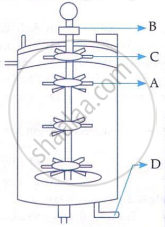
Given below are two statements:
Statement I: The DNA fragments extracted from gel electrophoresis can be used in construction of recombinant DNA.
Statement II: Smaller size DNA fragments are observed near anode while larger fragments are found near the wells in an agarose gel.
In the light of the above statements, choose the most appropriate answer from the options given below:
Which of the following statements is incorrect?
What is the primary definition of recombinant DNA technology?
Which enzyme is specifically used to break open fungal cells during the isolation of genetic material?
What is the process of cutting out and recovering a separated DNA band from an agarose gel called?
Which enzyme is responsible for joining the desired gene to a carrier vector DNA to form recombinant DNA?
How are bacterial cells typically made competent to facilitate the uptake of recombinant DNA during transformation?
