Advertisements
Advertisements
प्रश्न
Read the following paragraph and answer the questions that follow:
| Biotechnology revolves around the "gene of interest", with an objective to open various avenues for human welfare in health, medicine, pharma, agriculture etc. using different techniques, tools and processes. One of the breakthroughs of biotechnology in medicine is the gene therapy. |
- Name the human disease for which the gene therapy was used for the first time.
- Explain the steps of gene therapy carried to cure the disease using the lymphocytes of the patient. Why is this therapy not a permanent cure of the disease?
- Write the possible permanent cure of the disease by the gene therapy that is in progress.
मामले का अध्ययन
Advertisements
उत्तर
- The first clinical gene therapy was administered to a 4-year-old girl with ADA deficiency in 1990.
- The loss of the gene encoding adenosine deaminase, an enzyme essential for the immune system's proper operation, is what causes the illness.
Treatment:- By transferring bone marrow cells, the person who has this condition can be treated.
- The patient's bone marrow is used to obtain lymphocytes in the first step. Then, with the aid of a retrovirus, a functional gene for ADA is delivered into lymphocytes.
- The patient's bone marrow is subsequently given these treated cells that have the ADA gene. As a result, the patient's immune system is stimulated and functional T cells are produced by the gene.
- However, because these cells are not immortal, the patient needs to get these genetically modified lymphocytes on a regular basis.
- The defect might be permanently cured if a functional ADA gene is extracted from bone marrow cells and inserted at early embryonic stages.
shaalaa.com
क्या इस प्रश्न या उत्तर में कोई त्रुटि है?
APPEARS IN
संबंधित प्रश्न
Name two commonly used bioreactors.
Explain briefly:
PCR
An antibiotic resistance gene in a vector usually helps in the selection of ______.
Significance of 'heat shock' method in bacterial transformation is to facilitate ______.
Which of the following steps are catalysed by Taq DNA polymerase in a PCR reaction?
Which of the following should be chosen for best yield if one were to produce a recombinant protein in large amounts?
State the advantage of using Thermostable DNA polymerase.
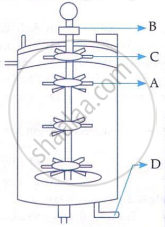
Identify the part of a bio-reactor which is used as a foam braker from the given figure.
Which of the following statements is incorrect?
What is the primary definition of recombinant DNA technology?
