Advertisements
Advertisements
प्रश्न
Look for a story, a poem and a newspaper article on environment conservation and see how the style of each is different from the other.
Advertisements
उत्तर
1. The Ailing Planet: the Green Movement’s Role by Nani Palkhivala (newspaper article)
2. ‘Country Town’ by Judith Wright (poem)
3. 'Environment story for children' by Ninfa Ortiz
(This question is to be answered on the basis of students' own reading, understanding and experience. However, names of a newspaper article, a poem and a story on the conservation of environment have been provided for students' reference)
APPEARS IN
संबंधित प्रश्न
Read the passage given below and answer the questions that follow:
The term dietary fibres refers collectively to indigestible carbohydrates present in plant foods. The importance of these dietary fibres came into the picture when it was observed that the people having diet rich in these fibres, had low incidence of coronary heart disease, irritable bowel syndrome, dental caries and gall stones.
The foodstuffs rich in these dietary fibres are cereals and grains, legumes, fruits with seeds, citrus fruits, carrots, cabbage, green leafy vegetables, apples, melons, peaches, pears etc.
These dietary fibres are not digested by the enzymes of the stomach and the small intestine whereas most of other carbohydrates like starch and sugar are digested and absorbed. The dietary fibres have the property of holding water and because of it, these get swollen and behave like a sponge as these pass through the gastrointestinal tract. The fibres add bulk to the diet and increase transit time in the gut. Some of these fibres may undergo fermentation in the colon.
In recent years, it has been considered essential to have some amount of fibres in the diet. Their beneficial effects lie in preventing coronary heart disease, and decreasing cholesterol level. The fibres like gums and pectin are reported to decrease postprandial (after meals) glucose level in blood. These types of dietary fibres are recommended for the management of certain types of diabetes. Recent studies have shown that the fenugreek (Methi) seeds, which contain 40 per cent gum, are effective in decreasing blood glucose and cholesterol levels as compared to other gum containing vegetables.
Some dietary fibres increase transit time and decrease the time of release of ingested food in colon. The diet having less fibres is associated with colon cancer and the dietary fibres may play a role in decreasing the risk of it.
The dietary fibres hold water so that stools are soft, bulky and readily eliminated. Therefore high fibre intake prevents or relieves constipation.
The fibres increase motility of the small intestine and the colon and by decreasing the transit time there is less time for exposure of the mucosa to harmful toxic substances. Therefore, there is a less desire to eat and the energy intake can be maintained within the range of requirement. This phenomenon helps in keeping a check on obesity. Another reason in helping to decrease obesity is that the high-fibre diets have somewhat lower coefficients of digestibility.
The dietary fibres may have some adverse effects on nutrition by binding some trace metals like calcium, magnesium, phosphorus, zinc and others and therefore preventing their proper absorption. This may pose a possibility of nutritional deficiency especially when diets contain marginal levels of mineral elements. This may become important constraints on increasing dietary fibres. It is suggested that an intake of 40 grams dietary fibres per day is desirable.
(Extracted from ‘The Tribune’)
(a) On the basis of your reading of the above passage make notes on it in points only, using recognizable abbreviations wherever necessary. Also suggest a suitable title. (5)
(b) Write a summary of the above in about 80 words. (3)
Answer any three of the following in 30-40 words each:
(a) Why has the poet’s mother been compared to the ‘late winter’s moon’?
(b) The poet says, ‘And yet, for these Children, these windows, not this map, their world.’ Which world do these children belong to? Which world is inaccessible to them?
(c) What was the plea of the folk who had put up the roadside stand?
(d) What will happen to Aunt Jennifer’s tigers when she is dead?
Answer any four of the following in 30 – 40 words each
(a) What precautions were taken for the smooth conduct of Evan's O-Level examination ?
(b) How did Jo want the Roger Skunk story to end ?
(c) What makes human beings love life inspite of all the troubles they face?
(A Thing of Beauty)
(d) What is suggested by the phrase, 'massive weight of Uncle's wedding band' ?
(e) How did Douglas remove his residual doubts about his fear of water ?
(f) Why did M. Hamel write 'Vive La France' on the blackboard ?
Read the following extract and answer the questions given below:
If you do not get lowered in your own eyes
While you raise yourself in those of others,
If you do not give in to gossips and lies
Rather heed them not, saying, 'who bothers?'
You may be the person I am looking for.
If you crave not for praise when you win
And look not for sympathy while you lose,
If cheers let not your head toss or spin
And after a set-back, you offer no excuse,
You may be the person I and looking for.
(1) What should be your reaction towards gossips and lies?
(2) Who are your role models? Why?
(3) Give the rhyming pairs of words from the first stanza.
(4) Which line is repeated in this extract and what is its effect?
Griffin failed not only as a son and a scientist, but also as a human being. Comment. (The Invisible Man)
The story is called ‘The Adventure’. Compare it with the adventure described in ‘We’re Not Afraid to Die...’
Do you think that the ruled always adopts the language of the ruler?
Look at the following set of words and mention what is common to them both in form and meaning.
|
Snuffle |
snort |
sniffle |
snore |
Discuss the following in pairs or in small groups.
Although Paul’s mother liked to be rich she did not approve of betting on horses.
Suggest a few instances in the poem which highlight humour and irony.
Comment on the use of the phrase ‘fresh-peeled voice’.
'There is no sophistry in my body' – this statement expresses the brutal frankness of the Hawk. Does the poet suggest something through this statement?
Comment on the capitalisation of all the words in the line:
'Children Must be Disciplined'.
The poem has a literal level and a figurative level. Why has the poet chosen 'tigers' and 'sheep' to convey his message?
Read the extract and state whether the following statement is true or false. Correct the false statement.
The author is an example of ‘reverse migration’.
Think and answer in your own words in your notebook.
Why do you think God created worms? What is their ecological importance?
Answer the given question in your own words.
Where was the Happy Prince’s statue located?
Given below are some words from legal terminology used in court affairs. Discuss and complete the table accordingly.
| Sr. No | Legal Terminology | Description |
| 1. | Affidavit | A written statement confirmed by oath or affirmation for use as evidence in court. |
| 2. | Argument | |
| 3. | Consent | |
| 4. | Counsel | |
| 5. | Judgement | |
| 6. | Trial | |
| 7. | Verdict | |
| 8. | Contempt of Court | |
| 9. | Notice | |
| 10. | Stay order |
Wash your handkerchief clean. Hang it with a peg to dry in the wind. Watch how it flutters.
Enlist a few reasons for watching a drama live on the stage.
Rewrite the poem in the form of a prose passage.
Find four words ending with ‘-ous’ from the story.
Can you add three more words ending with ‘-ous’ to this list?
Name the white and bright things mentioned in the poem.
An activity:
Speak fast, think faster! Form groups of 4-6. Discuss each of the following topics. Then each person in the group should choose a topic and speak about it for one minute. Try to say as many sentences as you can in that time
What is not likely to happen or will never happen...
‘It won’t rain in the classroom... I won’t ever see a live dinosaur... The sun will never set in the east...’ etc.
Read the passage and answer the following:
Who has written the book?
Form groups. Discuss the first two paragraphs. Try to present their content in the form of a series of conversations among the volunteers.
Prepare similar word chains using the following ideas.
waterbody - pool ____________.
Correct the following sentence using facts from the passage.
Achilles was killed by an arrow that pierced his heart.
Find out how the following game is played.
Lawn Tennis
Find out how the following game is played.
Badminton
List and say whether the following statement agrees with the passage or not.
In a discussion, you should share your ideas with others.
Read the word. Write the words that combine to make it.
anywhere
Describe Gulliver’s walk around the city.
Why did he spill the milk?
Read the following line from the poem and answer the question that follow.
Let me but live my life from year to year, With forward face and unreluctant soul; Not hurrying to, nor turning from the goal; Not mourning for the things that disappear.
Identify the rhyme scheme of the given lines.
Read the incident again and answer the following question.
Why were the other passengers in the flight gazing at the writer?
What made John Shepherd-Barron to come up with the idea of ATM?
‘My tongs are like a tiger among toys.’ It means ______
Discuss with your partner and complete the table.
| S.No. | Question | Who asked this? | Who answered? | What was the answer? |
|
1. |
Shall we run back together? | |||
| 2. | Can you see something behind the wall? | |||
| 3. | Who said good bye? | |||
| 4 | Was it just the wind? |
At dawn, the______ began to sing.
Neerja leapt into action when she______.
Describe the beauty of the blue mountain.
The war between the two kingdoms ended in peace.
A tiny bird looked for a place to lay her eggs.
Why did the farmer have to travel far?
We get water by burning _______.
Why did the family move to Patna?
The boy and the girl were taken by the cavalry to explain their action.
How did the third daughter use the grain?
What are the three parts of a robot
Choose the correct option from the given homophones.
You should never ______ to your parents.
Every ______ they would go fishing.
Muthu collected ______ from every house.
Recite any 4 lines of the poem with intonation.
Match with their storing places.
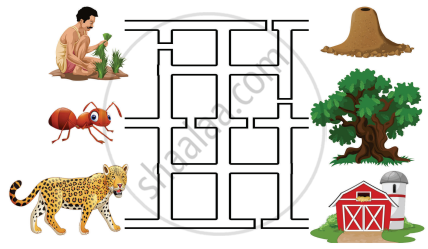
When should we not water the plants?
Match the following items from column-A with those column-B:
| Column 'A' | Column 'Non-Textual' |
| (a) Geoffrey Chaucer | (i) Trinidad |
| (b) Daniel Defoe | (ii) Wuthering Heights |
| (c) V.S. Naipaul | (iii) Robinson Crusoe |
| (d) Emile Bronte | (iv) The Canterbury Tales |
Being a bachelor, the stranger had no patience with children.
Write the compound words from the picture.
 |
 |
| ______ | |
