Advertisements
Advertisements
प्रश्न
“Lend thy ears to all but few thy tongue”…. is a famous quote by William Shakespeare. Justify.
Advertisements
उत्तर
The quote “Lend thy ears to all but few thy tongue” by William Shakespeare suggests that while one must be quick to listen to another's opinions or views, giving your opinion must be done more cautiously.
This is because listening to a variety of opinions and views helps to form a clearer perspective. However, when giving out an opinion, careful consideration and thought must be given to the matter at hand, and only when one is sure of their viewpoint, should one venture to speak.
The quote thus focuses on the importance of being a good listener and warns us about the disadvantages of speaking without thinking.
APPEARS IN
संबंधित प्रश्न
Read the following extract and complete the note with the help of the clues provided :
Vitamins are either fat-soluble (A, D, E, K) or water-soluble (B vitamins, including niacin, folic acid and riboflavin, and vitamin C). They consist mainly of the elements nitrogen, oxygen, carbon and hydrogen. Fat-soluble vitamins are stored in bod)' fat, while water-soluble vita1nins are used or quickly excreted in the urine.
Vitamin A is essential for the eyes, skin, hair, and bones; the B vitamins help enzymes to function; C is essential for the formation of collagen; D helps the body absorb calcium; E prevents cell damage, and K helps blood clotting. Most vitamins cannot be produced by the body and so must be obtained directly from food.
VITAMINS
| Vitamins are obtained from | |
| B Vitamins | Fat-soluble |
| Vitamins consist of | 1. 2. Oxygen 3. 4. Hydrogen |
| Vitamin A B C D E K |
Essential for eyes, skin, etc. Formation of collagen Prevents cell damage |
Transform the following sentence as per the given instruction.
How cruel Shylock was to demand his pound of flesh!
(Begin: It was cruel………………….)
Arun was asked by his mother to explain the missing buttons on his shirt.
(Rewrite: Using ‘explanation’)
In what way is the poet relevant to our times?
The caged bird sings with
A fearful trill of things unknown
But longed for still and his
Tune is heard on the distant hill
For the caged bird sings of freedom.
Read the above lines and answer the question that follow.
Explain, ‘stands on the grave of dreams / his shadow shouts on a nightmare scream’.
Is there any relevance of this poem to the present scenario?
Explain, ‘Just a palsied few at the windows set;’
Thus I entered, and thus I go!
In triumphs, people have dropped down dead,
"Paid by the world, what dost thou owe
Me?"....God might question; now instead,
'Tis God shall repay: I am safer so.
Read the above lines and answer the question that follow.
Which line is a contrast to the welcome he had received.
Thus I entered, and thus I go!
In triumphs, people have dropped down dead,
"Paid by the world, what dost thou owe
Me? "....God might question; now instead,
'Tis God shall repay: I am safer so.
Read the above lines and amswer the question that follow.
Explain with reference to the context.
Thus I entered, and thus I go!
In triumphs, people have dropped down dead,
"Paid by the world, what dost thou owe
Me? "....God might question; now instead,
'Tis God shall repay: I am safer so.
Read the above lines and amswer the question that follow.
How did the leader come and go?
What does the book of gold symbolize?
(A) He knew the culprit but refused to admit it.
(B) Although………………………..
Write a composition (350 - 400 words) on the following:
Write an original short story that begins with the words : “The day started off well enough, whoever thought it would ……….”
Write a composition (350 – 400 words) on the following:
Describe in detail the view from your bedroom window. Does your room overlook a park? A busy street? What are the sights, sounds, and smells that you would typically see, hear, and experience at different times of the day? What do you most enjoy about the view? Early in the morning, in the evening, or late at night?
Read the following passage carefully and answer the questions that follow:
Lying in bed, Swami realized with a shudder that it was Monday morning. It looked as though only a moment ago, it had been the last period on Friday; already, Monday was here. He hoped that an earthquake would reduce the school building to dust but that my good building, Albert Mission School, had withstood similar prayers for over a hundred years now.
At nine o'clock, Swaminathan wailed, “I have a headache.”
His mother said, “Why don’t you go to school in a bullock cart?”
“So that I may be completely dead at the other end? Have you any idea what it means to be jolted in a cart?”
“Have you any important lessons today?”
“Important! Bah! That geography teacher has been teaching the same lesson for over a year now. And we have arithmetic, which means for a whole period we are going to be beaten by the teacher............ Important lessons!”
And Mother generously suggested that Swami might stay at home.
At 9:30, when he ought to have been lining up in the school prayer hall, Swami was lying on the bench in Mother’s room.
Father asked him, “Have you no school today?”
“Headache,” Swami replied,
“Nonsense! Dress up and go.”
“Headache.”
“Loaf about less on Sundays, and you will be without a headache on Monday.”
Swami knew how stubborn his father could be and changed his tactics.
“I can’t go so late to class.”
“I agree, but you’ll have to; it is your own fault. You should have asked me before deciding to stay away.”
“What will the teacher think if I go so late?”
“Tell him you had a headache, and so are late.”
“He will beat me if I say so.”
“Will he? Let us see. What is his name?”
“Mr. Samuel.”
“Does he beat the boys?”
“He is very violent, especially with boys who come late. Some days ago, a boy was made to stay on his knees for a whole period in a corner of the class because he came late, and after getting six cuts from the cane and having his ears twisted, I wouldn’t like to go late to Mr Samuel’s class.”
“If he is so violent, why not tell your headmaster about it?”
“They say that even the headmaster is afraid of him. He is such a violent man.”
And then Swami gave a lurid account of Samuel’s violence; how when he started caning, he would not stop till he saw blood on the boy’s hand, which he made the boy press to his forehead like a Vermillion marking. Swami hoped his father would be made to see that he couldn’t go to his class late. But his father’s behaviour took an unexpected turn. He became excited.
“What do these people mean by beating our children? They must be driven out of service. I will see…..”
The result was that he proposed to send Swami late to his class as a kind of challenge. He was also going to send a letter with Swami to the headmaster. No amount of protest from Swami was of any avail: Swami had to go to school.
By the time he was ready, his father had composed a long letter to the headmaster, put it in an envelope, and sealed it.
“What have you written, father?” Swaminathan asked apprehensively.
“Nothing for you. Give it to your headmaster and go to your class.”
Swami’s father did not know the truth—that, actually, Mr. Samuel was a very kind gentleman.
(a) Give the meaning of each of the following words as used in the passage. (3)
One-word answers or short phrases will be accepted.
- jolted
- stubborn
- avail
(b) Answer the following questions briefly in your own words:
- What did Swami wish for on a Monday morning? Why was his wish unlikely to be answered? (2)
- Which sentence tells us that Swami’s father was completely unsympathetic to his son’s headache? (2)
- In what way was Swami’s mother’s response different from his father’s? (2)
- Why did Swami give a colourful account of Mr. Samuel to his father? (2)
- In what way did Father’s behaviour take an unexpected turn? (2)
- What was Swami finally ordered to do by his father? (2)
(c)
(i) In not more than 60 words, describe how Swami tries to prove that Mr. Samuel is a violent man. (8)
(ii) Give a title to your summary in 3
(c). Give a reason to justify your choice. (2)
Re-write the following sentences according to the instructions given after each. Make other changes that may be necessary, but do not change the meaning of each sentence.
- As soon as we lit the candle, the power supply was restored.
(Begin: No sooner………. ) - The bee is more industrious than all other creatures.
(Use: ‘most industrious’) - The old woman was too slow to catch the bus.
(Begin : The old woman was so……… ) - “I’ll do it tomorrow,” he promised.
(Rewrite in indirect speech) - Though Reema got an expensive gift she was not happy.
(Begin: In spite of……… ) - I prefer reading a book to watching a movie.
(Begin: I would rather…….. ) - I have never seen Mr. Roy lose his temper.
(Begin: Never…….. ) - She found your keys in the garage.
(Begin: The keys……… )
They had to climb ____________the steep pathway to reach the top.
Explain the statement, “King Tut is one of the first mummies to be scanned — in death, as in life...”
Given below is an interesting combination of words. Explain why they have been used together.
stunning artefacts
Below is a topic for essay writing. Follow the steps listed above to write on this topic.
Human Population Grows Up
What does the notice 'The world's most dangerous animal' at a cage in the zoo at Lusaka, Zambia, signify?
Discuss in groups of four.
Laws are never respected not enforced in India.
A sadist is a person who gets pleasure out of giving pain to others.
Given below are some dictionary definitions of certain kinds of persons.
Find out the words that fit these descriptions.
1. A person who considers it very important that things should be correct or genuine e.g. in the use of language or in the arts: P...
2. A person who believes that war and violence are wrong and will not fight in a war: P...
3.A person who believes that nothing really exists: N...
4. A person who is always hopeful and expects the best in all things: O...
5. A person who follows generally accepted norms of behaviour: C...
6. A person who believes that material possessions are all that matter in life: M...
Approval from the outside world and approval within the family.
Identify instances of ironical comment in the story.
Go to your school/college library and read some other stories by O’Henry like, ‘The Gift of the Magi’, ‘The Last Leaf’ and ‘After Twenty years’. Write the stories in short in your notebook.
Find out the information about the qualification and eligibility required in the profession related to wild life such as:
Forest officer / Ranger
Find out information about the Mahavastra of Maharashtra - Paithani.
Glance through the text again and explain the qualities of Tenzing Norgay. Pick lines that show his unique qualities. One is done for you.
| Sr No. | Qualities | Lines |
| 1. | Patriotic | I told Colonel Hunt that I was carrying the Indian flag with me and I would like it to be on the top with other flags. |
|
2. |
||
| 3. | ||
| 4. |
Refer to a standard dictionary and find out the meaning of the following word:
Reportorial
The poem creates a delightful picture of the city, rich in its natural beauty. Work in pairs, groups and pick out the lines from the poem which give the pictorial effect to the poem. Write it in your own words.
Compose two lines of your own on any sensory organ.
Write the appreciation of the poem.
- About the poem/poet/title
- Theme
- Poetic devices, language, style
- Special features/novelties/focusing elements
- Values, message
- Your opinion about the poem.
Prepare a poster on the need for the conservation of the Great Indian Bustard.
Is an educated person the same as a degree holder?
Make a list of the behaviours in educated people that you find unacceptable:
- ___________________
- ___________________
- ___________________
- ___________________
The present review concludes with two words 'Heartwarming and enjoyable'. Write your opinion about 100 to 150 words.
Write down the consequences of the following occurrences with the help of the play.
Dr. Thomas Stockmann wants an article exposing social evils to be printed in the newspaper.
Choose any novel/book that you enjoyed. Prepare a synopsis of the novel. It should include the major events and the links between them as described in the novel. You may prepare a chapter-wise outline first and then put the outlines together to write a brief synopsis.
Form pairs. Discuss how ‘Part II’ of the story could have been different. Write your storyline in the form of bullets showing the main events.
Give, in your own words, TWO reasons for each of the following :
One of the schoolboys helped the old woman cross the street.
Gather information on any one of the following by talking to your elders, family members, and from other sources in your mother tongue and write a short note on it in English.
A special type of embroidery
Think and write in your own words.
Why does the traveller doubt that he shall ever come back?
Form groups and discuss each element of planning an interview and prepare notes on each element.
- Format - Structure: ......................
- Size/Length - How much: ......................
- Do’s and Dont’s - Rules and Regulations: ......................
- Type of Questions - Yes/No questions or Wh Type: ......................
Write about a day when you felt very happy. Use the following questions to help you. Think/Recollect a day ............
Note down the points.
- Do you remember the exact day and date?
- Was it a special occasion or celebration?
- What happened on that day?
- How did you react to the things that happened on that day?
- How did other people react when they saw you were so happy?
- What did you do next ?
- What happened in the end?
- Describe any other emotions you felt that day
Now, with the help of the guidelines write a short paragraph of at least 100 words about that happy day. Give a suitable title for your narrative/write up.
Write a report of the following event in about 100-120 words.
You are the School Pupil Leader. You have been asked to write a report on the Inaugural Ceremony of English Literary Association of your school which was held recently. Write a report on the same in not more than 120 words.
Work in groups and discuss. Then write a diary entry in about 60-80 words describing your feelings and emotions for the given situation.
Imagine, you are Pongo.
Your feelings when you caught the boy.
Nalan’s grandfather showed him an old treasure trunk. A road map was stuck on the trunk. It showed the spot where a key was hidden. Look at the road map and write five directions to reach the spot where the key is hidden. Discuss with your partner and compare your directions with those of your classmates.

- ____________
- ____________
- ____________
- ____________
- ____________
Write about Your Favourite Sports person/Famous personality/Hobby/Recipe by starting your own blog.
Silent letter.
What is common in the following groups of words?
- knee, knife, knot, know ______
- neighbour, daughter, fight, straight ______
- honest, honour, hour, heir ______
Try and make more silent letter words.
gnat: ______, ______
tongue: ______, ______
chalk: ______, ______
whistle: ______, ______
Choose a story that you like.
In groups of four, write down dialogues for the story and make it into a short play. You may then present it in the class.
Animals are capable of empathy. Substantiate this statement with examples from the story as well as your own experiences.
‘Means should justify the end.’ Explain this adage with reference to O. Henry’s story
Write a paragraph of about 150 word, on the following topic.
The importance of Good Health
Imagine someone has invited your family to a program and you were the only person at home when the invitation was given orally.
As a member of the Student Council of your school, you wish to set up a Food Club to promote healthy eating habits among students. Write a proposal in not more than 150 words, outlining the steps that you will take to make this club a success.
Translate the following sentence into your mother tongue.
The first question we must ask ourselves before we speak is - is it true?
You want to convince the customer to buy your product. Prepare a conversation between you and the customer about it.
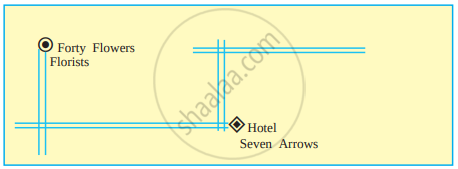
- Within one minute, write as many meaningful phrases as possible using the numbers given below. Do not repeat the ideas.
- One: ______
- Two: ______
- Three: ______
- Four: ______
- Five: ______
- Six: ______
- Seven: ______
- Forty: ______
- A hundred: ______
- Try to imagine a situation/context where all the above items fit in. Describe it in 8-10 lines.
- Think of a title for your passage.
- Try to draw a map incorporating your phrases in a meaningful way. (Two examples are given below.) Write a key/index for your map.
As the school leader, you have been given the responsibility of organising a school trip for the students of classes XI and XII to a place of historical importance. Write a proposal in about 150 words stating the steps you would take to successfully organise the trip.
