Advertisements
Advertisements
प्रश्न
Fill in the blanks choosing the words from the box given and complete the summary of the poem.
The casuarina tree is tall and strong, with a creeper winding around it like a (1) ______. The tree stands like a (2) ______with a colourful scarf of flowers. Birds surround the garden and the sweet song of the birds is heard. The poet is delighted to see the casuarina tree through her (3) ______. She sees a grey monkey sitting like a (4) ______on top of the tree, the cows grazing, and the water lilies (5) ______in the pond. The poet feels that the tree is dear to her not for its (6) ______appearance but for the (7) ______memories of her happy childhood that it brings to her. She strongly believes that (8) ______communicates with human beings. The poet could communicate with the tree even when she was in a far-off land as she could hear the tree (9) ______her absence. The poet (10) ______the tree’s memory to her loved ones, who are not alive. She immortalizes the tree through her poem like the poet Wordsworth who (11) ______the yew tree of Borrowdale in verse. She expresses her wish that the tree should be remembered out of love and not just because it cannot be (12) ______.
| python | statue | nature | casement |
| nostalgic | lamenting | impressive | forgotten |
| giant | consecrates | springing | sanctified |
Advertisements
उत्तर
The casuarina tree is tall and strong, with a creeper winding around it like a (1) python. The tree stands like a (2) giant with a colourful scarf of flowers. Birds surround the garden and the sweet song of the birds is heard. The poet is delighted to see the casuarina tree through her (3) casement. She sees a grey monkey sitting like a (4) statue on top of the tree, the cows grazing and the water lilies (5) springing in the pond. The poet feels that the tree is dear to her not for its (6) impressive appearance but for the (7) nostalgic memories of her happy childhood that it brings to her. She strongly believes that (8) nature communicates with human beings. The poet could communicate with the tree even when she was in a far-off land as she could hear the tree (9) lamenting her absence. The poet (10) consecrates the tree’s memory to her loved ones, who are not alive. She immortalizes the tree through her poem like the poet Wordsworth who (11) sanctified the yew tree of Borrowdale in verse. She expresses her wish that the tree should be remembered out of love and not just because it cannot be (12) forgotten.
APPEARS IN
संबंधित प्रश्न
Have you ever visited a fort or a castle?
Why were the soldiers in the castle fearless?
Our captain was brave and we were true
Underline the alliterated word in the following line.
With our arms and provender, load on load.
Underline the alliterated word in the following line.
A little wicked wicket gate.
Identify the figure of speech used in the following line.
A little wicked wicket gate.
What has Wordsworth sanctified in his poem?
Read the line given below and answer the question that follow.
“Fear, trembling Hope, and Death, the skeleton,
And Time the shadow”, and though weak the verse
That would thy beauty fain, oh, fain rehearse,
May Love defend thee from oblivion’s curse.
- What does the poet mean by the expression ‘May love defend thee from oblivion’s curse?’
- What does the expression ‘fain’ convey?
- What does the poet convey through the expression ‘Fear, trembling Hope’?
Explain the following line with reference to the context.
Dear is the Casuarina to my soul;
Explain the following line with reference to the context.
It is the tree’s lament, an eerie speech,…
Discuss with your partner the different stages in the growth of man from a new born to an adult

Fill in the blanks using the words given in the box to complete the summary of the poem.
Shakespeare considers the whole world a stage where men and women are only (1) ______. They (2)______the stage when they are born and exit when they die. Every man, during his life time, plays seven roles based on age. In the first act, as an infant, he is wholly (3) ______on the mother or a nurse. Later, emerging as a school child, he slings his bag over his shoulder and creeps most (4)______ to school. His next act is that of a lover, busy (5) ______ballads for his beloved and yearns for her (6) ______. In the fourth stage, he is aggressive and ambitious and seeks (7) ______in all that he does. He (8) ______solemnly to guard his country and becomes a soldier. As he grows older, with (9) ______and wisdom, he becomes a fair judge. During this stage, he is firm and (10) ______. In the sixth act, he is seen with loose pantaloons and spectacles. His manly voice changes into a childish (11) ______. The last scene of all is his second childhood. Slowly, he loses his (12) ______of sight, hearing, smell and taste and exits from the roles of his life.
| attention | treble | reluctantly |
| actors | maturity | reputation |
| serious | faculties | composing |
| enter | promises | dependent |
Why is the last stage called second childhood?
Pick out the word in ‘alliteration’ in the following line.
“And one man in his time plays many parts”
Complete the table based on your understanding of the poem.
| Stage | Characteristic |
| crying | |
| judge | |
| soldier | |
| unhappy | |
| second childhood | |
| whining | |
| old man |
Describe the various stages of a man’s life picturised in the poem “All the World’s a stage."
Introduction
The poem ‘Ulysses’ is a dramatic monologue that contains 70 lines of blank verse. Ulysses, the King of Ithaca, gathers his men together to prepare for the journey and exhorts them not to waste their time left on earth. Ulysses has grown old, having experienced many adventures at the battle of Troy and in the seas. After returning to Ithaca, he desires to embark upon his next voyage. His inquisitive spirit is always looking forward to more and more of such adventures.
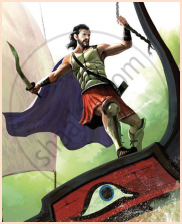
‘As tho’ to breathe were life!’ – From the given line what do you understand of Ulysses’ attitude to life?
How would Telemachus transform the subjects?
Identify the figure of speech employed in the following line.
There lies the port the vessel puffs her sail
List the roles and responsibilities Ulysses assigns to his son Telemachus, while he is away.
What is Ulysses’ clarion call to his sailors? How does he inspire them?
Here are a few poetic device used in the poem.
Transferred Epithet- It is a figure of speech in which an epithet grammatically qualifies a noun other than the person or a thing, it is actually meant to describe.
Read the line given below and answer the question that follow.
“Life is hard; be steel; be a rock.”
- How should one face life?
- Identify the figure of speech in the above line.
Explain the following line with reference to the context.
He will be lonely enough
to have time for the work
Explain how the poet guides his son who is at the threshold of manhood, to face the challenges of life.
Who do you think is the narrator of the poem?
Why did the rider keep his lips compressed?
Read the line given below and answer the question that follow.
A film the mother eagles eye When her bruised eaglet breathes
- Who is compared to the mother eagle in the above lines?
- Explain the comparison.
