Advertisements
Advertisements
प्रश्न
Distinguish between the following pairs of words
| Incredulous | - | Incredible |
| Suspicious | - | Susceptible |
| Sensitivity | - | Sentimentality |
| Successive | - | Successful |
Advertisements
उत्तर
|
Incredulous: not disposed or willing to believe, unbelieving Incredible: beyond belief or understanding |
|
Suspicious: openly distrustful and unwilling to confide Susceptible: yielding readily to or capable of |
|
Sensitivity: the ability to respond to physical stimuli or register small physical amounts or differences. Sentimentality: falsely emotional in a maudlin way. |
|
Successive: having or giving the right of succeeding to an inheritance, following in order or in uninterrupted course Successful: having succeeded or being marked by a favourable outcome |
APPEARS IN
संबंधित प्रश्न
Answer any six of the following questions in 30‒40 words:
(a) Why did Gandhiji feel that taking the Champaran case to the court was useless?
(b) Why did the peddler derive pleasure from his idea of the world as a rattrap?
(c) How is Mukesh different from the other bangle makers of Firozabad?
(d) What tempted Franz to stay away from school?
(e) Why did the maharaja ban tiger hunting in the state?
(f) How was the skunk's story different from the other stories narrated by Jack?
(g) Which words of her brother made a deep impression on Bama?
Answer the following question in 120-150 words:
What kind of life did Silas lead at Lantern Yard?
Answer the following question in 120-150 words :
Mrs. Hall is greedy but efficient in her business.
Attempt a character sketch of Mrs. Hall.
Read the extract and do the following activities :
B1 Likes and dislikes :
(i) The child likes eating _______
(ii) The child dislikes eating _______
They won’t eat peas, don’t like your bread -
For something in it crunches;
They gag on fat, the gravy’s gross,
They won’t eat grapes in bunches.
Tomatoes, onions, peppers, fish
Garlic nor cottage cheese;
Oh, it’s a dish uncommon rare
That truly seems to please.
No red sauce may the ice cream have,
“It’s bleeding,” they will say;
And gravely hand it to their mum
To take it to clean away
But let us speak of chocolate cake,
It must be frosted o’er;
They’ll devour three full slabs,
And calmly ask for more.
Oh, I do so always love to eat
With picky little pests,
Whose parents joy to make them
The most undesirable guests!
B2 What message does the poem convey for children?
B3 Pick out two pairs of rhyming words from the poem.
Which language do you use to talk to elderly relatives in your family?
How would you say ‘a dilapidated drum’ in your language?
Discuss in groups of four.
The sensitive behaviour of hill-folk.
Locate expressions in the text reflect the Indian idiom, for example, the pride of the generations of his ancestors.
Examine the communication channels in the story between Paul and his uncle.
Explain the line:
Within a week it sickened to a raging fever and its pulse went up to a hundred and fifty in the shade.
The power of poetry lies in suggestion and understatement. Discuss this with reference to the poem.
Qua story’: what does the word mean? Find other expressions using the word qua.
Comment on the capitalisation of all the words in the line:
'Children Must be Disciplined'.
What is the poetic technique used by the poet to convey the plaintive theme of the poem?
The poem has a literal level and a figurative level. Why has the poet chosen 'tigers' and 'sheep' to convey his message?
Read the extract 'Being Neighborly' and complete the following statement:
In order to tidy the room, Jo __________________.
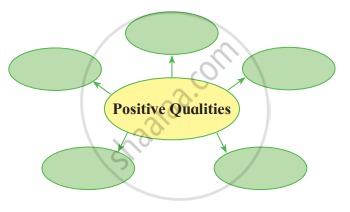
Find from the poem, positive qualities to fill up the web.
Pick out words from the poem to fill in the web diagram. They should be related to the theme in the web.
Read the story and complete the following.
Revathi’s grief knew no bounds because, ____________.
Which pictures reflect gender equality? Write their numbers.
Johnsy realised that her thinking was wrong.
Where do we find all types of wild animals in urban areas?
Discuss in your class.
Do you like to study science?
Read the lesson and name the following.
Anaesthetics used from mid 19th century ______
Select a season of your choice and give the following details:
- Time of the year -
- Characteristics- crops, festivals, etc.
- Features/changes - climate/weather/temperature etc.
- Advantages/Disadvantages -
Read the following word and use it in a sentence of your own.
Renown
Read the following phrase and use it in a sentence of your own in proper form.
To voice something
Read the description of the Kabaddi match and do the following:
Describe, in your own words, the important events in the first half.
Describe the following with the help of the story.
The fabric is woven by Thiruvalluvar
What does the poet pray for? Why?
Read the passage and name the following.
He composed the Illiad and Odyssey.
Write the symbol that is used in the poem to represent the following idea.
Choice of two options.
What did Gopal Bhand say he was doing?
Choose a suitable heading for each announcement from those given below.
(Change in School Hours, Cleanliness, Story-telling Competition, Lost and Found, Warning, Football Match)
1.
|
6 July 2015 It has been observed by the Head Boy and Head Girl that certain classes do not clean up their classrooms before leaving. If any class is found untidy and littered after school, that class will be detained the next day after school hours up to 4 pm. Please take note of this. |
2.
| Tomorrow, that is, on the 10th of July, the school will close an hour earlier, as the teachers have to attend an important P. T. A. meeting. So please inform your parents to arrange to pick you up at 2 pm instead of 3 pm. |
3.
| On Sunday, 12th July 2015 there is a football match between classes VIII and IX, on the school ground. The match will begin at 9 am. All students are invited to come and cheer their favorite team. Please come on time, so that the players are not distracted. |
4.
|
The school has organized a Story-telling Competition for Classes V, VI, and VII from 21st to 25th of July. The competition will be held in the school hall at 10 in the morning. Children may select -
Three prizes will be given for each category. The time limit is 3-5 minutes. Those who wish to participate may contact Mrs. Sanjana Mohite for other details. They must register their names with her before the 16th of July. |
5.
|
Construction work to extend the school building will start next week. All students are cautioned not to cross over the fence at the construction site. It is dangerous and may cause you injury. Please stay away from that fence. |
6.
| A cycle key with a blue key chain has been found on the ground. Whoever has lost it can contact the clerk Mrs. Neena Pinto and see if it belongs to him/her. |
Write what you can do to welcome birds in your surroundings.
What part did Anne Sullivan play in Helen’s life?
What prompted the young seagull to fly finally?
Who were the inhabitants of the island?
How did Miranda feel when her father raised the storm to destroy the ship?
The narrator searched for three days to buy ceramic paint.
Read the following line from the poem and answer the question given below.
Nothing goes right with the folks you meet
Down on that gloomy Complaining Street.
- What is the opinion about the folks you meet down the street?
- What does the word ‘gloomy’ mean here?
Why did Granny scold Hamid?
Read the following lines and answer the questions.
It’s a slow, unwavering, ingrained trait
With the patience to work and the strength to wait.
- What is an ‘ingrained trait’?
- Why does a courageous man need patience?
The turtles use their flippers and make a hollow for their nests.
Work in pair, find answer for the question and share in the class.
When is it autumn in India? Why does the poet say this? Is there an autumn season in India?
The ________ are trying to terraform Mars.
What day is it?
What are the things given by the tree?
What is your hobby?
The bird-catcher decided to sit under the ________.
Write the rhyming word.
goat
Circle and write the adverbs.
I drink coffee thrice a day. ______
Read the advertisement and answer the question given below.

What is the advertisement about?
A Shepherd had a _______.
Why did Nasruddin say, “It was my aim,” the third time?
What sort of a boy is described in the poem?
How did he challenge everybody?
What did the boy make with the trunk of the tree?
How should teenagers guard against cyber crimes?
