Mathematical Concept of Variation
Topics
Commercial Mathematics
Goods and Services Tax (G.S.T.)
- Basic Concept of Taxes in Mathematics
- Mathematical Study of GST (Goods and Services Tax)
- Terms Related to Goods and Service Tax (GST)
- Types of GST in Mathematics
- Examples based on GST Calculations
- Mathematical Study of GST on Value Addition
- Reverse Charge Mechanism in Mathematics
- Composition Scheme in Mathematics
- Input Tax Credit (ITC) in Mathematics
- E-way Bill in GST Sums
Compound Interest
- Compound Interest as a Repeated Simple Interest Computation with a Growing Principal
- Use of Compound Interest in Computing Amount Over a Period of 2 Or 3-years
- Use of Formula
- Finding CI from the Relation CI = A – P
Algebra
Banking
- Money and Banking in Arithmetic
- Types of Bank Accounts
- Mathematics of Recurring Deposit (R.D.)
- Calculation for Interest and Maturity Value on a Recurring Deposit
- Depositing and Withdrawing Money from a Savings Bank Account
- Opening a Saving Bank Account
- Calculating Interest in a Savings Bank Account
Geometry
Shares and Dividends
- Important Terms Related to Shares and Dividends
- Formulae for Shares and Dividends
- Examples based on Shares and Dividends
- Types of Shares in Mathematics
Mensuration
Linear Inequations
Quadratic Equations
- Concept of Quadratic Equations
- Method of Solving a Quadratic Equation>Factorisation Method
- Method of Solving a Quadratic Equation>Quadratic Formula (Shreedharacharya's Rule)
- Nature of Roots of a Quadratic Equation
- Equations Reducible to Quadratic Equations
- Problems on Quadratic Equations
Trigonometry
Ratio and Proportion
Statistics
Probability
Factorisation of Polynomials
- Function and Polynomial
- Division Algorithm for Polynomials
- Remainder Theorem
- Factor Theorem
- Applications of Factor Theorem
Matrices
Arithmetic and Geometric Progression
Co-ordinate Geometry
- Foundation of Coordinate Geometry
- Advanced Concept of Reflection in Mathematics
- Invariant Points
- Combination of Reflections
- Using Graph Paper for Reflection
Similarity
Symmetry
Loci
- Locus
- Points Equidistant from Two Given Points
- Points Equidistant from Two Intersecting Lines
- Summary of Important Results on Locus
- Important Points on Concurrency in a Triangle
Circles
Tangent and Secant Properties
Constructions
Area and Volume of Solids (Cylinder, Cone and Sphere)
- Mensuration of Cylinder
- Hollow Cylinder
- Mensuration of Cones
- Mensuration of a Sphere
- Hemisphere
- Conversion of Solids
- Solid Figures
- Problems on Mensuration
Trigonometrical Identities
Heights and Distances
- Angles of Elevation and Depression
- Problems based on Elevation and Depression
Statistics : Basic Concepts, Mean, Median, Mode. Histograms and Ogive
Probability
Advertisements
- Definition: Direct Variation
- Definition: Inverse Variation
- Example 1
- Example 2
- Example 3
- Example 4
- Key Points Summary
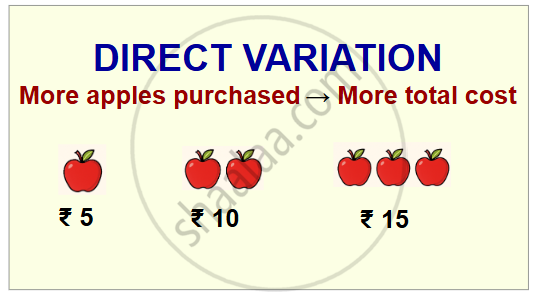
Definition: Direct Variation
Two quantities are said to have direct variation if, when one quantity increases, the other quantity also increases, and when one quantity decreases, the other quantity also decreases.
Definition: Inverse Variation
Two quantities are in inverse variation if, when one quantity increases, the other decreases, and when one decreases, the other increases.

Example 1
A car, running with uniform speed, covers a distance of 96 km in 3 hours. How much distance will the car cover in 5 hours, running at the same speed?
Solution:
In 3 hours, car covers 96 km
⇒ In 1 hour, car covers
96 In 1 hour, car covers `96/3` km = 32 km
And, in 5 hours, car covers = 32 km × 5 = 160 km.
Example 2
A car can travel 360 km, consuming 24 litres of petrol. How much petrol will it consume while travelling a distance of 480 km?
Solution:
Car can travel 360 km, consuming 24 litres of petrol.
⇒ Car can travel 1 km consuming `24/360` litres of petrol.
And the car can travel 480 km, consuming `24/360` × 480 litres of petrol.
= 32 litres of petrol
Example 3
A car covers a distance of 30 km, consuming 2 litres of petrol, whereas a motorcycle covers a distance of 90 km, consuming 1.2 litres of petrol.
- How much distance will each cover after consuming 3 litres of petrol?
- Which of these two will cover more distance (each consuming 3 litres of petrol), and by how much?
Solution:
(i) Consuming 2 liters of petrol, the car covers 30 km
⇒ Consuming 1 liter of petrol, the car covers `30/2` km = 15km
And, consuming 3 litres of petrol, the car covers 15 km × 3 = 45 km.
Now, consuming 1.2 litres of petrol, the motorcycle covers 90 km.
⇒ Consuming 1 liter of petrol, motorcycle covers `90/1.2` km = 75 km.
And, consuming 3 litres of petrol, motorcycle covers 75 × 3 km = 225 km
(ii) Motorcycle covers more distance, by 225 km - 45 km = 180 km
Example 4
The number of men and the number of days taken by them to complete certain work. Clearly, if the number of men is more (increased), the number of days taken by them to complete the same work is less (decreased). And, if the number of men is less (decreased), the number of days taken by them to complete the same work is more (increased).
Explanation:
-
Inverse Relationship
-
More Men → Fewer Days
-
Fewer Men → More Days
-
Total Work Remains Constant
Key Points Summary
-
Variation: When two things change together
-
Direct Variation: Both go up or down together
-
Inverse Variation: One goes up, the other goes down
-
Constant: Fixed number in a formula
Test Yourself
Related QuestionsVIEW ALL [6]
Check whether x and y vary inversely or not.
| x | 30 | 120 | 60 | 24 |
| y | 60 | 30 | 30 | 75 |
In which of the following table, x and y vary directly:
| x | 3 | 5 | 8 | 11 |
| y | 4.5 | 7.5 | 12 | 16.5 |
In which of the following table, x and y vary directly:
| x | 16 | 30 | 40 | 56 |
| y | 32 | 60 | 80 | 84 |
Check whether x and y vary inversely or not.
| x | 10 | 30 | 60 | 10 |
| y | 90 | 30 | 20 | 90 |
Check whether x and y vary inversely or not.
| x | 4 | 3 | 12 | 1 |
| y | 6 | 8 | 2 | 24 |
In which of the following table, x and y vary directly:
| x | 27 | 45 | 54 | 75 |
| y | 81 | 180 | 216 | 225 |
