Topics
Natural Resources – Air, Water and Land
The Living World
Diversity in Living Things and Their Classification
Disaster Management
Substances in the Surroundings –Their States and Properties
Substances in Daily Use
Nutrition and Diet
- Nutrients and Nutrition
- Component of Food
- Carbohydrates
- Diseases Due to Deficiency of Carbohydrates
- Fats (Lipids)
- Diseases Due to Deficiency of Fats
- Proteins
- Diseases Due to Deficiency of Proteins
- Vitamin and Minerals
- Diseases Due to Deficiency of Vitamin
- Diseases Due to Deficiency of Minerals
- Fibre
- Diseases Due to Deficiency of Fibre
- Water
- Diseases Due to Deficiency of Water
- A Balanced Diet
- Nourishment and Malnutrition
- Food Adulteration
Our Skeletal System and the Skin
Motion and Types of Motion
Force and Types of Force
Work and Energy
- Force, displacement and work
- Energy
- The relationship between work and energy
- Forms of Energy > Solar Energy
- Forms of Energy > Mechanical Energy
- Forms of Energy > Geo Thermal Energy
- Forms of Energy > Light Energy
- Forms of Energy > Sound Energy
- Forms of Energy > Chemical Energy
- Conversion of Energies
- Energy Resources
- Energy Resources > Conventional energy resources or non-renewable energy resources
- Energy Resources > Non-conventional energy resources or renewable energy resources
- Energy saving and green energy
Simple Machines
Sound
Light and the Formation of Shadows
Fun with Magnets
The Universe
- Introduction
- Experiment
- Food is necessary for growth
Maharashtra State Board: Class 6
Introduction:
| Type of Growth | Description |
|---|---|
| Human Growth | Babies grow into adults (women or men). |
| Gain in height, weight, and strength during growth. | |
| Full growth takes 18 to 21 years. | |
| Animal Growth | Animals grow into adults over a specific period. |
| For example, hens, cows, and dogs have different growth periods. | |
| Unlike humans, animals have varying growth times. | |
| Plant Growth | Plants grow in the width and height of their stems. |
| Some plants grow branches, while others do not. | |
| Plants continue to grow as long as they live, unlike animals that stop growing. |
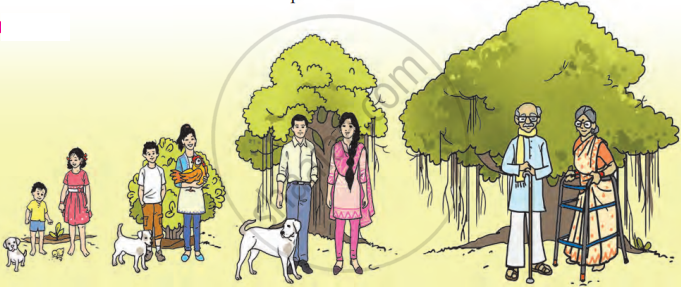
Growth in living things
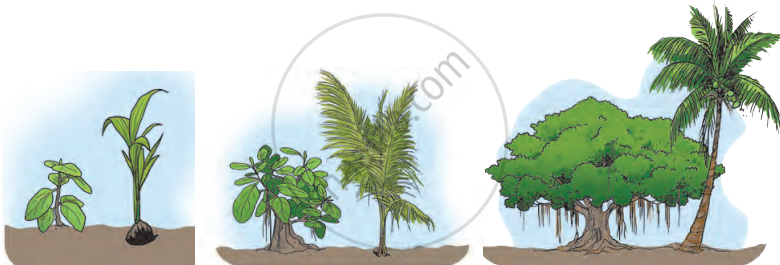
Growth in banyan and coconut trees
Maharashtra State Board: Class 6
Experiment
1. Aim: To observe and measure the growth of a potted sapling over ten to fifteen days.
2. Requirements: potted sapling, thread, peg or nail, and measuring scale.
3. Procedure
- Tie a thread to the tip of the sapling.
- Stretch the thread upwards and tie it to a peg or nail above the plant.
- Ensure the thread remains taut and observe the setup daily for 10–15 days.
4. Observations
- After 10–15 days, the plant's tip is no longer aligned with the thread's original position.
- The plant tip has risen above the thread, indicating vertical growth.
- Any changes in the width of the stem or the formation of new branches can also be noted.
5. Conclusion: The distance between the tip and the thread indicates that the sapling has grown taller. This experiment demonstrates that a plant's growth occurs in both height and width, and some may develop branches.

Sapling in a pot
Maharashtra State Board: Class 6
Food is necessary for growth:
| Category | Description |
|---|---|
| Plants (Photosynthesis) | Plants make food using sunlight, water, soil nutrients, and carbon dioxide. |
| This process is called photosynthesis, which requires chlorophyll (which gives plants a green colour). | |
| During photosynthesis, plants release oxygen into the air. | |
| Animals (Food Search) | Animals cannot make their food because they lack chlorophyll. |
| Herbivores (e.g., goats, sheep, horses) eat plants like grass. | |
| Carnivores (e.g., tigers and lions) hunt other animals that live on plants. |
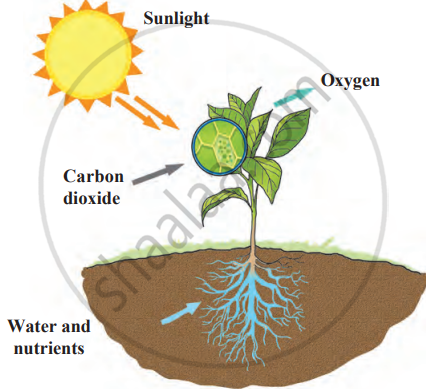
Photosynthesis
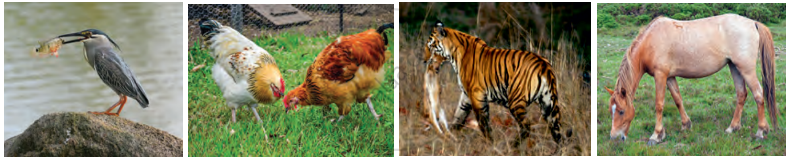
Intake of food by animals
