Topics
Matter
- Matter (Substance)
- Composition of Matter
- Characteristics of Particles (Molecules) of Matter
- States of Matter
- The Solid State
- The Liquid State
- The Gaseous State
- Change of State
- Concept of Melting (Fusion)
- Vaporisation or Boiling
Physical Quantities and Measurement
- Measurements
- Unit and Its Types
- Unit Systems
- Physical Quantities
- Rules and Conventions for Writing SI Units and Their Symbols
- The International System of Units (SI)
- Unit Prefixes
- Measurement of Length
- Devices for Measuring Length
- Measurement of Mass
- Devices for Measuring Mass
- Measurement of Time
- Devices for Measuring Time
- The Temperature and a Thermometer
- Measuring Temperature
- Area and It’s Unit
- Measurement of Area
Force
- Force - Push or Pull
- Effect of Force
- Types of Forces>Contact and Non-Contact Forces
- Force of Friction
- Effects of Friction
- Types of Friction>Rolling Friction
- Increasing and Reducing Friction
Simple Machines
- Concept of Work
- Concept of Energy
- Concept of Machines
- Principle of a Machine
- Efficiency of a Machine
- Simple Machines
- Mechanical Advantage
- Levers
- Types of Levers
- Pulley
- A Wheel and Axle
- An Inclined Plane
- A Wedge
- Screw
- Care of Machines
- Machines (Numerical)
Light
Magnetism
- Discovery of Magnets
- Classification of Magnets
- Magnetic and Non-magnetic Materials
- Magnet
- Magnetic Properties of Materials
- Concept of Magnetic Field
- Concept of Magnetism
- Making a Magnet
- Electromagnet
- Making of an Electromagnet
- Uses of Electromagnet
- Care and Storage of Magnets
- Demagnetization of a Magnet
Maharashtra State Board: Class 6
A wedge:
A wedge is a simple machine made by joining two inclined planes. It has a sharp edge that helps in cutting or splitting objects. When force is applied to the sharp edge of the wedge, it pushes objects apart or breaks them into two pieces. Wedges are very useful when we need to cut, split, or separate things.
For example: axe, knife, chisel, needle and nail.
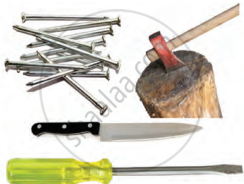
Wedges