Topics
Introduction to Chemistry
- Chemistry and Its Historical Perspective
- Importance of Chemistry
- Dark Side of Chemistry
Common Laboratory Apparatus and Equipments
Matter
Elements, Compounds, Symbols and Formulae
Pure Substances and Mixtures; Separation of Mixtures
Air and Atmosphere
- Air Around Us
- Atmosphere and Its Layers
- Air is a Mixture
- Importance of Oxygen
- Importance of Nitrogen
- Composition and Components of Air
- Importance of Air
- Concept of Photosynthesis
- Process of Photosynthesis
- Rusting
Water
- Water: Our Lifeline
- Sources of Water
- Change in State of Water
- Water Cycle
- Importance of Water
- Anomalous Expansion of Water
- Potable Water
- Waterborne Diseases Caused by Bacteria
- Waterborne Diseases Caused by Virus
- Purification of Water
- Tap Water Contains Dissolved Impurities
- Simple Distillation Method
- Composition of a Solution
- Water - a Universal Solvent
- Physical Properties of Water
- Water Management (Conservation of Water)
- Fresh Water Management
- Water Pollution
- Prevention and Control of Water Pollution
- Drought (Famine)
- Introduction
- Uses of Gases in Air
Maharashtra State Board: Class 6
Introduction:
Air is a mixture of several gases, water vapour, and dust particles that make up the Earth's atmosphere. These gases are essential for supporting life and various processes on Earth. The amount of gases in the air is highest near the Earth's surface and gradually decreases as you go higher, which is why air becomes thinner or "rarer" at higher altitudes.
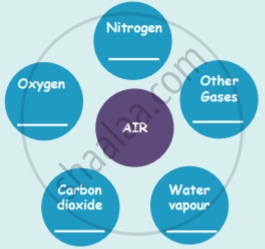
Proportions of gases in the air: Air is made up of the following gases in different amounts.
- Nitrogen (78%): The most abundant gas in the air.
- Oxygen (21%): The second most common gas, essential for life.
- Other Gases (1%): This includes small amounts of carbon dioxide, argon, helium, neon, krypton, and xenon.

Proportions of the various gases in the air
Maharashtra State Board: Class 6
Uses of Gases in Air:
| Gas | Role in Nature | Uses by Humans |
|---|---|---|
| Nitrogen (78%) | It is very important for all living things. Plants and animals use it to build proteins necessary for the growth and repair of body tissues. | Used to make fertilisers like ammonia to help crops grow. It is also used in food packaging to keep food fresh by removing oxygen. |
| Oxygen (21%) | Oxygen is essential for respiration in humans and animals, helping them breathe and get energy from food. Plants release oxygen during photosynthesis. | Used for breathing, especially in hospitals. Important in combustion is the process of burning fuels to produce energy. |
| Carbon Dioxide (0.04%) | It is used by plants for photosynthesis to make their food and release oxygen. | Used in fire extinguishers to stop fires by cutting off the oxygen supply. It is also used in soft drinks to create bubbles. |
| Argon (0.93%) | An inert gas that doesn’t react easily with other substances. | Used in electric light bulbs to prevent the filament from burning quickly, making the bulb last longer. |
| Helium | A very light gas that doesn’t burn. | It is used in balloons and airships because it’s lighter than air. It is also used in scientific research to achieve very low temperatures. |
| Neon | An inert gas that doesn’t interact much with other substances. | It is famous for its use in bright, colourful lights for signs and street lighting. |
| Krypton | A rare gas is found in small amounts in the air. | Used in fluorescent tubes, often found in offices and schools. |
| Xenon | Like krypton and argon, it’s an inert gas. | It is used in flash photography to create bright light for cameras and in special types of lights, like those in cars. |