Advertisements
Chapters
1: Rational and Irrational Numbers
Unit 2: Commercial Mathematics
2: Compound Interest (Stage 1) [Basic Concepts]
3: Compound Interest (Stage 2) [Applications]
Unit 3: Algebra
4: Expansions
5: Factorisation
6: Simultaneous (Linear) Equations [Including Problems]
7: Indices [Exponents]
8: Logarithms
Unit 4: Geometry
9: Triangles [Congruency in Triangles]
10: Isosceles Triangles [Including Inequalities]
11: Mid-point Theorem and Its Converse [Including Intercept Theorem]
12: Pythagoras Theorem [Proof and Simple Applications with Converse]
13: Rectilinear Figures [Quadrilaterals: Parallelogram, Rectangle, Rhombus, Square and Trapezium]
14: Construction of Polygons (Using ruler and compass only)
▶ 15: Area Theorems [Proof and Use]
16: Circle
Unit 5: Statistics and Graph Work
17: Statistics
18: Mean and Median [For Ungrouped Data Only]
Unit 6: Mensuration
19: Area and Perimeter of Plane Figures
20: Solids [Surface Area and Volume of 3-D Solids]
Unit 7: Trigonometry
21: Trigonometrical Ratios [Sine, Consine, Tangent of an Angle and their Reciprocals]
22: Solution of Right Triangles [Simple 2-D Problems Involving One Right-angled Triangle]
Unit 8: Co-Ordinate
23: Co-ordinate Geometry
24: Graphical Solution [Solution of Simultaneous Linear Equations, Graphically]
25: Distance Formula
![Selina solutions for Concise Mathematics [English] Class 9 ICSE chapter 15 - Area Theorems [Proof and Use] - Shaalaa.com](/images/concise-mathematics-english-class-9-icse_6:e09935b48e334a1e8f06ebb2011509f8.jpg "Selina solutions for Concise Mathematics [English] Class 9 ICSE chapter 15 - Area Theorems [Proof and Use]")
Advertisements
Solutions for Chapter 15: Area Theorems [Proof and Use]
Below listed, you can find solutions for Chapter 15 of CISCE Selina for Concise Mathematics [English] Class 9 ICSE.
Selina solutions for Concise Mathematics [English] Class 9 ICSE 15 Area Theorems [Proof and Use] Exercise 15 [Pages 221 - 223]
Multiple Choice Tуpе: Choose the correct answer from the options given below.
In the given figure, BD : DC = 3 : 5, then area of ΔABD : area of ΔACD is:
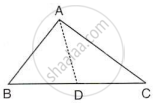
5 : 3
3 : 5
25 : 9
9 : 25
A median of a triangle divides it into two ______.
triangle of equal areas
congruent triangles
triangles of areas in the ratio 2 : 1
right triangles
In the given figure, AB is parallel to DС and AB ≠ DC, the area of ΔAOD is equal to area of triangle:
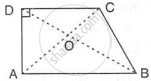
AOB
COD
ACB
BOC
In the given figure, AF//BE and PQ//RS, FC and ED are perpendiculars to RS. The area of parallelogram ABEF is equal to:
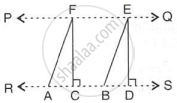
rect. CDEF
quad. CBEF
2 × ΔАCF
2 × ΔEBD
In the given figure, D is mid-point of side BC, the area of triangle BEA is equal to area of triangle:
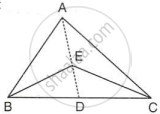
BED
CED
CEA
ACD
In the given figure, if the area of triangle ADE is 60 cm2, state, given reason, the area of :
(i) Parallelogram ABED;
(ii) Rectangle ABCF;
(iii) Triangle ABE.
The given figure shows a rectangle ABDC and a parallelogram ABEF; drawn on opposite sides of AB.
Prove that:
(i) Quadrilateral CDEF is a parallelogram;
(ii) Area of the quad. CDEF
= Area of rect. ABDC + Area of // gm. ABEF.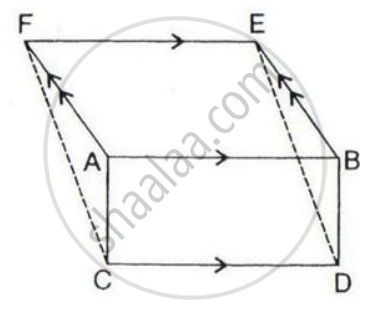
In the given figure, diagonals PR and QS of the parallelogram PQRS intersect at point O and LM is parallel to PS. Show that: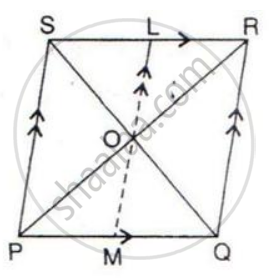
(i) 2 Area (POS) = Area (// gm PMLS)
(ii) Area (POS) + Area (QOR) = Area (// gm PQRS)
(iii) Area (POS) + Area (QOR) = Area (POQ) + Area (SOR).
In parallelogram ABCD, P is a point on side AB and Q is a point on side BC.
Prove that:
(i) ΔCPD and ΔAQD are equal in the area.
(ii) Area (ΔAQD) = Area (ΔAPD) + Area (ΔCPB)
In the given figure, M and N are the mid-points of the sides DC and AB respectively of the parallelogram ABCD.
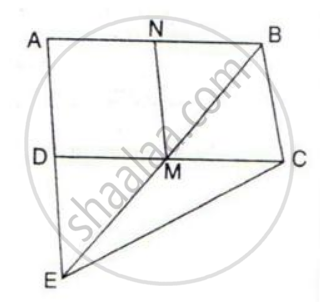
If the area of parallelogram ABCD is 48 cm2;
(i) State the area of the triangle BEC.
(ii) Name the parallelogram which is equal in area to the triangle BEC.
In the following figure, CE is drawn parallel to diagonals DB of the quadrilateral ABCD which meets AB produced at point E.
Prove that ΔADE and quadrilateral ABCD are equal in area.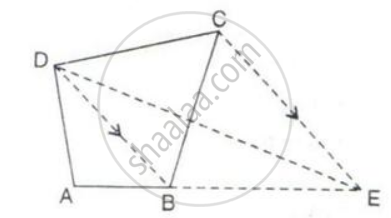
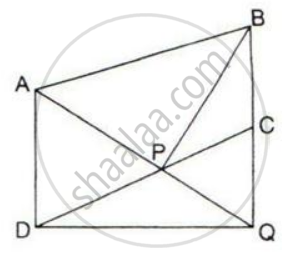
ABCD is a parallelogram a line through A cuts DC at point P and BC produced at Q. Prove that triangle BCP is equal in area to triangle DPQ.
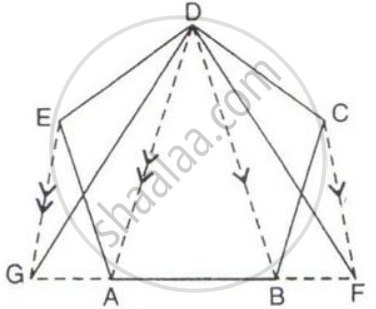
The given figure shows a pentagon ABCDE. EG drawn parallel to DA meets BA produced at G and CF draw parallel to DB meets AB produced at F.
Prove that the area of pentagon ABCDE is equal to the area of triangle GDF.
In the given figure, AP is parallel to BC, BP is parallel to CQ.
Prove that the area of triangles ABC and BQP are equal.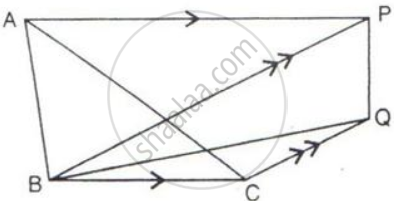
In the figure given alongside, squares ABDE and AFGC are drawn on the side AB and the hypotenuse AC of the right triangle ABC.
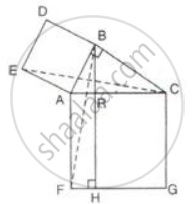
If BH is perpendicular to FG
prove that:
- ΔEAC ≅ ΔBAF
- Area of the square ABDE
- Area of the rectangle ARHF.
In the following figure, DE is parallel to BC.
Show that:
(i) Area ( ΔADC ) = Area( ΔAEB ).
(ii) Area ( ΔBOD ) = Area( ΔCOE ).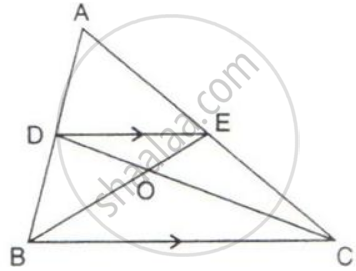
Show that:
A diagonal divides a parallelogram into two triangles of equal area.
Show that:
The ratio of the areas of two triangles of the same height is equal to the ratio of their bases.
Show that:
The ratio of the areas of two triangles on the same base is equal to the ratio of their heights.
In the given figure; AD is median of ΔABC and E is any point on median AD.
Prove that Area (ΔABE) = Area (ΔACE).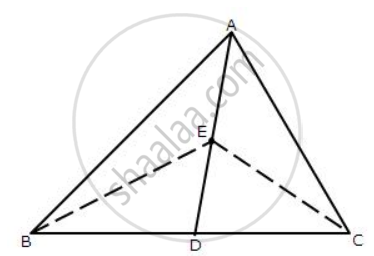
In the figure, if E is the mid-point of median AD, then prove that:
Area (ΔABE) = `1/4` Area (ΔABC).

ABCD is a parallelogram. P and Q are the mid-points of sides AB and AD respectively.
Prove that area of triangle APQ = `1/8` of the area of parallelogram ABCD.
The base BC of triangle ABC is divided at D so that BD = `1/2`DC.
Prove that area of ΔABD = `1/3` of the area of ΔABC.
In a parallelogram ABCD, point P lies in DC such that DP: PC = 3:2. If the area of ΔDPB = 30 sq. cm.
find the area of the parallelogram ABCD.
Selina solutions for Concise Mathematics [English] Class 9 ICSE 15 Area Theorems [Proof and Use] TEST YOURSELF [Pages 224 - 226]
Multiple Choice Type: Choose the correct answer from the options given below.
The median of a triangle divides it into two ______.
triangles of equal area
congruent triangles
right triangles
isosceles triangles
equilateral triangle
In the following figure, the area of parallelogram ABCD is ______.
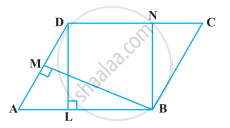
AB × BM
BC × BN
DC × DL
AD × DL
ABCD is a quadrilateral whose diagonals intersect each other at point O. The diagonal AC bisects diagonal BD. Then area of quadrilateral ABCD is ______.
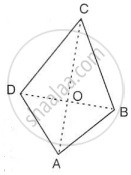
2 × area of ΔABD
2 × area of ΔBCD
4 × area of ΔAOB
2 × area of ΔABC
Two parallelograms ABCD and ABEF are equal in area, they lie between the same parallel lines:
Yes
No
Nothing can be said
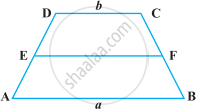
ABCD is a trapezium with parallel sides AB = a cm and DC = b cm (Figure). E and F are the mid-points of the non-parallel sides. The ratio of ar (ABFE) and ar (EFCD) is ______.
a : b
(3a + b) : (a + 3b)
(a + 3b) : (3a + b)
(2a + b) : (3a + b)
Statement (1): ABCD is a quadrilateral whose diagonal AC divides it into two parts, equal in area.
Statement (2): It is not necessary that the quadrilateral ABCD is a rectangle or a parallelogram or rhombus.
Both the statements are true.
Both the statements are false.
Statement 1 is true, and statement 2 is false.
Statement 1 is false, and statement 2 is true.
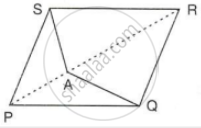
Assertion (A): PQRS a parallelogram whose area is 180 cm2 and A is any point on the diagonal PR. The area of triangle ASR = 45 cm2.
Reason (R): A is not the mid-point of diagonal PR.
A is true, R is false.
A is false, R is true.
Both A and R are true and R is the correct reason for A.
Both A and R are true and R is the incorrect reason for A.
Assertion (A): ABCD is a square. E is mid-point of side AB and F is mid-point of side DC. If DA = 16 cm, the area of triangle COF is 32 cm2.
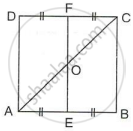
Reason (R): EF is ⊥ to DC and OF = `1/2` EF = `1/2` DA = 8 cm. Area of COF = `1/2` × CF × OF.
A is true, R is false.
A is false, R is true.
Both A and R are true and R is the correct reason for A.
Both A and R are true and R is the incorrect reason for A.
ABCD and BCFE are parallelograms. If area of triangle EBC = 480 cm2; AB = 30 cm and BC = 40 cm.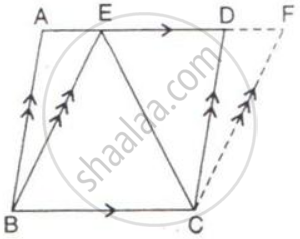
Calculate :
(i) Area of parallelogram ABCD;
(ii) Area of the parallelogram BCFE;
(iii) Length of altitude from A on CD;
(iv) Area of triangle ECF.
In the given figure, D is mid-point of side AB of ΔABC and BDEC is a parallelogram.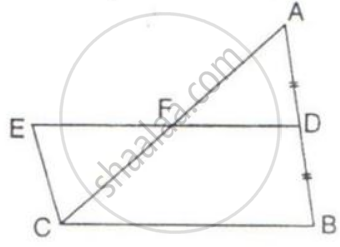
Prove that: Area of ABC = Area of // gm BDEC.
In the following, AC // PS // QR and PQ // DB // SR.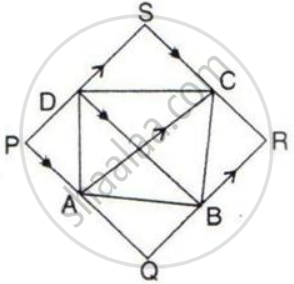
Prove that: Area of quadrilateral PQRS = 2 x Area of the quad. ABCD.
ABCD is a trapezium with AB // DC. A line parallel to AC intersects AB at point M and BC at point N.
Prove that: area of Δ ADM = area of Δ ACN.
In the given figure, AD // BE // CF.
Prove that area (ΔAEC) = area (ΔDBF)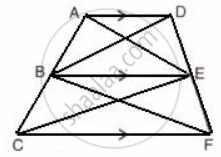
In the given figure, ABCD is a parallelogram; BC is produced to point X.
Prove that: area ( Δ ABX ) = area (`square`ACXD )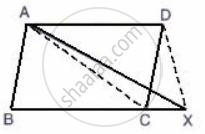
The given figure shows the parallelograms ABCD and APQR.
Show that these parallelograms are equal in the area.
[ Join B and R ]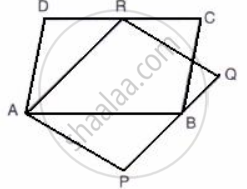
ABCD is a parallelogram in which BC is produced to E such that CE = BC and AE intersects CD at F.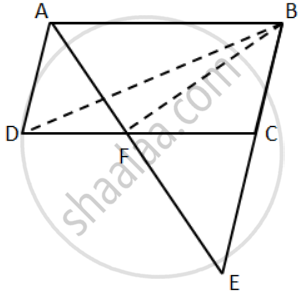
If ar.(∆DFB) = 30 cm2; find the area of parallelogram.
The following figure shows a triangle ABC in which P, Q, and R are mid-points of sides AB, BC and CA respectively. S is mid-point of PQ:
Prove that: ar. ( ∆ ABC ) = 8 × ar. ( ∆ QSB )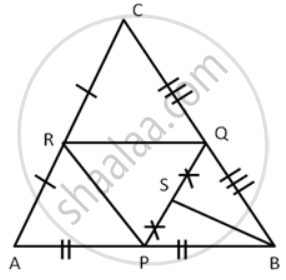
In the given figure, the diagonals AC and BD intersect at point O. If OB = OD and AB//DC,
show that:
(i) Area (Δ DOC) = Area (Δ AOB).
(ii) Area (Δ DCB) = Area (Δ ACB).
(iii) ABCD is a parallelogram.

The given figure shows a parallelogram ABCD with area 324 sq. cm. P is a point in AB such that AP: PB = 1:2
Find The area of Δ APD.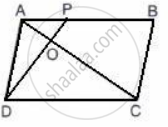
In ΔABC, E and F are mid-points of sides AB and AC respectively. If BF and CE intersect each other at point O,
prove that the ΔOBC and quadrilateral AEOF are equal in area.
In parallelogram ABCD, P is the mid-point of AB. CP and BD intersect each other at point O. If the area of ΔPOB = 40 cm2, and OP: OC = 1:2, find:
(i) Areas of ΔBOC and ΔPBC
(ii) Areas of ΔABC and parallelogram ABCD.
The medians of a triangle ABC intersect each other at point G. If one of its medians is AD,
prove that:
(i) Area ( ΔABD ) = 3 x Area ( ΔBGD )
(ii) Area ( ΔACD ) = 3 x Area ( ΔCGD )
(iii) Area ( ΔBGC ) = `1/3` x Area ( ΔABC ).
The perimeter of a triangle ABC is 37 cm and the ratio between the lengths of its altitudes be 6: 5: 4. Find the lengths of its sides.
Let the sides be x cm, y cm, and (37 - x - y) cm. Also, let the lengths of altitudes be 6a cm, 5a cm, and 4a cm.
In parallelogram ABCD, E is a point in AB and DE meets diagonal AC at point F. If DF: FE = 5:3 and area of ΔADF is 60 cm2; find
(i) area of ΔADE.
(ii) if AE: EB = 4:5, find the area of ΔADB.
(iii) also, find the area of parallelogram ABCD.
In the following figure, BD is parallel to CA, E is mid-point of CA and BD = `1/2`CA
Prove that: ar. ( ΔABC ) = 2 x ar.( ΔDBC )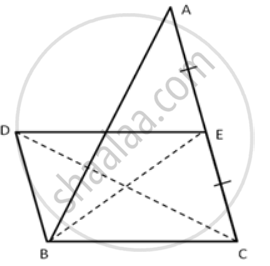
In the following figure, OAB is a triangle and AB || DC.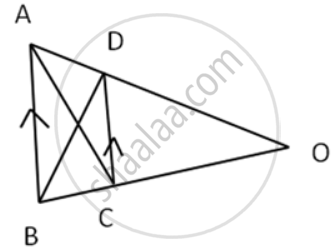
If the area of ∆ CAD = 140 cm2 and the area of ∆ ODC = 172 cm2,
find : (i) the area of ∆ DBC
(ii) the area of ∆ OAC
(iii) the area of ∆ ODB.
E, F, G, and H are the midpoints of the sides of a parallelogram ABCD.
Show that the area of quadrilateral EFGH is half of the area of parallelogram ABCD.
Solutions for 15: Area Theorems [Proof and Use]
Selina solutions for Concise Mathematics [English] Class 9 ICSE chapter 15 - Area Theorems [Proof and Use]
Shaalaa.com has the CISCE Mathematics Concise Mathematics [English] Class 9 ICSE CISCE solutions in a manner that help students grasp basic concepts better and faster. The detailed, step-by-step solutions will help you understand the concepts better and clarify any confusion. Selina solutions for Mathematics Concise Mathematics [English] Class 9 ICSE CISCE 15 (Area Theorems [Proof and Use]) include all questions with answers and detailed explanations. This will clear students' doubts about questions and improve their application skills while preparing for board exams.
Further, we at Shaalaa.com provide such solutions so students can prepare for written exams. Selina textbook solutions can be a core help for self-study and provide excellent self-help guidance for students.
Concepts covered in Concise Mathematics [English] Class 9 ICSE chapter 15 Area Theorems [Proof and Use] are .
Using Selina Concise Mathematics [English] Class 9 ICSE solutions Area Theorems [Proof and Use] exercise by students is an easy way to prepare for the exams, as they involve solutions arranged chapter-wise and also page-wise. The questions involved in Selina Solutions are essential questions that can be asked in the final exam. Maximum CISCE Concise Mathematics [English] Class 9 ICSE students prefer Selina Textbook Solutions to score more in exams.
Get the free view of Chapter 15, Area Theorems [Proof and Use] Concise Mathematics [English] Class 9 ICSE additional questions for Mathematics Concise Mathematics [English] Class 9 ICSE CISCE, and you can use Shaalaa.com to keep it handy for your exam preparation.
